Imroatul Nasiyah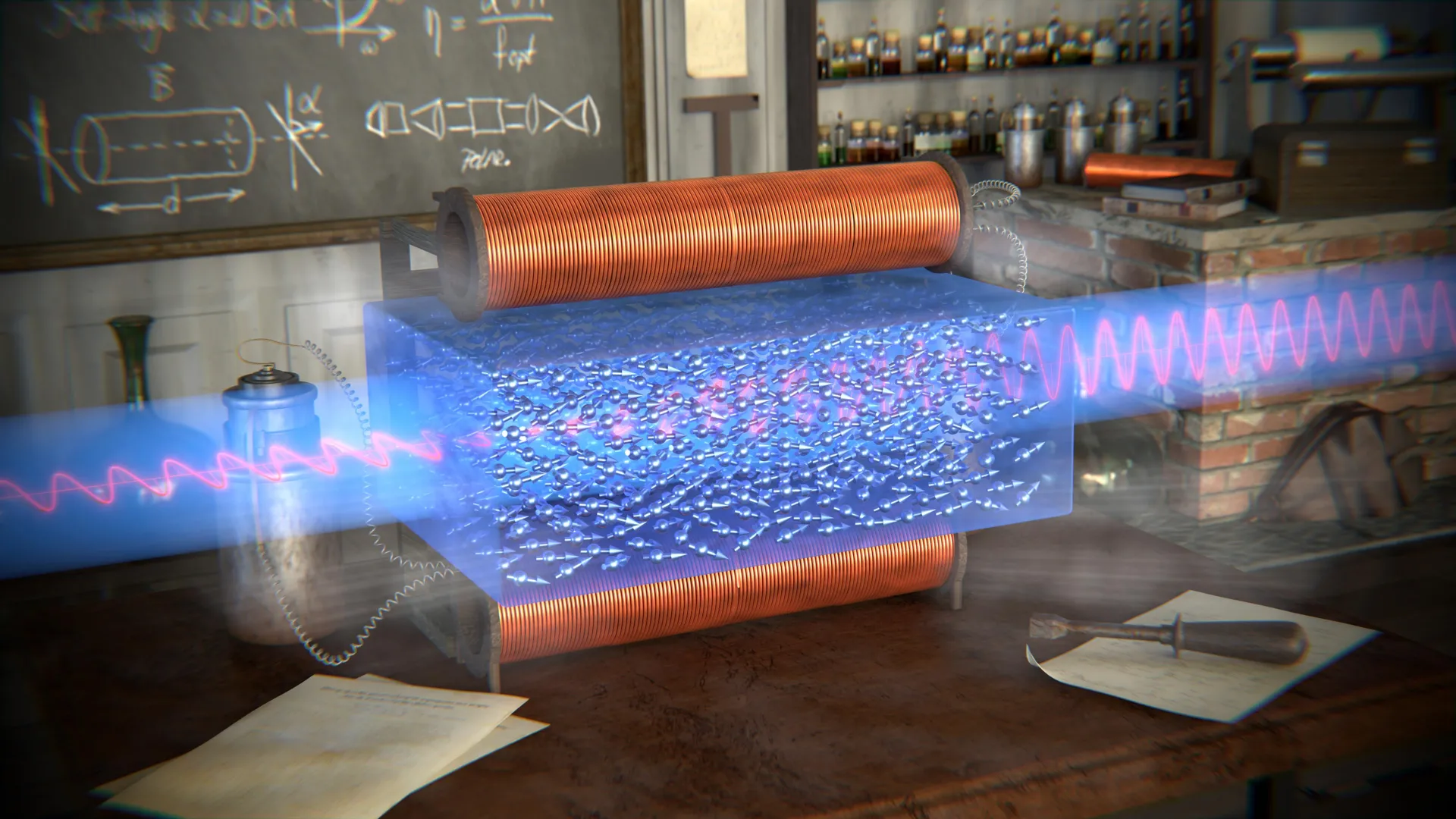
For almost two centuries, the scientific community has operated under the assumption that the Faraday Effect, a phenomenon where the polarization of light rotates as it passes through a material under the influence of an external magnetic field, was exclusively mediated by the electric field of light interacting with the electric charges within the material. This established understanding, a cornerstone of classical electromagnetism and optics, has guided countless experiments and theoretical frameworks. However, the recent research conducted at the Hebrew University of Jerusalem, led by Dr. Amir Capua and Benjamin Assouline from the university’s Institute of Electrical Engineering and Applied Physics, fundamentally re-evaluates this paradigm. Their work, meticulously detailed in a publication in Nature’s Scientific Reports, provides the first theoretical and increasingly empirical evidence that the oscillating magnetic field inherent in light itself is a crucial and active participant in the Faraday Effect. This revelation suggests that light is not merely a passive observer of magnetic fields but an active agent capable of exerting its own magnetic influence on the fabric of matter.
The Faraday Effect, named after the English scientist Michael Faraday who discovered it in 1845, describes the magneto-optical phenomenon where a magnetic field applied parallel to the direction of light propagation causes a rotation of the plane of polarization of the light. This rotation is proportional to the strength of the magnetic field and the length of the material through which the light travels. Historically, the prevailing explanation focused on the Lorentz force acting on the electrons within the material, which are responsible for the electric dipole response to light. The external magnetic field, in this model, would influence the orbital motion of these electrons, leading to a circular birefringence, which in turn results in the observed rotation of polarization. This model, while highly successful in explaining many aspects of light-matter interaction, did not account for a direct magnetic interaction originating from the light itself.
Dr. Capua eloquently summarizes the essence of their discovery: "In simple terms, it’s an interaction between light and magnetism. The static magnetic field ‘twists’ the light, and the light, in turn, reveals the magnetic properties of the material. What we’ve found is that the magnetic part of light has a first-order effect, it’s surprisingly active in this process." This statement highlights a critical shift in perspective. Instead of light solely being a force that is acted upon by external magnetic fields, it is now understood to possess its own magnetic dynamism that actively engages with matter. This active magnetic component of light, previously relegated to the background or considered negligible, is now brought to the forefront as a significant contributor to the Faraday Effect.
The theoretical underpinnings of this new understanding are rooted in advanced computational methods. The research team employed sophisticated calculations informed by the Landau-Lifshitz-Gilbert (LLG) equation, a fundamental equation in the theory of magnetism that describes the dynamics of magnetization in ferromagnetic materials. The LLG equation is crucial for understanding how magnetic moments respond to torques and damping. By applying this equation within their theoretical framework, the researchers were able to demonstrate that the oscillating magnetic field of light can indeed generate a magnetic torque within a material. This torque is analogous to the torque produced by a static magnetic field, thereby establishing a direct magnetic interaction pathway. Dr. Capua elaborates on this crucial point: "In other words, light doesn’t just illuminate matter, it magnetically influences it." This statement underscores the active role of light’s magnetic field, moving beyond its traditional perception as purely an oscillating electric field.
To quantify the significance of this newly identified magnetic contribution, the researchers applied their theoretical model to Terbium Gallium Garnet (TGG), a well-known magneto-optical crystal frequently used in experimental studies of the Faraday Effect. Their analysis revealed that the magnetic component of light is not a trivial factor. In the visible spectrum, this magnetic interaction accounts for approximately 17% of the total observed rotation of light polarization. This percentage escalates dramatically in the infrared spectrum, where the magnetic contribution rises to an astonishing 70%. These figures are substantial and undeniably significant, indicating that the magnetic aspect of light has been systematically underestimated in its influence on materials. The difference in percentages between the visible and infrared spectra likely relates to the specific absorption and scattering properties of TGG at different wavelengths, and how these properties modulate the interaction of light’s electric and magnetic fields with the material’s atomic and electronic structure.
Benjamin Assouline further emphasizes the broader implications of their findings: "Our results show that light ‘talks’ to matter not only through its electric field, but also through its magnetic field, a component that has been largely overlooked until now." This metaphor of "talking" to matter beautifully encapsulates the active and communicative nature of light’s interaction with the physical world. The discovery opens up a new dimension in understanding how light mediates its influence, suggesting that future technological applications might leverage this magnetic channel more directly and effectively.
The implications of this paradigm shift are far-reaching and promise to catalyze innovation across several cutting-edge fields. In the realm of optics, a deeper understanding of light’s magnetic behavior could lead to the development of novel optical devices with enhanced functionalities. This might include more efficient optical modulators, polarization controllers, and sensors that are sensitive to magnetic properties. For instance, new types of optical isolators or circulators, crucial components in optical communication systems, could be designed with unprecedented performance characteristics by exploiting the magnetic interaction.
Spintronics, a field that seeks to utilize the intrinsic spin of electrons, in addition to their charge, for information processing and storage, stands to benefit immensely. The ability of light to directly influence electron spins via its magnetic field could enable new methods for manipulating spin states. This could pave the way for faster, more energy-efficient spintronic devices, such as magnetic random-access memory (MRAM) and spin-based transistors, where magnetic fields are often used for writing and reading information. Imagine a future where optical signals can directly control the magnetic state of a material, offering a non-contact and potentially faster way to encode data.
Furthermore, the research holds significant promise for emerging quantum technologies, particularly in the domain of spin-based quantum computing. Quantum computers rely on qubits, which are often realized using the quantum properties of spins. If light can directly and precisely manipulate these spins through its magnetic field, it could offer a powerful new tool for initializing, controlling, and reading out qubit states. This could lead to more robust and scalable quantum computing architectures, accelerating the development of this transformative technology. The ability to control quantum states with light’s magnetic component could also find applications in quantum communication and quantum sensing, where precise manipulation of quantum systems is paramount.
The scientific community is already recognizing the importance of this discovery. The re-evaluation of a 180-year-old scientific tenet is a rare and significant event. It compels a re-examination of existing experimental data and theoretical models within the fields of optics, condensed matter physics, and electromagnetism. The Hebrew University of Jerusalem’s research not only corrects a long-standing misconception but also provides a fertile ground for new theoretical explorations and experimental investigations. Future research will likely focus on exploring this magnetic interaction in a wider range of materials, under different conditions, and for various applications. The development of new experimental techniques to isolate and measure the magnetic component of light’s interaction with matter will be crucial. Furthermore, exploring the interplay between light’s electric and magnetic fields and their combined influence on different types of matter, from simple dielectrics to complex magnetic systems, will undoubtedly reveal further fascinating phenomena. This fundamental insight into the dual nature of light’s interaction with matter promises to redefine our understanding of the electromagnetic spectrum and unlock a new era of technological innovation.