anjir abdul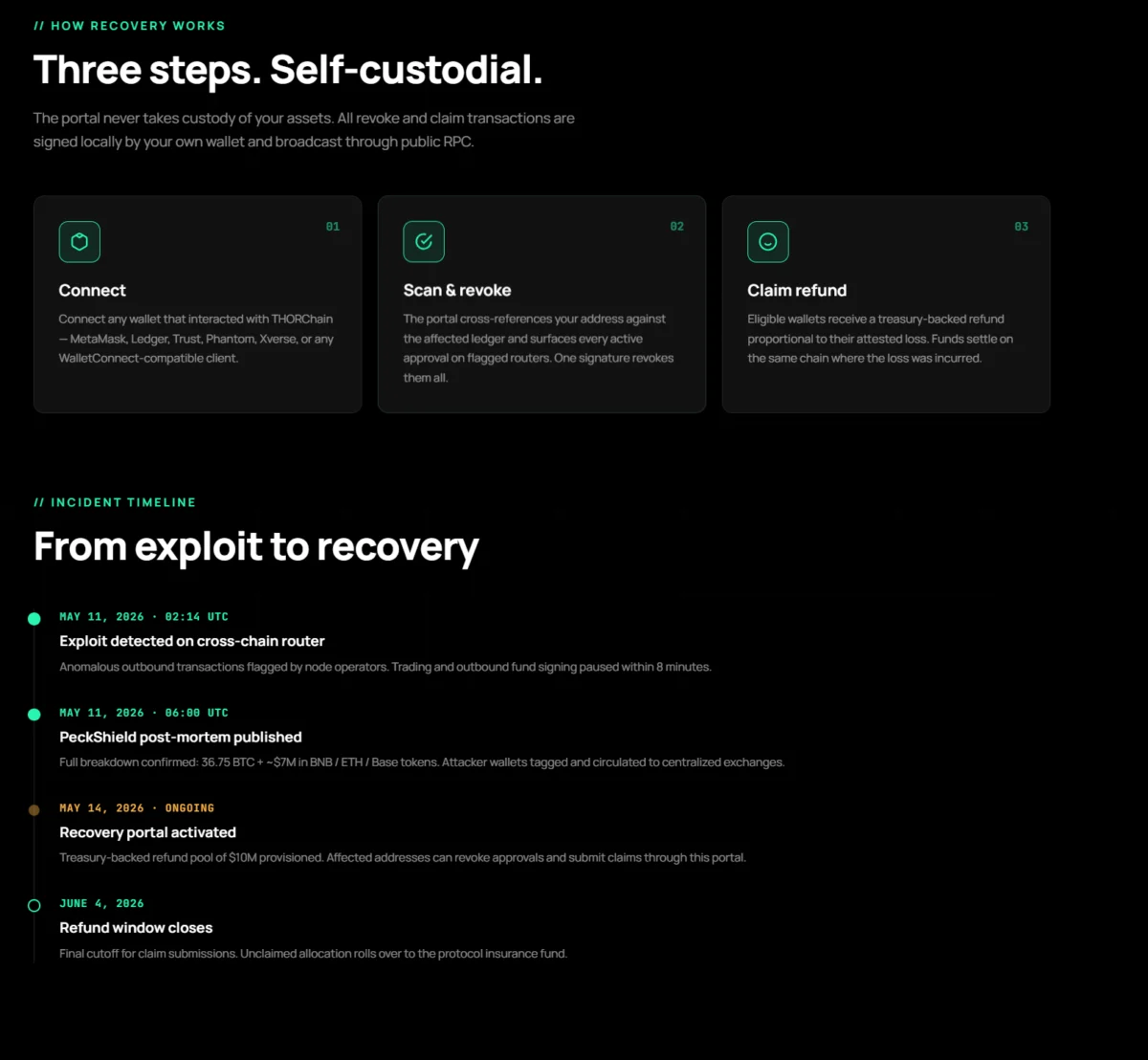
THORChain, a prominent decentralized cross-chain liquidity protocol, has officially confirmed a significant security breach resulting in a $10 million exploit and has promptly launched a dedicated recovery portal. This crucial initiative provides affected users with a self-custodial mechanism to revoke potentially malicious token approvals and submit refund claims. The integrity of the refund process is underpinned by a substantial treasury-provisioned refund pool, meticulously established to match the exact size of the stolen funds, thereby demonstrating THORChain’s commitment to its user base and the stability of its ecosystem. The portal is designed to streamline the compensation process, ensuring that users can directly interact with the system to recover their lost assets without intermediaries, fostering a sense of security and trust even in the wake of a significant setback.
In a comprehensive update shared on Saturday via their official X (formerly Twitter) account, the THORChain Foundation formally introduced the recovery portal to its community. The announcement clearly stated that "affected users are now able to check what they will be paid as compensation following the exploit," signaling a proactive approach to addressing the aftermath of the security incident. This step is critical not only for financial restitution but also for maintaining user confidence in a decentralized finance (DeFi) landscape frequently challenged by security vulnerabilities. The transparent communication regarding the availability of the portal and the clear outline of the compensation process underscores THORChain’s efforts to manage the crisis effectively and rebuild trust among its stakeholders.
The recovery portal itself, drawing insights from a post-mortem analysis conducted by blockchain security firm PeckShield, details the timeline and specifics of the attack. The exploit was first detected at precisely 02:14 UTC on May 11, when vigilant node operators within the THORChain network flagged a series of anomalous outbound transactions. This rapid detection mechanism proved vital, as trading and outbound signing functionalities were swiftly paused within an impressive eight-minute window following the initial alert. Despite the rapid response, attackers managed to drain a total of $10 million in various cryptocurrencies. This sum included approximately 36.75 Bitcoin (BTC), valued at around $3 million at the time of the incident, alongside an additional $7 million in diverse tokens distributed across several major blockchain networks, including BNB Chain, Ethereum, and Base. The widespread nature of the attack impacted a staggering 12,847 wallets across these four distinct blockchain ecosystems, highlighting the exploit’s broad reach and sophisticated execution.
Affected users are urged to act promptly, as a strict 21-day window has been established for submitting claims through the recovery portal. This crucial period commenced immediately upon the portal’s launch and is scheduled to close definitively on June 4. Any allocated funds that remain unclaimed by this deadline will not be held indefinitely but will instead be rolled over into the protocol’s dedicated insurance fund. This mechanism ensures that even unallocated compensation contributes to the long-term resilience and security of the THORChain protocol, reinforcing its commitment to risk management and community protection. The insurance fund serves as a critical safety net, designed to absorb the financial impact of unforeseen events and maintain the stability of the ecosystem.
Delving into the technical specifics of how THORChain was compromised, an incident update released by the protocol elaborated on the leading theory behind the exploit. It suggests that the attacker leveraged a sophisticated vulnerability within the Generalized Group Signature Scheme 20 (GG20) threshold signature scheme (TSS) implementation. TSS is a cryptographic protocol that allows multiple parties to jointly compute a digital signature without any single party ever possessing the complete private key. In this particular case, the vulnerability reportedly enabled sensitive vault key material to leak gradually over time. By diligently accumulating sufficient fragments of this leaked data, the attacker was eventually able to reconstruct the vault’s private key. Possession of the private key granted the attacker the ability to authorize unauthorized outbound transactions, effectively bypassing the protocol’s security measures and siphoning off funds from the liquidity pools.
Further investigation into the incident revealed a potentially critical lead: a newly churned node had entered the THORChain network just days prior to the attack. This node is now strongly believed to be associated with the exploit. On-chain analysis has identified direct links between the bonding addresses used by this suspicious node and the specific wallets that ultimately received the stolen funds. This finding suggests a highly coordinated attack, potentially involving an insider or a meticulously planned infiltration designed to exploit an internal vulnerability. The Treasury department within THORChain is actively engaged in collecting forensic data, working in close coordination with specialized blockchain analytics firm Outrider Analytics, and collaborating with relevant law enforcement agencies. This multi-pronged effort aims to identify the attacker, trace the flow of stolen funds, and pursue recovery wherever feasible, underscoring the serious legal ramifications of such illicit activities in the decentralized space.
The THORChain incident unfolds against a backdrop of a recent surge in crypto hacks, painting a concerning picture for the broader decentralized finance (DeFi) industry. April witnessed a dramatic increase in security breaches, with total losses across the crypto landscape reaching an alarming $629.7 million. This figure marks April as the worst month for the industry since a previous significant period in February, when an estimated $1.47 billion was stolen, underscoring a persistent and escalating threat environment. Two major incidents significantly contributed to April’s staggering losses: the KelpDAO exploit, which accounted for $293 million, and the Drift Protocol hack, responsible for $280 million in damages. Together, these two incidents alone represented a colossal 82% of the total losses incurred during the month, firmly cementing DeFi as the most frequently targeted sector within the cryptocurrency ecosystem due to its high liquidity, complex smart contract interactions, and often nascent security frameworks.
The pattern of these recent attacks points towards a notable shift in how protocols are being compromised. The industry is moving beyond straightforward smart contract bugs, which were once the predominant vector for exploits. Instead, a new generation of sophisticated attacks is emerging, with vulnerabilities in cross-chain bridges, misuse of privileged access, and operational failures increasingly serving as the root cause of major incidents. This evolution in attack methodologies demands a corresponding advancement in security strategies, requiring protocols to adopt multi-layered defenses, conduct rigorous security audits, and implement robust incident response plans. The interconnected nature of DeFi, while enabling innovation, also creates complex attack surfaces that require constant vigilance and adaptation from developers and security professionals alike.
The THORChain hack, like many before it, serves as a stark reminder of the inherent risks within the rapidly evolving DeFi landscape. While the self-custodial nature of decentralized finance empowers users, it also places a significant onus on protocols to ensure the highest levels of security. The efforts by THORChain to launch a comprehensive refund portal and engage forensic experts and law enforcement agencies are crucial steps not only for its own recovery but also for setting a precedent in the broader crypto community for responsible incident management. As the industry continues to mature, the collective response to such challenges, through enhanced security practices, proactive threat intelligence sharing, and transparent communication, will be paramount in fostering a more secure and resilient decentralized future. The lessons learned from these incidents contribute invaluable insights into bolstering the defenses of an ecosystem that, despite its revolutionary potential, remains a prime target for malicious actors.