Imroatul Nasiyah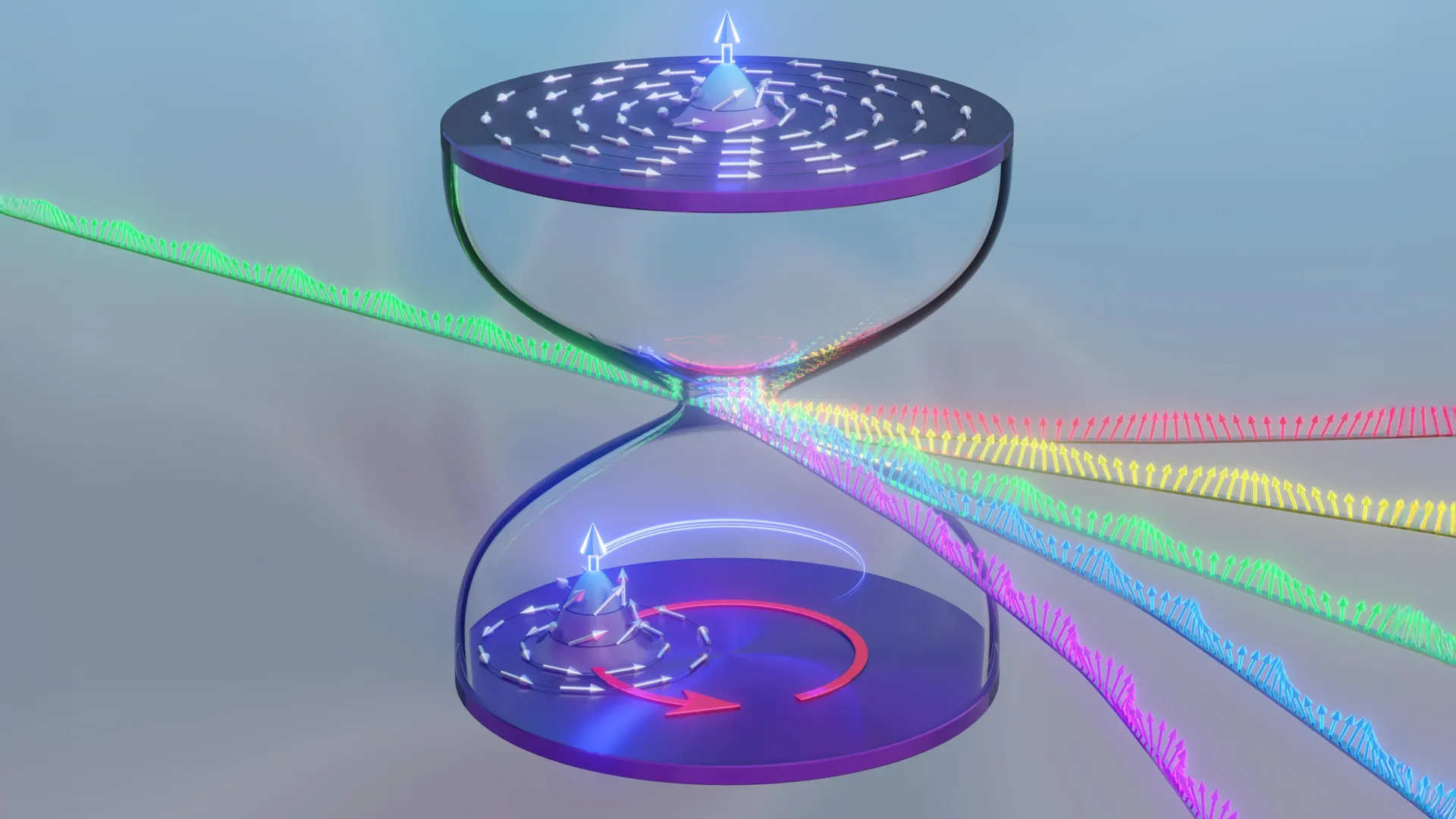
Researchers at the Helmholtz-Zentrum Dresden-Rossendorf (HZDR) have identified previously unseen oscillation patterns, termed Floquet states, within incredibly small magnetic vortices, a discovery that promises to redefine our understanding of fundamental physics and pave the way for revolutionary advancements in electronics, spintronics, and quantum technologies. In a significant departure from prior research that necessitated the use of powerful laser pulses to generate these elusive states, the Dresden team has demonstrated that a gentler approach, employing magnetic waves, is sufficient. This groundbreaking finding, published in the prestigious journal Science, not only challenges established theoretical frameworks but also presents itself as a potential "universal connector," bridging disparate technological domains.
Magnetic vortices, the microscopic arenas for this newfound phenomenon, are intricate structures found in ultrathin disks composed of materials like nickel-iron. These disks, often measuring mere micrometers or even nanometers in diameter, host a fascinating internal order: tiny magnetic moments, akin to miniature compass needles, align themselves in a distinct circular pattern. When these systems are perturbed, they exhibit a collective behavior reminiscent of a stadium crowd executing a coordinated "wave." Each individual magnetic moment undergoes a slight tilt, which is then transmitted to its neighbor, initiating a cascade of synchronized motion. These collective, wave-like excitations are scientifically classified as magnons, and their ability to propagate information through magnetic materials without the need for charge transport has long been a tantalizing prospect for the development of next-generation computing technologies.
"These magnons can transmit information through a magnet without the need for charge transport," explains Dr. Helmut Schultheiß, the project leader from the Institute of Ion Beam Physics and Materials Research at HZDR. "This capability makes them highly attractive for research into next-generation computing technologies." The allure of magnons lies in their potential to overcome the limitations of conventional electronics, which are increasingly constrained by heat dissipation and power consumption. By harnessing these spin waves, researchers envision a future of computing that is both faster and more energy-efficient.
The HZDR team’s investigation into these minuscule magnetic disks began with an exploration of how their size might influence neuromorphic computing, a cutting-edge field aiming to replicate the brain’s information processing capabilities. The researchers meticulously reduced the size of their magnetic disks, shrinking them from several micrometers down to an astonishing few hundred nanometers. It was during the rigorous analysis of the experimental data that an unexpected anomaly emerged. Instead of the anticipated single resonance signal, a subset of the disks consistently displayed a series of closely spaced spectral lines, a phenomenon known as a frequency comb.
Initially, the researchers harbored skepticism, attributing the unusual observation to potential measurement artifacts or external interference. "At first we assumed it was a measurement artifact or some kind of interference," recalls Schultheiß. "But when we repeated the experiment, the effect reappeared. That is when it became clear we were looking at something genuinely new." This persistent reappearance of the frequency comb, even after repeated experiments, solidified the team’s conviction that they had stumbled upon a novel physical phenomenon.
The theoretical underpinnings of this discovery trace back to the pioneering work of the 19th-century French mathematician Gaston Floquet. Floquet’s theory established that systems subjected to periodic forces can develop entirely new and distinct oscillation states. Historically, the generation of these so-called Floquet states has been an energy-intensive endeavor, typically requiring the application of powerful and focused laser pulses. However, the HZDR researchers found that within magnetic vortices, these states can emerge spontaneously when magnons are sufficiently energized. The crucial mechanism involves the transfer of energy from the magnons to the vortex core. This energy transfer causes the vortex core to embark on a subtle, yet rhythmic, circular trajectory around its central axis. Even this minuscule motion is sufficient to exert a periodic influence on the surrounding magnetic state, thereby inducing the formation of Floquet states.
The experimental manifestation of this phenomenon is the observed frequency comb. Rather than a single, sharp spectral peak, the interaction between the moving vortex core and the magnons results in the emergence of multiple, evenly spaced lines. This splitting of a primary signal into a series of harmonics is analogous to how a pure musical tone can produce overtones. "We were stunned that such a minute core motion was enough to transform the familiar magnon spectrum into a whole array of new states," exclaims Schultheiß. This finding is particularly remarkable given the extremely small scale of the vortex core and the seemingly modest energy involved in its rotation.
One of the most profoundly significant aspects of this discovery is its exceptional energy efficiency. Unlike previous methods that demanded high-powered lasers, the Floquet states in these magnetic vortices can be triggered with a mere microwatt of power, a fraction of the energy consumed by a smartphone in standby mode. This ultra-low energy requirement represents a monumental breakthrough, opening up a vast landscape of new possibilities. Frequency combs generated through this efficient mechanism hold the potential to act as synchronization agents for vastly different systems. They could serve as a crucial bridge, harmonizing ultrafast terahertz signals with the established frequencies of conventional electronics, and even with the delicate oscillations of quantum devices.
"We call it the universal adapter," Schultheiß explains. "Just as a USB adapter allows devices with different connectors to work together, Floquet magnons could bridge frequencies that would otherwise remain incompatible." This "universal adapter" capability is particularly exciting for the integration of disparate technological platforms. Imagine seamlessly connecting high-frequency magnonic communication channels with existing silicon-based microelectronics or the qubits of a quantum computer. This discovery offers a tangible pathway toward achieving such ambitious integration.
The implications for future computing architectures are immense. The HZDR team is already planning further investigations to determine if this same energy-efficient mechanism can be replicated in other types of magnetic structures. The potential role of this discovery in the development of future computing systems is considerable, particularly in enabling seamless communication between magnon-based signals, conventional electronic circuits, and nascent quantum components.
"On the one hand, our discovery opens new avenues for addressing fundamental questions in magnetism," Schultheiß emphasizes. "On the other hand, it could eventually serve as a valuable tool to interconnect the realms of electronics, spintronics, and quantum information technology." This dual impact underscores the profound significance of the research. It not only pushes the boundaries of fundamental scientific understanding but also offers practical solutions for the engineering challenges of tomorrow. The ability to control and manipulate magnetic states with such low energy expenditure could revolutionize the design of energy-efficient processors, novel sensors, and advanced communication systems.
Furthermore, the practical implementation of the research benefits from advanced tools. All measurements of the magnetic vortices and the subsequent analysis of data from multiple instruments were meticulously conducted using the Labmule program. Developed at HZDR, Labmule is a sophisticated lab automation tool that streamlines experimental workflows, enhances data acquisition, and facilitates complex analysis, thereby accelerating the pace of discovery in fields like condensed matter physics and materials science. The availability of Labmule as an open-source lab automation tool further empowers the broader scientific community to replicate and build upon these groundbreaking findings. The journey from observing an unexpected spectral signature to uncovering a new fundamental state of matter, with the potential to unify disparate technological frontiers, exemplifies the power of curiosity-driven research and the ingenuity of scientific exploration.