Imroatul Nasiyah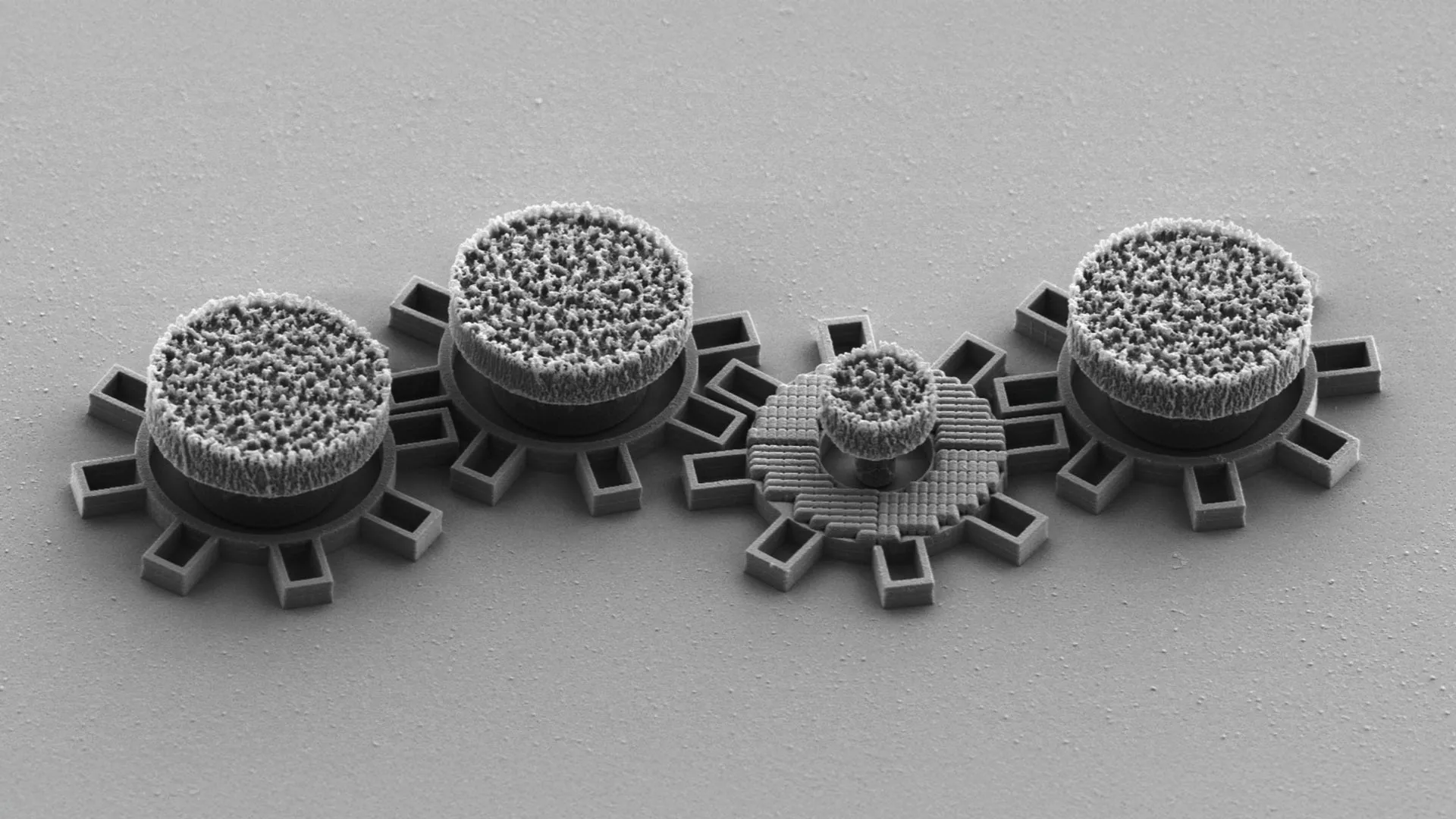
For decades, the ubiquitous presence of gears in everything from intricate timepieces to colossal wind turbines has inspired a persistent quest among scientists to miniaturize these essential mechanical components. The ultimate goal has been the construction of micro-engines, capable of performing tasks at incredibly small scales. However, for over thirty years, progress in this domain had reached a seemingly insurmountable barrier, with the smallest functional gears topping out at a mere 0.1 millimeters. The fundamental challenge lay in devising the necessary drive trains – the intricate systems of interlocking parts that transmit rotational motion – to enable these minuscule gears to move effectively at such reduced dimensions. Traditional mechanical couplings, with their inherent bulk and complexity at the micro-level, proved to be the Achilles’ heel of this miniaturization effort.
Now, a collaborative team of researchers, prominently featuring scientists from the University of Gothenburg, has shattered this long-standing impediment. Their revolutionary approach jettisons the limitations of traditional mechanical drive trains altogether, opting instead for an entirely novel paradigm: the direct application of laser light to set the gears in motion. This innovative strategy represents a fundamental shift in how micro-mechanical systems can be powered and controlled, opening up unprecedented avenues for miniaturization and functionality.
Gears Powered by Light: A New Era of Optical Mechanics
The core of this scientific breakthrough lies in the ingenious utilization of optical metamaterials. These are not ordinary materials; they are meticulously engineered, small, patterned structures designed to interact with light in highly specific and controllable ways. Specifically, these metamaterials possess the remarkable ability to capture and manipulate light at the nanoscale. The researchers have demonstrated that by fabricating gears incorporating these optical metamaterials directly onto microchips using established lithography techniques, they can achieve a remarkable outcome. The resulting gears, with diameters typically measuring in the tens of micrometers, are then subjected to laser illumination.
When a laser beam strikes the optical metamaterial embedded within the gear, it induces a rotational motion. The brilliance of this method lies in its inherent controllability. The intensity of the laser light directly dictates the speed at which the gear spins, offering a precise means of regulating its movement. Furthermore, the researchers have discovered that the direction of the gear’s rotation can be manipulated simply by altering the polarization of the incident laser light. This level of fine-tuned control, achieved without any physical contact, is a monumental leap forward in micro-mechanical engineering. The implications are profound, as the research team is now tantalizingly close to realizing functional micromotors, devices that can generate continuous and controlled motion at the microscopic level.
A Fundamentally New Way of Thinking: Overcoming the Size Barrier with Light
The implications of this research extend far beyond the mere creation of spinning gears. The study showcases the remarkable potential of microscopic machines driven by optical metamaterials, demonstrating their capacity for complex functionalities. "We have built a gear train in which a light-driven gear sets the entire chain in motion," explains Gan Wang, the study’s first author and a researcher in soft matter physics at the University of Gothenburg. "The gears can also convert rotation into linear motion, perform periodic movements and control microscopic mirrors to deflect light." This versatility underscores the transformative potential of their work, moving beyond simple rotation to enable more sophisticated mechanical operations.
The ability to seamlessly integrate these light-powered machines directly onto microchips and to control them with laser light unlocks an entirely new landscape of possibilities. Unlike traditional mechanical systems that require physical connections and can be cumbersome to scale, laser light offers a non-contact, easily controllable, and highly precise means of actuation. This characteristic is crucial for scaling up these nascent micromotors into complex microsystems, where intricate interactions and precise movements are paramount.
"This is a fundamentally new way of thinking about mechanics on a microscale," Gan Wang emphasizes. "By replacing bulky couplings with light, we can finally overcome the size barrier that has constrained micro-mechanical engineering for so long." This paradigm shift represents a departure from conventional approaches, signaling a future where light itself becomes the primary driver and controller of microscopic machinery.
From Micro-Gears to Medical Miracles: Applications at the Cellular Level and Beyond
The potential applications of these miniaturized, light-powered machines are vast and profoundly impactful, particularly in the fields of medicine and advanced diagnostics. With these technological advancements, researchers are beginning to envision micro- and nanomachines that can perform an array of sophisticated tasks. These include precisely controlling light, meticulously manipulating microscopic particles, and seamlessly integrating into the next generation of lab-on-a-chip systems – devices that promise to revolutionize biological and chemical analysis.
A single gear wheel, as demonstrated in the study, can be as small as 16-20 micrometers in diameter. This is a critical measurement, as it aligns with the size of many human cells. This remarkable congruence between the size of the manufactured gears and biological entities opens up a direct pathway to medical applications, a prospect that Gan Wang believes is firmly within reach.
"We can use the new micromotors as pumps inside the human body, for example to regulate various flows," Gan Wang suggests. Imagine tiny, implantable devices capable of precisely delivering medication, managing fluid levels in targeted areas, or even assisting in blood flow regulation. The non-invasive nature of light-based actuation makes these applications particularly attractive, minimizing the need for complex internal wiring or mechanical power sources within the body.
Furthermore, Gan Wang is actively exploring the potential of these micromotors as microscopic valves. These valves could be programmed to open and close with extreme precision, controlling the flow of fluids or gases within the body or within microfluidic devices. This capability is essential for a multitude of medical procedures, from drug delivery systems to diagnostic assays. The ability to create these intricate mechanical functions at the cellular scale represents a paradigm shift in how we can interact with and manipulate biological systems.
The broader implications of this research are far-reaching. The development of these light-powered micromotors signifies a pivotal moment in the ongoing quest for miniaturization and advanced functionality. As the technology matures, we can anticipate the emergence of entirely new classes of microscopic robots and devices capable of performing tasks that were once confined to the realm of science fiction. From targeted drug delivery and minimally invasive surgery to advanced diagnostics and environmental monitoring, the impact of these tiny, light-driven machines promises to reshape numerous scientific and technological landscapes, ushering in an era of unprecedented precision and control at the smallest scales. The University of Gothenburg’s breakthrough is not just about building smaller gears; it’s about unlocking the potential for a future where microscopic machinery can perform macroscopic miracles.