Imroatul Nasiyah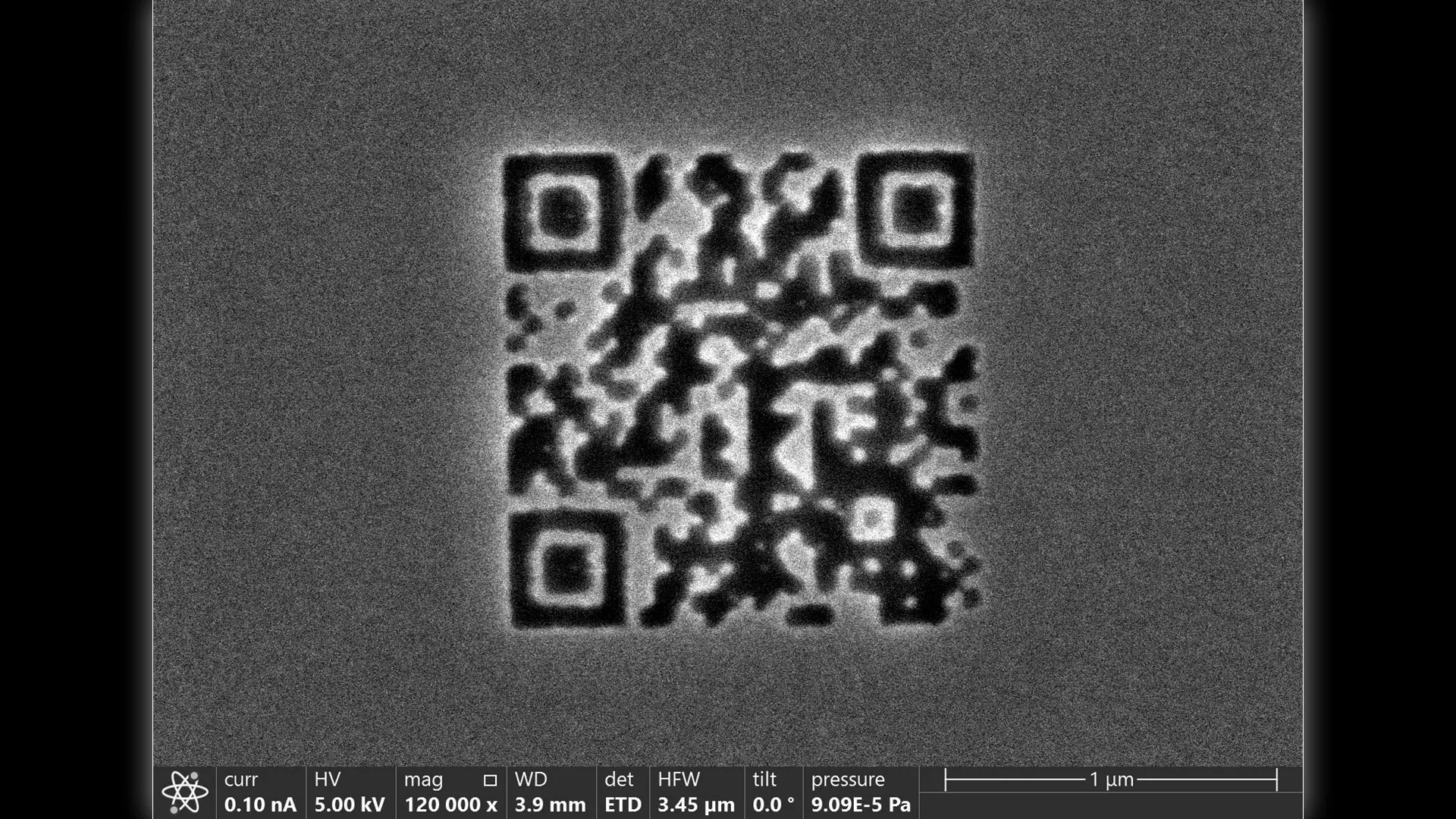
In a groundbreaking achievement that blurs the lines between microscopic engineering and archival potential, a team of researchers from TU Wien, in collaboration with the data storage company Cerabyte, has successfully created the world’s smallest QR code. This revolutionary code, measuring an astonishingly minute 1.98 square micrometers, is so infinitesimally small that it dwarfs most bacteria and can only be detected and read using the sophisticated lens of an electron microscope. This monumental feat has been officially verified and proudly inscribed in the annals of the Guinness Book of Records, marking a significant leap forward in the quest for durable and high-density data storage.
Beyond its sheer diminutive size, this breakthrough carries profound implications for the longevity of digital information. Traditional data storage technologies, such as magnetic hard drives and solid-state electronic systems, are notoriously ephemeral, often succumbing to degradation within a mere few years. This inherent fragility poses a significant challenge in an era defined by the ever-increasing volume of data we generate and seek to preserve. In stark contrast, the innovative approach of encoding information directly into the robust structure of ceramic materials offers a tantalizing prospect: the potential to preserve data for hundreds, if not thousands, of years, providing an unparalleled level of archival stability.
Professor Paul Mayrhofer from TU Wien’s Institute of Materials Science and Technology elucidated the remarkable nature of this innovation. "The structure we have created here is so fine that it cannot be seen with optical microscopes at all," he stated. "But that is not even the truly remarkable part. Structures on the micrometer scale are nothing unusual today — it is even possible to fabricate patterns made of individual atoms. However, that alone does not result in a stable, readable code." The challenge at these extreme scales lies in the inherent instability of matter. At the nanoscale, atoms can readily shift their positions or fill vacant spaces, a phenomenon that can lead to the corruption or complete erasure of stored data. "What we have done is something fundamentally different," Mayrhofer emphasized. "We have created a tiny, but stable and repeatedly readable QR code." This stability is the cornerstone of its archival potential.
The secret to this extraordinary durability and readability lies within the intrinsic properties of the ceramic materials employed. Erwin Peck and Balint Hajas, key researchers in the project, explained, "We conduct research on thin ceramic films, such as those used for coating high-performance cutting tools." These materials are specifically engineered to withstand extreme conditions, maintaining their integrity and performance even under immense stress and heat. "For high-performance tools, it is essential that materials remain stable and durable even under extreme conditions. And that is exactly what makes these materials ideal for data storage as well," they added.
The process of engraving the QR code involved the precise application of focused ion beams, a highly controlled method that etches microscopic patterns into a thin ceramic layer. Each individual pixel within this QR code measures a mere 49 nanometers across – approximately ten times smaller than the wavelength of visible light. This microscopic precision renders the pattern completely invisible to the naked eye and unresolvable by conventional optical microscopes. However, when subjected to the probing gaze of an electron microscope, the intricate pattern of the QR code emerges with crystalline clarity, allowing for its accurate and reliable readout.
The storage capacity of this ceramic-based system is equally astounding. Projections indicate that the area of a single A4 sheet of paper, when utilized with this technology, could potentially store over 2 terabytes of data. This density far surpasses that of many contemporary storage solutions. Furthermore, unlike conventional storage systems that are susceptible to gradual decay and require constant energy input to maintain data integrity, these ceramic data carriers are designed to remain intact indefinitely, without demanding any energy expenditure for the preservation of the stored information. This passive preservation capability is a significant advantage for long-term archival purposes.
Alexander Kirnbauer articulated the philosophical and practical impetus behind this research, stating, "We live in the information age, yet we store our knowledge in media that are astonishingly short-lived." He highlighted the inherent vulnerability of modern digital storage, where magnetic and electronic devices often face data loss within a few years, particularly without the continuous support of power, cooling, and regular maintenance. He drew a compelling parallel to ancient civilizations, which, through their inscriptions on stone, managed to preserve their knowledge for millennia. "With ceramic storage media, we are pursuing a similar approach to that of ancient cultures, whose inscriptions we can still read today," Kirnbauer explained. "We write information into stable, inert materials that can withstand the passage of time and remain fully accessible to future generations."
Another significant benefit of this technology is its unparalleled energy efficiency. Modern data centers, the backbone of our digital world, consume vast amounts of electricity and require extensive cooling infrastructure. Ceramic-based storage, in contrast, offers a paradigm shift by preserving information without any ongoing energy input. This passive approach not only reduces operational costs but also contributes significantly to mitigating the environmental impact associated with data storage.
The officially recognized world record for the smallest QR code, along with its rigorous verification process, was a collaborative effort between TU Wien and Cerabyte, conducted under the watchful eyes of independent witnesses. The University of Vienna played a crucial role as an independent verifier, lending its academic credibility to the proceedings. TU Wien provided access to its state-of-the-art materials science facilities, including the high-resolution electron microscopes housed within its USTEM center, essential for the precise measurement and readout of the microscopic QR code. The resultant QR code measures a mere 37% of the size of the previous record holder, underscoring the magnitude of this achievement.
Alexander Kirnbauer expressed optimism about the future trajectory of this technology: "The now confirmed world record marks just the beginning of a very promising development." The research team’s ambitious goals include exploring the use of alternative ceramic materials, enhancing writing speeds to improve efficiency, and developing scalable manufacturing processes. The ultimate aim is to transition ceramic data storage from the confines of laboratories to widespread industrial applications. Concurrently, investigations are underway to determine how more complex data structures, extending far beyond simple QR codes, can be robustly, rapidly, and energy-efficiently written into ceramic thin films and reliably read out. This pioneering work heralds a future where data preservation is not only secure and long-lasting but also environmentally sustainable, ensuring that our collective knowledge remains accessible for generations to come with minimal energy expenditure.