anjir abdul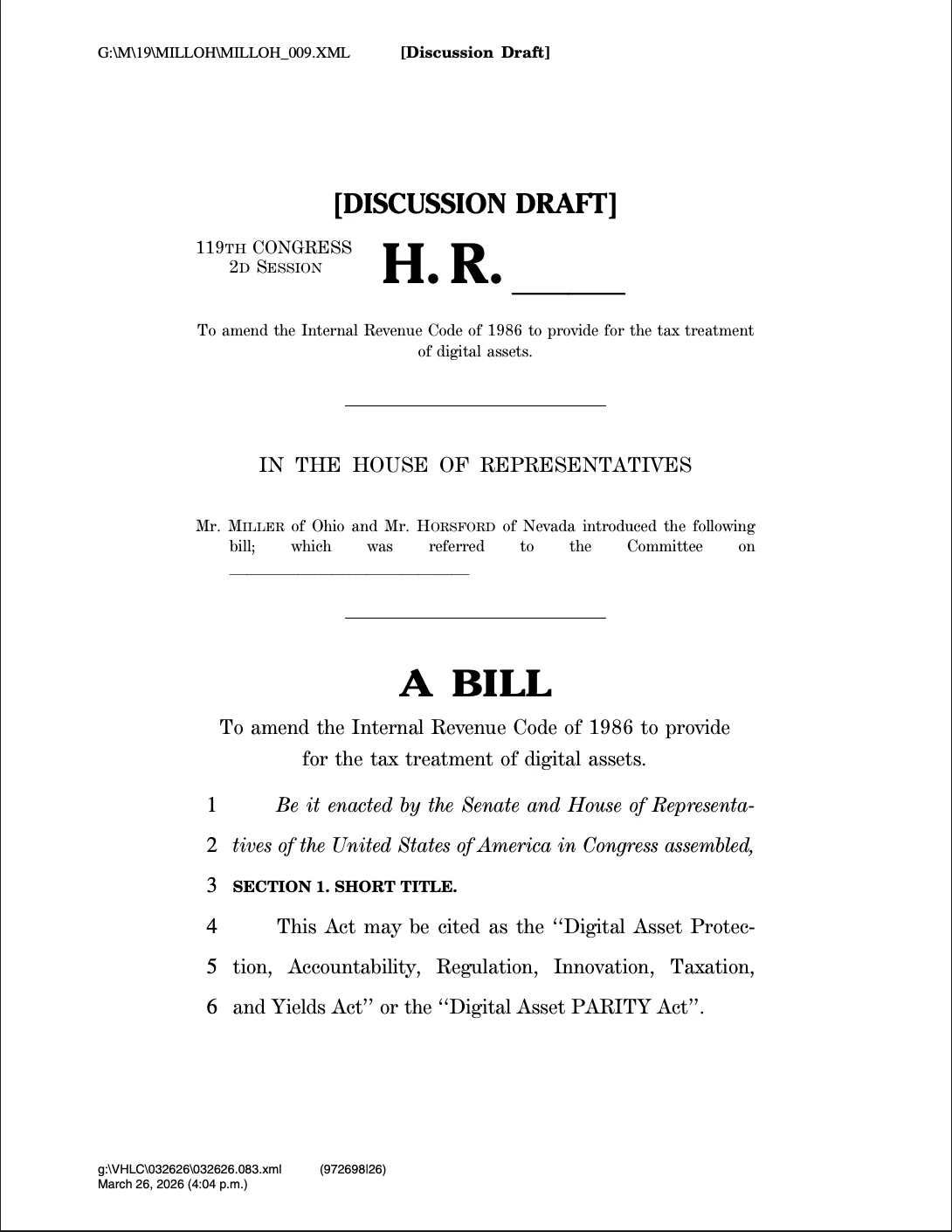
US Representatives Max Miller (R-OH) and Steven Horsford (D-NV) have unveiled a comprehensive discussion draft bill, titled the "Digital Asset Protection, Accountability, Regulation, Innovation, Taxation, and Yields Act" – more concisely known as the "Digital Asset PARITY Act." This bipartisan legislative effort, published on Thursday, aims to fundamentally reform and clarify the existing tax code pertaining to digital assets, addressing a pressing need for regulatory certainty in the rapidly evolving cryptocurrency landscape. The release of this draft underscores the increasing urgency among lawmakers to establish a clear framework for digital asset taxation, an area currently fraught with ambiguity and complexity under the Internal Revenue Code of 1986.
The Digital Asset PARITY Act is a significant step towards bringing clarity to digital asset taxation, proposing specific provisions designed to integrate cryptocurrencies more smoothly into the traditional financial system while fostering innovation. For years, the Internal Revenue Service (IRS) has struggled to provide definitive guidance that keeps pace with the technological advancements and diverse applications of digital assets. Existing IRS notices, such as Notice 2014-21 and Revenue Ruling 2019-24, have largely treated cryptocurrencies as property for tax purposes, subjecting every transaction to potential capital gains or losses. This approach has created an immense compliance burden for users engaging in even small transactions, hindering the widespread adoption of digital assets for everyday commerce. The PARITY Act seeks to alleviate this burden by introducing tailored rules for various types of digital assets, particularly stablecoins.
One of the most notable proposals within the discussion draft concerns the tax treatment of stablecoins. The legislation suggests that stablecoins would not be subject to capital gains if their cost basis – the original amount paid by the investor – does not fluctuate by more than 1% of $1, or $0.01. This provision is critical because stablecoins are designed to maintain a stable value, typically pegged to a fiat currency like the U.S. dollar. Under current property rules, even minor fluctuations could theoretically trigger a taxable event. By introducing this de minimis threshold for stablecoin value changes, the PARITY Act aims to treat them more like currency for tax purposes, acknowledging their role as a medium of exchange rather than a speculative investment asset. This clarification is intended to remove a significant barrier to the use of stablecoins for payments, remittances, and other transactional purposes, encouraging their integration into mainstream financial activities.
Furthermore, the bill specifies that transaction costs incurred to acquire or move regulated dollar-pegged stablecoins cannot be counted toward an investor’s cost basis. This distinction is important; typically, transaction fees can be added to the cost basis of an asset, thereby reducing the taxable gain when the asset is sold. By disallowing this for stablecoins, the bill reinforces the idea that these assets are primarily for stable transfers of value, and associated fees should not be used to alter their tax profile. This measure aims to simplify reporting and prevent potential complexities that might arise from fluctuating transaction fees impacting the tax treatment of a stable asset.

In a move widely anticipated by the industry, the Digital Asset PARITY Act also introduces a specific de minimis tax exemption for stablecoin transactions. Under this proposal, stablecoin transactions below a $200 threshold would not trigger tax or reporting requirements. This is a crucial step towards facilitating micro-transactions and everyday spending with stablecoins without the onerous record-keeping and tax implications associated with every small purchase. The concept of a de minimis exemption exists in other areas of tax law for small, inconsequential amounts, and its application to stablecoins is seen as a pragmatic approach to foster usability. However, the discussion draft notes that a total annual exemption cap for these de minimis transactions is yet to be determined. This indicates that while small individual transactions might be exempt, there could still be an aggregate limit to prevent abuse or significant revenue loss, an aspect that will likely be a subject of further debate and negotiation.
Beyond stablecoins, the PARITY Act addresses other critical areas of digital asset income. It clarifies that income derived from lending, staking, or "passive" validator services will be treated as part of the recipient’s gross income annually. This income would be calculated using "fair market value" at the time it is received. This provision seeks to bring consistency to the taxation of various yield-generating activities common in the decentralized finance (DeFi) space. Currently, there’s significant ambiguity regarding when staking rewards or lending interest are recognized as income – at the time they are earned, or when they are sold. By establishing that these are annual gross income, similar to traditional interest or dividends, the bill provides much-needed clarity for participants in these activities. However, determining the "fair market value" of highly volatile digital assets at the exact moment of receipt can still pose practical challenges for taxpayers and tax software providers.
It is vital to emphasize that the Digital Asset PARITY Act has not yet been formally introduced to Congress. Its publication as a discussion draft serves a specific and important purpose: to open up a broad dialogue among lawmakers, industry stakeholders, crypto advocacy organizations, and the general public. This initial phase allows for crucial feedback, identification of potential issues, and refinement of the legislative language before it proceeds through the formal legislative process. This collaborative approach reflects the complex and rapidly evolving nature of digital assets, requiring careful consideration from diverse perspectives to craft effective and future-proof policy. The goal is to avoid unintended consequences and ensure the legislation truly serves to overhaul crypto tax policy in the U.S. in a beneficial manner.
The unveiling of the PARITY Act has predictably ignited a fervent debate within the crypto industry, highlighting a significant schism in perspectives regarding optimal tax policy for digital assets. Cody Carbone, CEO of the crypto advocacy organization Digital Chamber, voiced strong support for the initiative, stating, "We need digital asset tax clarity or activity will never fully onshore." Carbone’s sentiment reflects a widespread desire within the broader crypto industry for clear rules that can encourage businesses to establish and expand their operations within the United States, rather than seeking more favorable regulatory environments abroad. Many believe that regulatory uncertainty is a major impediment to innovation and job creation in the digital asset sector within the U.S.
However, the bill’s focus on stablecoins for its de minimis exemption has drawn sharp criticism from Bitcoin maximalists and proponents of decentralized cryptocurrencies. They argue that the PARITY Act, much like other pending legislation such as the CLARITY crypto market structure bill, overlooks Bitcoin (BTC) for similar tax relief. Pierre Rochard, CEO of The Bitcoin Bond Company and a prominent voice in the Bitcoin community, strongly condemned the draft, asserting, "This is the wrong direction to go in." Rochard articulated a fundamental ideological divide: "It’s Bitcoin that should have a de minimis tax exemption. Stablecoins are not decentralized, and they are not permissionless. They’re not real money; they’re just fiat."

This divergence of opinion underscores a critical philosophical debate within the digital asset space. Bitcoin maximalists view Bitcoin as a truly decentralized, permissionless, and censorship-resistant form of digital gold or "sound money," distinct from traditional fiat currencies. They advocate for a de minimis exemption for Bitcoin transactions to facilitate its use as an everyday medium of exchange, similar to how small cash transactions are not typically tracked for tax purposes. From their perspective, stablecoins, especially those centrally issued and backed by fiat reserves, are merely digital representations of existing fiat currencies, subject to the same regulatory and control mechanisms. Granting stablecoins a tax exemption while excluding Bitcoin is seen by some as favoring centralized financial structures over decentralized innovation.
The "competing" aspect in the news title refers not necessarily to direct legislative rivals to the PARITY Act, but to the competing philosophies and priorities within the broader digital asset policy discussion. Different factions within the industry, and indeed among lawmakers, hold diverse views on which digital assets deserve specific tax treatment and why. The PARITY Act’s focus on stablecoins reflects one policy direction – facilitating stable value transfers and payments – while critics advocate for a different path that prioritizes truly decentralized assets like Bitcoin for similar tax relief.
This ongoing legislative dialogue comes amidst a broader global effort to regulate digital assets. Jurisdictions like the European Union with its Markets in Crypto-Assets (MiCA) regulation and the United Kingdom with its progressive approach are rapidly developing comprehensive frameworks. The lack of a clear, unified approach in the U.S. risks ceding leadership in digital asset innovation to other countries. Clear tax guidance is not only crucial for fostering innovation but also for protecting investors, enabling them to navigate their tax obligations without fear of inadvertent non-compliance. It also benefits the IRS by providing unambiguous rules for enforcement, reducing the likelihood of disputes and litigation.
Ultimately, the Digital Asset PARITY Act, in its current discussion draft form, represents an important step in the long and complex journey toward comprehensive crypto tax reform in the United States. It highlights both the bipartisan interest in addressing this critical area and the inherent challenges in crafting legislation that satisfies the diverse needs and philosophies within the burgeoning digital asset ecosystem. The coming months will undoubtedly see extensive debate, negotiation, and potentially significant modifications to this proposal as lawmakers and stakeholders strive to forge a consensus that can unlock the full potential of digital assets while ensuring fairness and compliance within the U.S. financial system. The outcome will have profound implications for the future of crypto adoption, innovation, and the U.S.’s standing in the global digital economy.