Faris Adani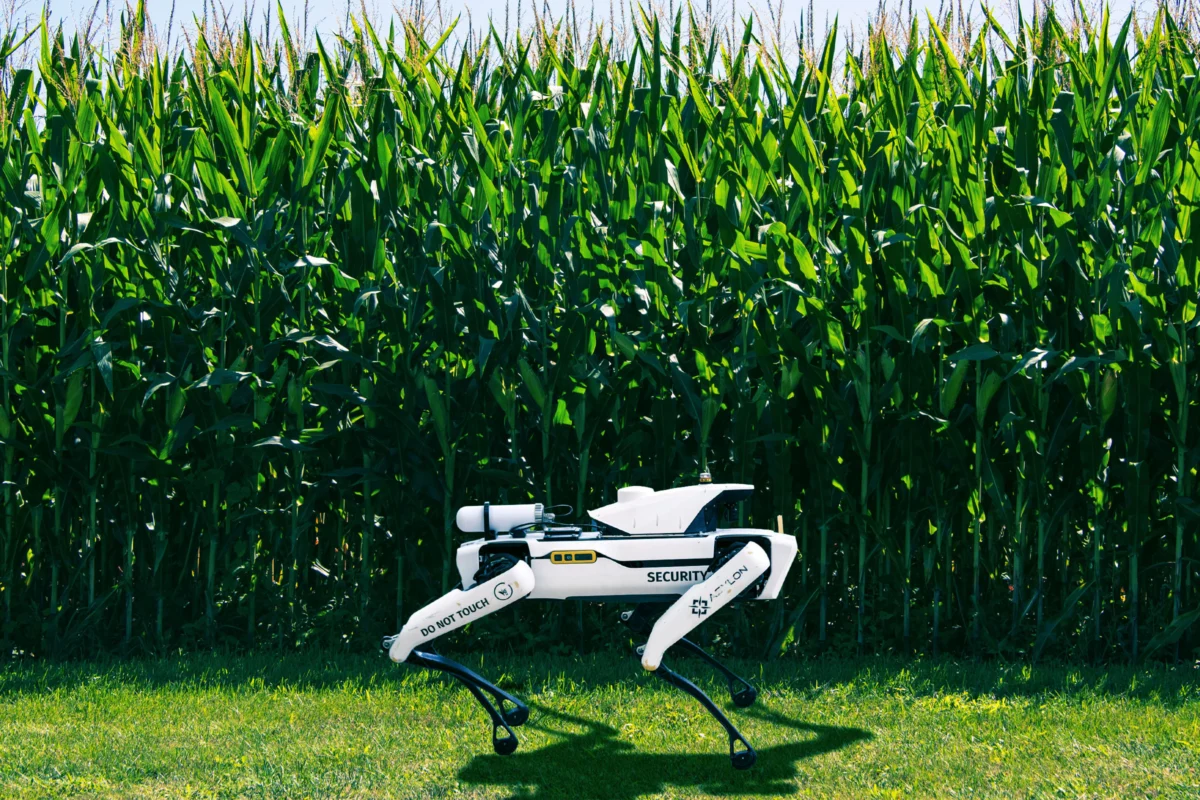
As advanced robotics become increasingly integrated into daily life, a striking and somewhat dystopian reality is unfolding: sophisticated robot dogs are now deployed to guard high-value agricultural assets, most notably corn crops, at a time when a deepening global food crisis leaves billions struggling with severe food insecurity. These robotic sentinels, equipped with cutting-edge surveillance technology, stand watch over vast fields, a stark contrast to a world grappling with disrupted supply chains, soaring fertilizer costs, and widespread hunger exacerbated by geopolitical conflicts.
Robot dogs, once subjects of science fiction and experimental prototypes, have rapidly transitioned into practical roles, securing sensitive locations ranging from advanced AI data centers and the formidable US-Mexico border to private estates like Donald Trump’s Mar-a-Lago resort. Their latest assignment, however, highlights a disturbing trend in resource allocation and security priorities. Industrial agriculture giants, exemplified by Bayer, are now deploying these mechanical guardians to protect hundreds of thousands, if not millions, of dollars worth of raw corn in the United States.
Specifically, the agrochemical and pharmaceutical behemoth Bayer has augmented its human security patrols at its sprawling 8,000-acre Hawaiian corn farm with robotic security dogs. These units are supplied by Asylon, a prominent tech firm specializing in robotic security solutions. The decision to integrate such high-tech surveillance underscores the immense value and vulnerability of these agricultural holdings. The Asylon dogs are tasked with an around-the-clock vigil, safeguarding Bayer’s precious maize from a myriad of threats, including human vandals, the devastating potential of wildfires, and incursions by wild fauna.
The technological prowess of these robot dogs is formidable. Each unit carries an advanced payload of thermal cameras and electro-optical sensors, technology commonly found in sophisticated unmanned military drones. These sensors provide a comprehensive view of the environment, allowing the robots to detect anomalies and potential threats regardless of lighting conditions. Thermal cameras can identify heat signatures through dense foliage or in complete darkness, making it virtually impossible for intruders, whether human or animal, to remain undetected. Electro-optical sensors offer high-resolution visual data, enabling detailed observation and identification. Furthermore, these robodogs are not isolated units; they are seamlessly integrated into a dual command structure, connecting directly to Bayer’s Hawaii Security Operations Centre and, concurrently, to Asylon’s own Robotic Security Operations Centre. This dual oversight ensures continuous monitoring and rapid response capabilities, presenting a formidable deterrent to anyone contemplating a daring corn heist.
While the deployment of such advanced robotics might appear to be an excessive measure, the financial stakes involved are substantial. According to industry reports from The Fence Post, Bayer’s Hawaiian corn holdings represent a staggering 90 percent of the company’s international feed corn exports. Considering an average cost of approximately $113.50 per acre for seed corn investment alone, the 8,000-acre farm signifies an initial investment exceeding $900,000. However, the true market value, particularly on the international stage for specialized hybrid seeds, would undoubtedly soar into the millions. This figure pales in comparison to the broader economic impact of the industrial corn system in the US, a monumental powerhouse that generated an astounding $123 billion in revenue in 2024 alone. Protecting these crops is not merely about safeguarding a harvest; it is about preserving significant capital investment, intellectual property embodied in proprietary seed strains, and a critical link in the global food and feed supply chain.
This advanced robotic protection of high-value crops emerges against a deeply unsettling global backdrop: a looming and intensifying food crisis. The statistics paint a grim picture, with the World Health Organization reporting that a staggering 2.3 billion people worldwide already face moderate to severe levels of food insecurity. This crisis, far from being a distant threat, is actively deepening, driven by a confluence of factors, prominently including geopolitical tensions and conflicts that are disrupting critical supply chains.
One significant catalyst for this escalating crisis has been the severe disruption to global supply chains stemming from geopolitical conflicts, particularly those impacting vital trade corridors. Reports indicate that these tensions have significantly affected approximately one-third of the world’s global fertilizer supply. Fertilizers are the lifeblood of modern agriculture, essential for maintaining crop yields necessary to feed a growing population. The scarcity and skyrocketing cost of these critical inputs have led farmers globally to issue dire warnings of imminent food price spikes in the coming months.
Máximo Torero, the chief economist of the Food and Agriculture Organization of the United States (FAO), articulated the gravity of the situation in a recent press briefing concerning the economic shockwaves emanating from conflicts impacting strategic regions like the Strait of Hormuz. He warned of a "systematic shock affecting agrifood systems globally," highlighting the fragility of interconnected global markets. Torero elaborated on the "dual cost shock" confronting farmers: not only are they grappling with significantly more expensive fertilizers, but they are also facing rapidly rising fuel costs. These elevated fuel prices permeate the entire agricultural value chain, impacting everything from irrigation systems that rely on energy to the transportation of harvested crops to markets. Such pressures inevitably translate into higher production costs, which are then passed on to consumers, exacerbating food insecurity for vulnerable populations.
The duration and ultimate severity of these consequences remain uncertain, largely dependent on how long geopolitical conflicts persist and how effectively global communities can adapt to the resulting economic shockwaves. However, one stark reality is unequivocally clear: we are now inhabiting a world where billions endure hunger and food insecurity, while simultaneously, invaluable cash crops are meticulously patrolled and safeguarded by sophisticated robot dogs. This juxtaposition evokes unsettling comparisons to dystopian narratives, particularly the "Black Mirror" anthology, where technological advancement often serves to highlight profound societal inequalities and ethical dilemmas.
The scene of a robot dog patrolling a cornfield, with its advanced sensors and military-grade technology, is a powerful symbol of contemporary priorities. It represents the ultimate privatization of security for high-value commodities, ensuring that capital investments are protected with the most cutting-edge tools available, regardless of the broader human context. The very existence of these highly automated guardians underscores the economic imperative driving their deployment: to protect profits, proprietary genetics, and the efficiency of industrial agriculture against any threat, be it human or environmental. This level of investment in robotic security for a food crop speaks volumes about the perceived value of these assets and the lengths to which corporations will go to secure them.
The implications of this trend extend beyond mere security. It signals a future where human labor in guarding roles might be increasingly replaced by autonomous systems, raising questions about employment and the nature of work. More profoundly, it forces a critical examination of resource allocation in a world of finite resources. If such advanced technology can be developed and deployed to protect crops that contribute to a multi-billion-dollar industry, what does it say about the collective will or capacity to address the fundamental human right to food for those facing starvation? The stark contrast highlights a growing chasm between technological capability and humanitarian priorities.
The Strait of Hormuz, a narrow passage connecting the Persian Gulf to the open ocean, is a prime example of a geopolitical chokepoint whose disruption has cascading global effects. It is a crucial route for a significant portion of the world’s oil and gas shipments, and conflicts in the region inevitably ripple through global energy markets, directly influencing fuel costs for agriculture. Moreover, the production of many essential fertilizers relies on raw materials and energy sources often transported through such volatile regions. When these supply lines are jeopardized, the impact is felt on every farm, ultimately reaching every dinner table. The fragility of these globalized systems means that a conflict thousands of miles away can directly influence the price of corn in Iowa or the availability of food in Sub-Saharan Africa.
In essence, the deployment of robot dogs to guard corn fields in Hawaii is more than just an interesting technological advancement; it is a profound symptom of a global system under immense strain. It represents a future where the security of economic assets takes precedence, even as the fundamental needs of a significant portion of humanity remain unmet. As the world navigates increasingly complex geopolitical landscapes and the intensifying realities of climate change and resource scarcity, the image of a robotic sentinel standing guard over a valuable crop while billions go hungry serves as a powerful, uncomfortable, and urgent call for re-evaluating our collective priorities and the ethical implications of our technological advancements. The question is not merely whether these robot dogs can protect the corn, but what the protection of that corn signifies for the future of humanity itself.