Faris Adani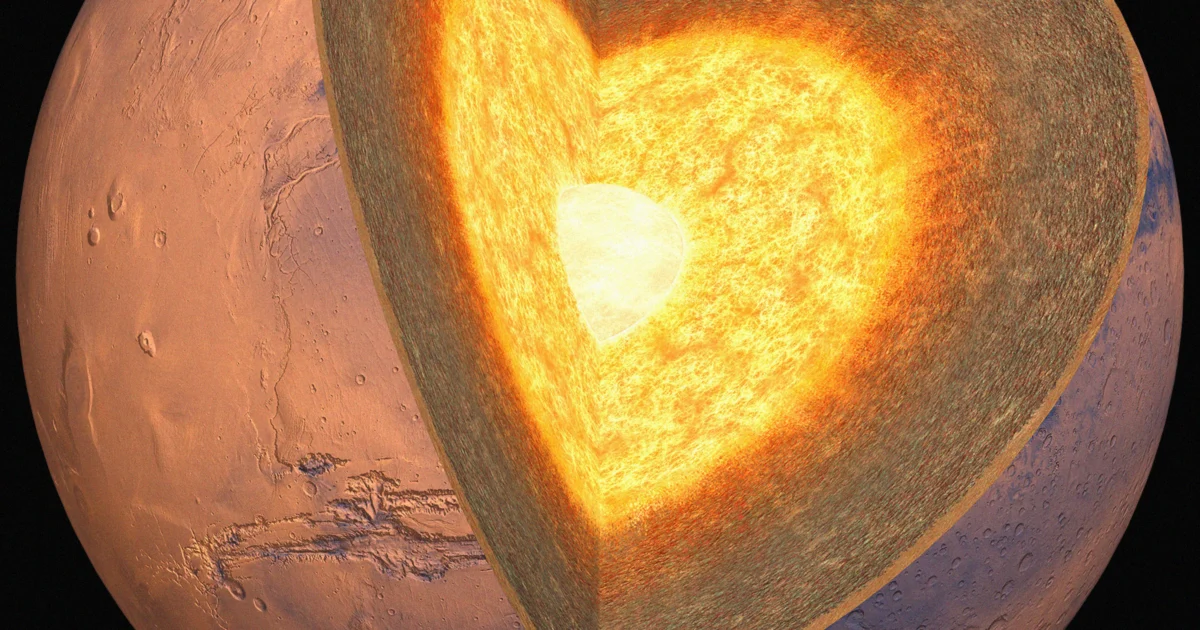
A groundbreaking discovery by NASA’s InSight Mars lander, corroborated by decades-old data from the Viking missions, has revealed that the Red Planet is spinning at an ever-increasing rate, subtly shortening the Martian day by fractions of a millisecond each year. This perplexing acceleration has now found a compelling explanation, put forth by a team of scientists from Delft University in the Netherlands: a massive, buoyant plume of hot mantle material, dubbed a “negative mass anomaly,” buried deep beneath Mars’ surface, which is dynamically altering the planet’s rotation. This revelation, detailed in a recent study published in the Journal of Geophysical Research: Planets, paints a picture of a Martian interior far more active and complex than previously assumed.
The journey to this discovery began with the meticulous work of NASA’s InSight lander, which touched down on Mars in November 2018. Designed to probe the planet’s deep interior, InSight carried a suite of sophisticated instruments, including the Rotation and Interior Structure Experiment (RISE). RISE utilized a radio transponder to precisely measure the tiny wobbles and shifts in Mars’ rotation axis, and critically, the rate at which the planet spins. Over four years, InSight collected invaluable data, beaming it back to Earth for analysis. What scientists observed was a consistent, albeit minuscule, increase in Mars’ angular velocity. To confirm this wasn’t an anomaly in InSight’s readings, researchers painstakingly compared this new data with rotation measurements taken by NASA’s Viking landers back in the 1970s. The continuity across nearly five decades of observations solidified the finding: Mars is indeed speeding up. Understanding a planet’s rotation rate is not merely an academic exercise; it provides crucial insights into its internal structure, mass distribution, and ongoing geological processes. Any change in rotation signals a redistribution of mass within the planet, offering a window into its deep, otherwise inaccessible interior.
The lead author of the study, Bart Root, an assistant professor of planetary exploration at Delft University of Technology, highlighted the significance of connecting internal dynamics with surface features. "The Martian surface is so old and shows all these complex but largely not well understood process[es], which I think we can start to unravel by combining interior with surface," Root told Live Science. "Understanding Mars will help in understanding our solar system, as its history is laid out on the red soil." This holistic approach led Root and his colleagues to focus on one of Mars’ most prominent and enigmatic geological features: the Tharsis volcanic province.
Tharsis is an immense, elevated region near Mars’ equator in the western hemisphere, a colossal bulge on the planet’s surface that covers roughly 25% of its total area and rises up to 10 kilometers (6 miles) above the surrounding plains. It is home to some of the largest volcanoes in the solar system, including the majestic Olympus Mons, a shield volcano that dwarfs Earth’s largest peaks. For billions of years, Tharsis has been a site of extensive volcanic activity, though its most massive volcanoes are now long dormant. The sheer scale and longevity of Tharsis have long puzzled planetary scientists, who sought an explanation for its formation and the immense geological forces required to create and sustain it.
Root’s team leveraged InSight’s data, particularly its seismic readings and gravitational field measurements, to develop computer simulations of Mars’ interior. These simulations revealed the likely presence of a deep-seated "negative mass anomaly" beneath the Tharsis region. In geophysical terms, a "negative mass anomaly" doesn’t imply an absence of mass, but rather a region of unusually low density compared to its surroundings. This lower density material, being more buoyant, tends to rise through the denser mantle, much like a hot air balloon ascends through cooler air. This phenomenon is known as a mantle plume. On Earth, similar plumes are thought to be responsible for hotspots like Hawaii and Yellowstone, where molten rock rises from deep within the mantle, creating volcanic chains as tectonic plates move over them. On Mars, the proposed plume beneath Tharsis would be a colossal, long-lived feature, continuously forcing new, less dense material upwards.
"The negative or light mass anomaly will move upwards and hit the lithosphere of Mars, introducing melt pockets that have the potential to penetrate the crust and erupt as volcanoes," Root explained. The lithosphere is the rigid outermost layer of a planet, comprising the crust and the uppermost part of the mantle. On Mars, this layer is estimated to be quite thick, possibly up to 500 kilometers (310 miles) in places. The interaction of a buoyant mantle plume with this thick lithosphere would provide the sustained heat and material necessary to build the colossal Tharsis province and its associated volcanoes over eons. The fact that Tharsis is centered near the equator is also crucial to the explanation for Mars’ accelerating rotation.
The ingenious part of the Delft team’s hypothesis lies in connecting this mantle plume to the planet’s increasing spin rate. The principle at play is the conservation of angular momentum, a fundamental law of physics. It’s often illustrated by the classic "ice skater" analogy: when an ice skater pulls their arms in towards their body during a pirouette, their rotational speed increases because their mass is redistributed closer to their axis of rotation, reducing their moment of inertia. Conversely, when they extend their arms, their speed decreases.
On a planetary scale, the upward flow of less dense, buoyant material from the mantle plume beneath Tharsis, coupled with the corresponding downward movement of denser material elsewhere, effectively redistributes mass within Mars. Because the Tharsis anomaly is located near the equator, the outward movement of less dense material, and the inward movement of denser material (closer to the rotation axis), reduces the planet’s moment of inertia. As Root put it, "A negative mass flowing upwards means something heavier needs to go down, and because the mass anomaly is located on the equator of Mars, this means the heavier mass is going closer to [the] rotation axis, hence a speed up." This subtle but persistent redistribution of mass, driven by the internal dynamics of the mantle plume, provides a compelling mechanism for the observed acceleration of Mars’ rotation. "With some simple back-on-the-envelope calculations, we can explain the order of magnitude of the observed speed up," Root added, acknowledging that "more complicated modeling will be needed to actually link this better."
This finding carries profound implications for our understanding of Mars. For decades, Mars has often been considered a geologically "dead" planet, particularly compared to Earth with its active plate tectonics and widespread volcanism. While Mars undoubtedly lacks global plate tectonics, the presence of an active, buoyant mantle plume suggests that its interior is not entirely quiescent. It implies that Mars still retains significant internal heat, driving convective processes deep within its mantle, hundreds of miles below the surface. Such internal activity could have influenced the planet’s past climate, its magnetic field (which largely disappeared billions of years ago), and even its potential for past habitability, as subsurface heat can sustain liquid water environments.
The study’s methodology, relying on sophisticated computer simulations constrained by real-world data from InSight and Viking, represents a triumph of planetary science. It demonstrates the power of combining long-term observational data with theoretical models to unravel the complex history and ongoing processes of distant worlds. However, as with any groundbreaking hypothesis, it also opens new avenues for research and raises further questions. While the model provides a strong explanation, direct confirmation of such a deep-seated plume remains challenging.
To that end, the researchers conclude their paper with a call for future missions, arguing that the "time is ripe for a dedicated gravity mission to Mars." Such a mission, equipped with highly precise instruments, could map Mars’ gravitational field with unprecedented detail. Variations in gravity can reveal the distribution of mass beneath the surface, providing stronger evidence for the existence, size, and characteristics of the proposed negative mass anomaly. This would either confirm Root’s team’s hypothesis or point towards alternative explanations for the Martian acceleration.
Ultimately, this research transforms our view of Mars from a static, geologically inert world to one that, while far less active than Earth, still harbors dynamic processes deep within its core and mantle. It reminds us that every planet, regardless of its apparent tranquility, holds secrets beneath its surface, waiting to be unearthed by the persistent curiosity and ingenuity of scientific exploration. The Red Planet continues to surprise us, offering invaluable insights into the diverse evolutionary paths of celestial bodies within our solar system and beyond.