Imroatul Nasiyah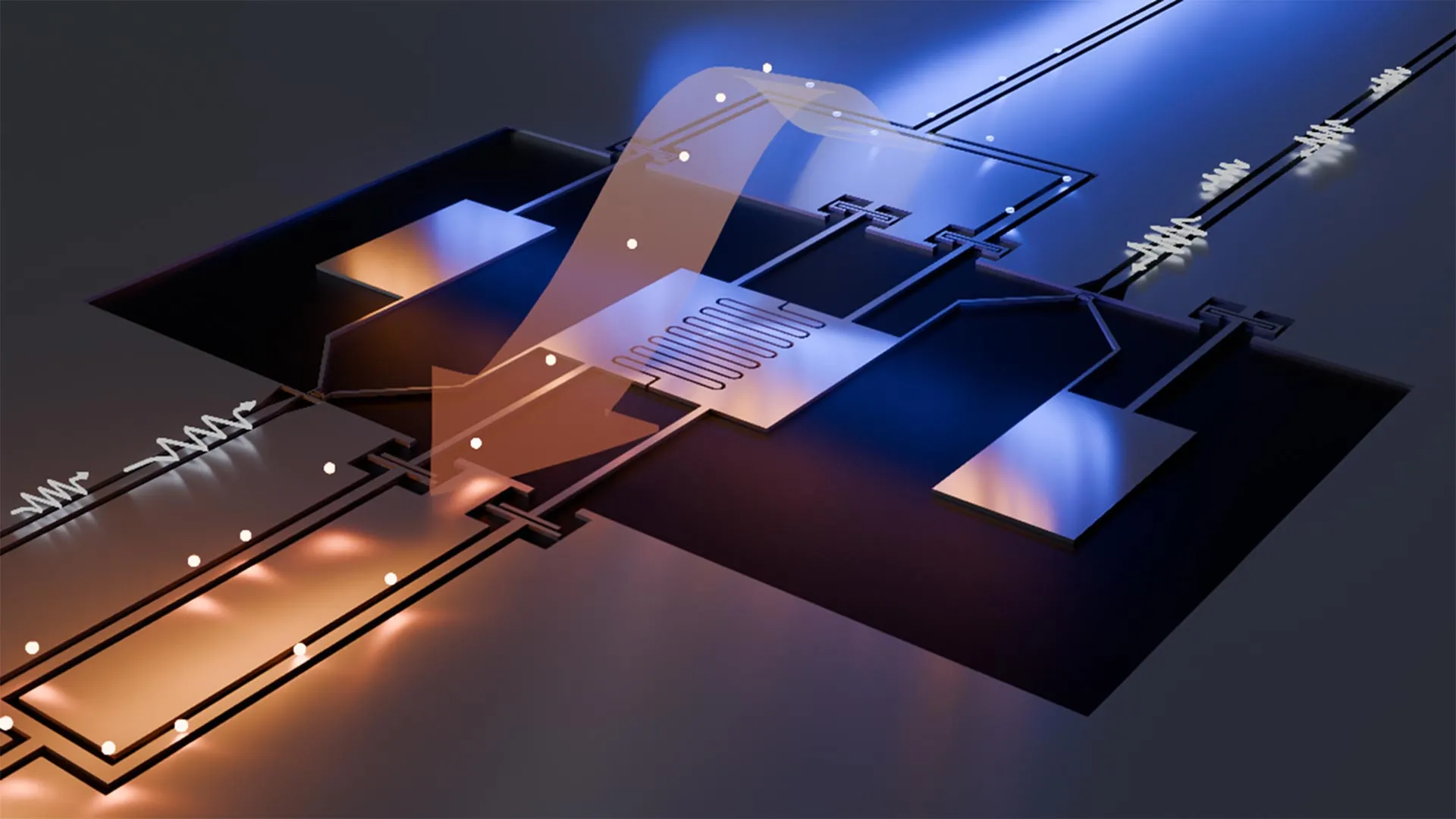
The extreme sensitivity of these quantum states means that even minuscule environmental disturbances – a slight temperature fluctuation, a whisper of electromagnetic interference, or even background noise – can corrupt and erase the stored information. This inherent vulnerability makes quantum systems challenging to operate and exponentially more difficult to scale up for practical problem-solving. As researchers push towards larger and more complex quantum architectures, the problem of heat dissipation and noise management becomes increasingly acute. Larger systems inherently generate more heat during operation and measurement, creating more pathways for unwanted energy to propagate and disrupt the delicate quantum coherence.
"Many quantum devices are ultimately limited by how energy is transported and dissipated," explains Simon Sundelin, a doctoral student in quantum technology at Chalmers University of Technology and the lead author of the groundbreaking study. "Understanding these pathways and being able to measure them allows us to design quantum devices in which heat flows are predictable, controllable, and even useful." This sentiment underscores a fundamental shift in thinking: instead of viewing noise as an enemy to be eradicated, the Chalmers team has ingeniously explored its potential as a tool.
In a pivotal study published in the prestigious journal Nature Communications, the Chalmers researchers unveiled a novel quantum refrigerator that defies conventional cooling paradigms. Rather than striving to eliminate noise, their device cleverly harnesses it as the primary engine for its cooling process. "Physicists have long speculated about a phenomenon called Brownian refrigeration; the idea that random thermal fluctuations could be harnessed to produce a cooling effect," notes Simone Gasparinetti, an associate professor at Chalmers and the senior author of the study. "Our work represents the closest realization of this concept to date."
At the heart of this innovative quantum refrigerator lies a meticulously engineered superconducting artificial molecule. Fabricated in Chalmers’ state-of-the-art nanofabrication laboratory, this molecule mimics the behavior of its natural counterparts but is constructed not from atoms, but from intricate networks of tiny superconducting electrical circuits. This artificial molecule is strategically connected to multiple microwave channels, acting as conduits for energy.
The ingenious aspect of the design lies in the controlled injection of microwave noise. By introducing precisely calibrated random signal fluctuations within a specific, narrow frequency range, the researchers gain unprecedented control over the flow of heat and energy throughout the system. This controlled noise acts as a gatekeeper, dictating how thermal energy moves. "The two microwave channels serve as hot and cold reservoirs," elaborates Sundelin. "But the key point is that they are only effectively connected when we inject controlled noise through a third port. This injected noise enables and drives heat transport between the reservoirs via the artificial molecule."
The precision of this control is staggering. The team was able to measure heat currents of astonishingly small magnitudes, down to the attowatt (10-18 watt) range. To put this into perspective, Sundelin illustrates, "If such a small heat flow were used to warm a drop of water, it would take the age of the universe to see its temperature rise one degree Celsius." This remarkable sensitivity highlights the potential for incredibly fine-grained thermal management.
Beyond its primary function as a refrigerator, this novel device exhibits remarkable versatility. By subtly adjusting the reservoir temperatures and meticulously tracking these minuscule heat flows, the quantum refrigerator can be configured to operate in multiple modes. Depending on the specific conditions, it can function as a refrigerator, drawing heat away from a system; it can act as a heat engine, converting thermal energy into useful work; or it can even amplify thermal transport, facilitating more efficient heat movement.
This multifaceted control over heat is particularly crucial for the advancement of larger-scale quantum systems. In these complex architectures, heat is inevitably generated locally during the operation and measurement of qubits. The ability to manage this heat directly within the quantum circuits, at the microscopic level, offers a significant advantage over conventional cooling methods, which often struggle to address localized heat sources effectively. Such localized thermal management promises to enhance the stability and performance of quantum computers, making them more reliable and robust.
"We see this as an important step towards controlling heat directly inside quantum circuits, at a scale that conventional cooling systems can’t reach," states Aamir Ali, a researcher in quantum technology at Chalmers and a co-author of the study. "Being able to remove or redirect heat at this tiny scale opens the door to more reliable and robust quantum technologies." This breakthrough signifies a critical stride in overcoming a major obstacle on the path to realizing the full potential of scalable quantum computing. The ability to precisely engineer heat flow, rather than simply battling its detrimental effects, offers a powerful new tool in the quantum engineer’s arsenal.
The implications of this research are far-reaching. By turning a persistent challenge – noise – into a fundamental aspect of its operation, the Chalmers team has not only demonstrated a novel cooling mechanism but also provided a blueprint for a more sophisticated and controllable approach to quantum system management. This innovative quantum refrigerator, powered by precisely controlled noise, could pave the way for the development of more stable, scalable, and ultimately, more powerful quantum computers, bringing the transformative promise of quantum technology closer to reality.
Further details of this pioneering work can be found in the scientific journal Nature Communications, under the title "Quantum refrigeration powered by noise in a superconducting circuit." The research team, comprising Simon Sundelin, Mohammed Ali Aamir, Vyom Manish Kulkarni, Claudia Castillo-Moreno, and Simone Gasparinetti, all affiliated with the Department of Microtechnology and Nanoscience at Chalmers University of Technology, has significantly advanced our understanding of thermal management in quantum systems. The fabrication of the quantum refrigerator was facilitated by the cutting-edge facilities at the Nanofabrication Laboratory, Myfab, at Chalmers University of Technology. This vital research received substantial support from various esteemed funding bodies, including the Swedish Research Council, the Knut and Alice Wallenberg Foundation through the Wallenberg Centre for Quantum Technology (WACQT), the European Research Council, and the European Union, underscoring the global recognition of its scientific importance.