Imroatul Nasiyah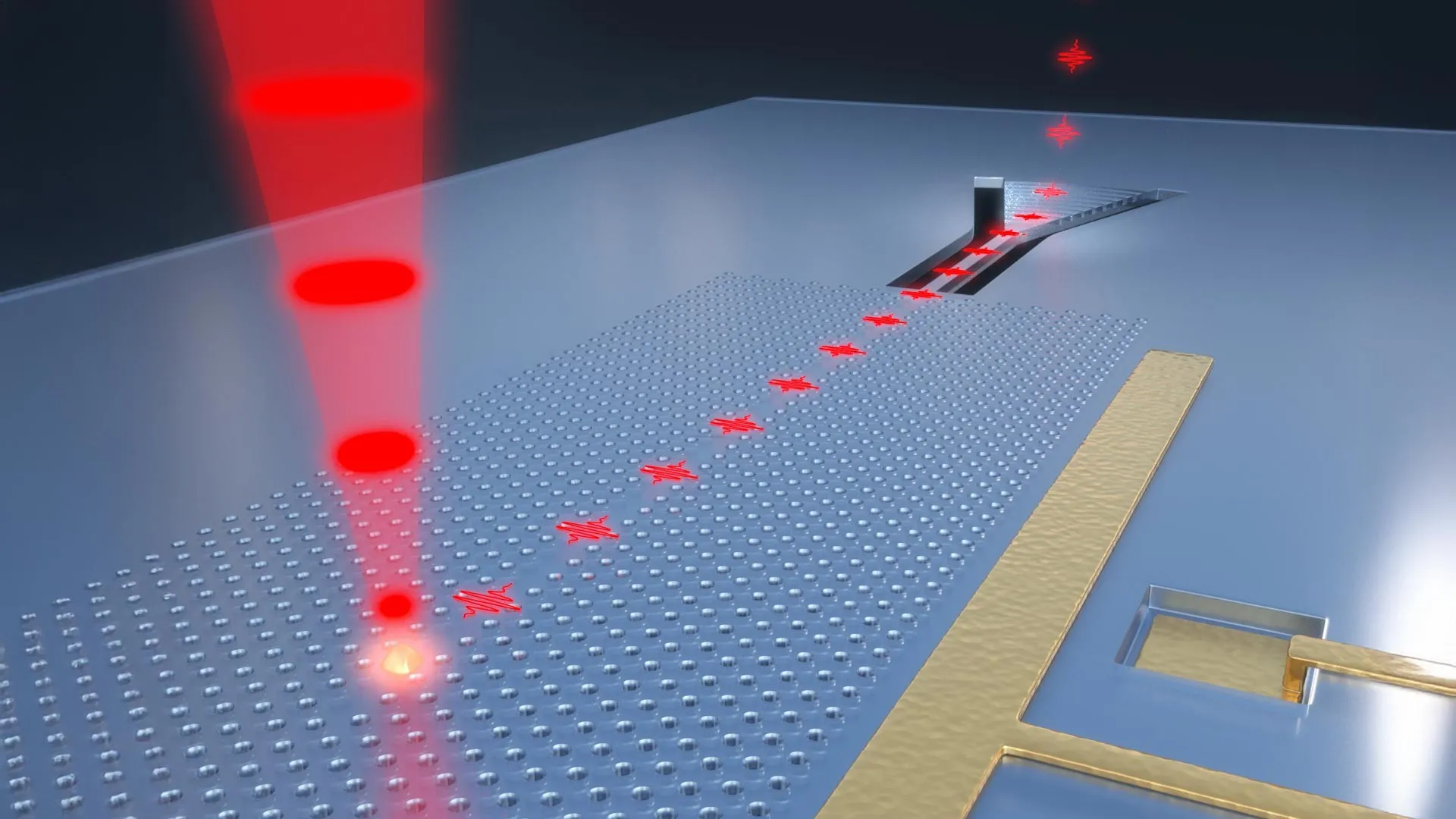
Researchers at the University of Iowa have unveiled a novel method to "purify" photons, a development poised to significantly improve the functionality and security of light-based quantum technologies. This innovative approach focuses on refining the generation of single photons, the fundamental building blocks of photonic quantum computers and secure communication networks, thereby overcoming critical obstacles that have historically hindered the reliable creation of these essential light particles.
The team’s work directly confronts two principal challenges that impede the consistent production of single photons. The first is known as "laser scatter." This phenomenon occurs when a laser is used to excite an atom, prompting it to emit a photon. However, the laser interaction can inadvertently produce extraneous, unwanted photons alongside the desired single particle. These surplus photons act as noise within an optical circuit, diminishing its efficiency much like stray electrical currents disrupt the smooth operation of conventional electronic circuits. This unwanted interference can corrupt quantum computations and weaken the integrity of secure communication channels.
The second significant hurdle stems from the inherent behavior of atoms when interacting with laser light. In certain instances, an atom can emit more than one photon in a single excitation event. This multi-photon emission is detrimental to quantum operations because it disrupts the precise, sequential arrival of single photons that is crucial for executing quantum algorithms and protocols. When multiple photons are emitted simultaneously, the intended one-by-one flow is broken, introducing errors and compromising the fidelity of quantum information transfer. This lack of precise control over photon emission timing and quantity has been a persistent bottleneck for scaling up photonic quantum systems.
Harnessing Laser Noise for Unwanted Photon Suppression
In a remarkable turn of events, the new study, led by graduate student Matthew Nelson from the Department of Physics and Astronomy, has uncovered an unexpected and powerful connection between these two seemingly disparate problems. Nelson’s research revealed that when an atom releases multiple photons, the resulting spectral and waveform characteristics of these unwanted photons bear a striking resemblance to those of the original laser light used for excitation.
This profound similarity, according to the researchers, presents an opportunity for a sophisticated form of cancellation. By meticulously adjusting the properties of the laser light and the emitted photons, the team has demonstrated that the unwanted, multi-photon emissions can be effectively neutralized. In essence, the very "laser scatter" that has long been a source of frustration and inefficiency can now be strategically employed as a tool to suppress the very emissions it inadvertently contributes to. This is a paradigm shift, transforming a detrimental artifact into a powerful mechanism for enhancing photon purity.
"We have shown that stray laser scatter, typically considered a nuisance, can be harnessed to cancel out unwanted, multi-photon emission," stated Ravitej Uppu, assistant professor in the Department of Physics and Astronomy and the study’s corresponding author. "This theoretical breakthrough could turn a long-standing problem into a powerful new tool for advancing quantum technologies." This statement underscores the transformative potential of their findings, suggesting that a previously insurmountable obstacle might now be a key to unlocking new levels of performance in quantum computing and communication.
The Critical Role of Single Photons in Quantum Computing
The concept of photonic computing hinges on the utilization of light, rather than electricity, to perform complex calculations. This approach holds immense promise for the development of computing systems that are not only faster but also significantly more energy-efficient than their conventional counterparts. Traditional computers operate using bits, which represent binary states of either a "one" or a "zero" through electrical or optical pulses. Quantum computers, however, leverage the principles of quantum mechanics, employing qubits. These qubits, often embodied by subatomic particles such as photons, can exist in superpositions of both "one" and "zero" simultaneously, enabling them to perform calculations in ways unimaginable for classical computers.
A growing consensus among leading technology companies and research institutions points towards photonic platforms as a cornerstone of future quantum computing architectures. The realization of this vision is critically dependent on the ability to generate and control a stable, well-ordered stream of single photons. Such control is essential for building robust quantum processors capable of executing complex algorithms and for establishing highly secure communication networks.
An orderly stream of single photons offers significant advantages in terms of manageability and scalability. Imagine trying to process information by having a chaotic crowd of people rush through a line versus having them proceed one by one in an organized fashion. The latter is far easier to manage, track, and control. Similarly, a precise stream of single photons allows for more straightforward manipulation and integration into larger quantum systems. Furthermore, this orderliness directly enhances security. When information is encoded in individual photons arriving in a predictable sequence, it becomes much harder for an eavesdropper to intercept or decipher the data without detection. This "one-photon-at-a-time" delivery system is analogous to sending secret messages in individual, carefully timed bursts, making unauthorized access exceedingly difficult.
Achieving Purity Through Precision Laser Control
Professor Uppu further elaborated on the practical implications of their discovery, emphasizing that precise control over the laser beam is the linchpin of their new purification method. "If we can control exactly how the laser beam shines on an atom — the angle at which it’s coming, the shape of the beam, and so on — you can actually make it cancel out all the additional photons that the atom likes to emit," he explained. "We would be left with a stream that is actually very pure."
This meticulous adjustment of laser parameters allows for a level of control previously unattainable. By fine-tuning the laser’s interaction with the atom, researchers can effectively "tune out" the unwanted multi-photon emissions, leaving behind a highly purified stream of single photons. This level of precision opens the door to creating quantum systems that are not only more powerful but also more reliable and less prone to errors.
The significance of this work lies in its demonstration, at a theoretical level, that two of the most significant barriers to the development of faster and more efficient photonic circuitry can be addressed simultaneously. The successful experimental validation of this technique could dramatically accelerate the progress towards building advanced quantum computers and implementing next-generation secure communication systems. The research team is now gearing up for future experiments to translate this theoretical breakthrough into tangible advancements.
Study Details and Funding
The groundbreaking research, titled "Noise-assisted purification of a single-photon source," has been formally published in the esteemed journal Optica Quantum, a testament to its scientific rigor and potential impact. The research received crucial financial backing from the Office of the Under Secretary of Defense for Research and Engineering within the U.S. Department of Defense, highlighting the strategic importance of these advancements for national security and technological leadership. Additional support was generously provided through a seed grant from the University of Iowa Office of the Vice President for Research via the P3 program, an initiative designed to foster and launch promising new research projects. This multi-faceted funding demonstrates a strong commitment to advancing quantum science and its applications.