anjir abdul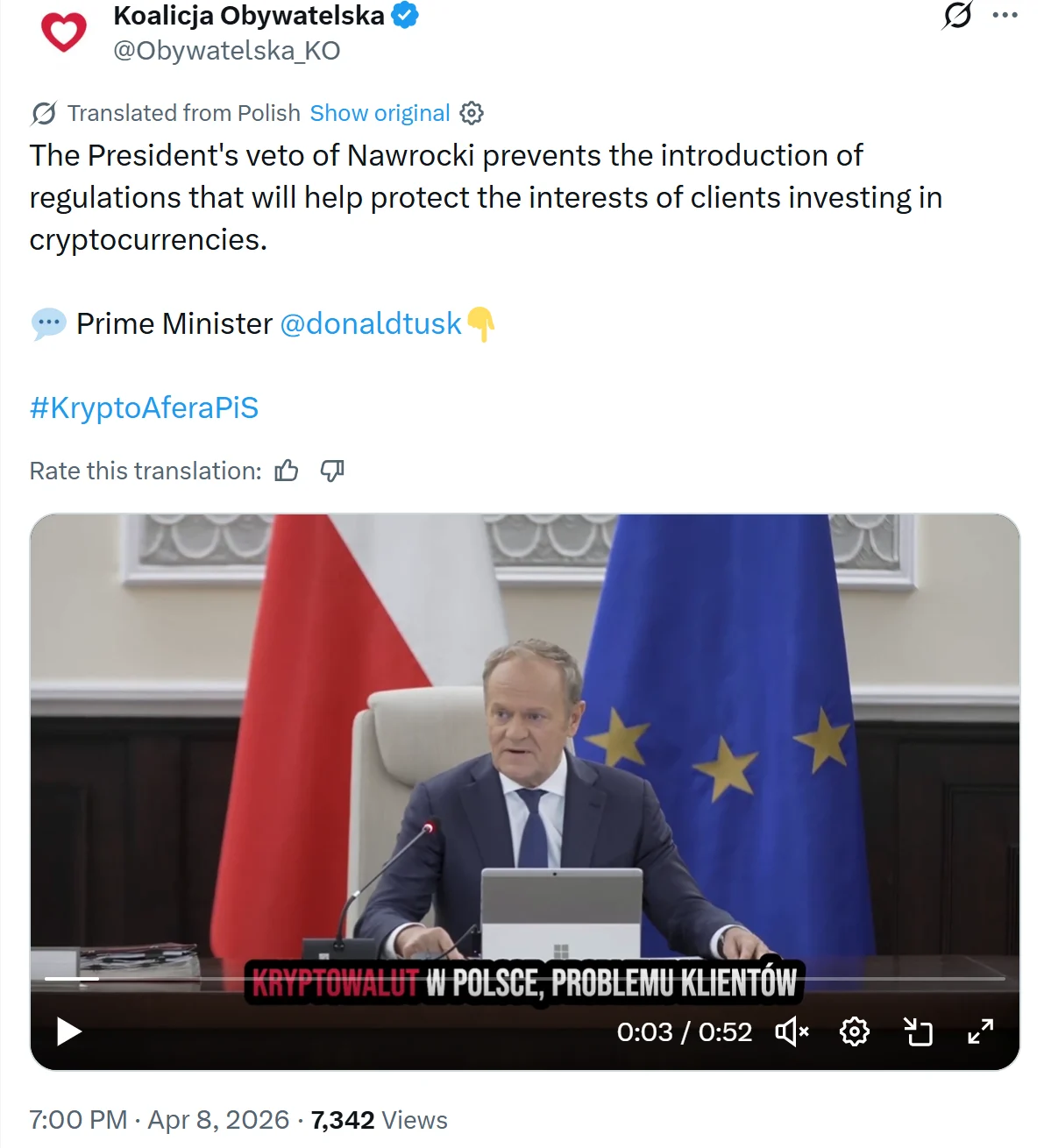
Poland’s parliament has once again failed to overturn a presidential veto blocking a key crypto regulation bill, extending the protracted political standoff over how the country should oversee digital assets and leaving it isolated as the sole European Union member state yet to implement the bloc’s comprehensive Markets in Crypto-Assets Regulation (MiCA). This latest parliamentary setback, occurring on Friday, saw lawmakers fall significantly short of the 263 votes required to override the veto issued by President Karol Nawrocki. As reported by local outlet TVP World, a total of 243 Members of Parliament voted to challenge the veto, while 191 supported the President’s decision, underscoring the deep divisions within Poland’s political landscape regarding digital asset governance.
The legislative proposal, strongly championed by Prime Minister Donald Tusk’s government, is designed to bring Poland into alignment with MiCA, a landmark EU framework introduced in 2024 (with various provisions taking effect through 2024 and 2025) to standardize the issuance, custody, and trading of crypto assets across the 27-member bloc. MiCA represents a concerted effort by the EU to foster innovation while mitigating risks in the rapidly evolving crypto space, aiming to provide legal certainty, protect consumers, and prevent market abuse. For Poland to remain the only EU nation yet to adopt this framework is not merely a procedural anomaly but a significant impediment to its integration into the broader European digital economy and a potential source of future legal and financial repercussions from Brussels.
President Nawrocki has consistently defended his decision to veto the bill, articulating concerns over what he perceives as excessive regulation, limited transparency within the proposed framework, and the potential for an undue administrative and financial burden on small businesses and startups operating in the burgeoning crypto sector. His stance aligns with a more cautious, sometimes skeptical, approach to new financial technologies, emphasizing the need for regulatory clarity that doesn’t stifle innovation or disadvantage smaller market participants.
However, government officials, particularly Finance Minister Andrzej Domański, have voiced strong warnings about the perils of this regulatory vacuum. Domański reportedly articulated fears that delaying comprehensive crypto regulation leaves Polish investors dangerously exposed to illicit activities, potentially transforming the market into an "El Dorado for fraudsters." He stressed that without clear, robust rules, both individual consumers and legitimate businesses remain acutely vulnerable to exploitation, scams, and market manipulation, highlighting the urgent need for a regulatory environment that fosters trust and security. The absence of a clear legal framework also deters foreign investment and innovation, as companies prefer jurisdictions with established and predictable regulatory landscapes.
This recent failed overturn of the presidential veto marks the second unsuccessful attempt by the current government to push through the crucial legislation. The initial bill faced a similar rejection in December of the previous year. Following that initial defeat, Polish lawmakers swiftly reintroduced the regulation within days, presenting it as an "improved" version. Yet, critics, including the presidential camp, contended that the revised draft was virtually unchanged from its predecessor, merely a strategic maneuver rather than a substantive revision addressing the President’s original concerns. President Nawrocki subsequently vetoed this resubmitted bill again in February of this year, issuing a resolute statement that underscored his unwavering conviction: "I will not sign a wrong law just because it was passed again by the parliamentary majority. A wrong law that passed a hundred times still remains a wrong law." This firm stance highlights the deep ideological chasm between the executive and legislative branches on this issue, emblematic of Poland’s broader political landscape often characterized by cohabitation governments where the President and Prime Minister hail from opposing political camps.

The implications of this prolonged regulatory deadlock extend beyond mere legislative inconvenience. For businesses operating within Poland’s crypto sector, the uncertainty is palpable. Without a clear MiCA-aligned framework, Polish crypto companies face a competitive disadvantage compared to their counterparts in other EU states that have already adopted the regulation. This lack of legal clarity can hinder their ability to scale, attract investment, and even operate effectively, leading some to consider seeking licenses abroad in more predictable jurisdictions. For investors, the risks are magnified; without the consumer protections and oversight mechanisms inherent in MiCA, they are more susceptible to the kind of fraudulent schemes that Finance Minister Domański warned against.
Adding another layer of complexity and controversy to this ongoing political row is the involvement of Zonda, Poland’s largest crypto exchange. Zonda has reportedly lobbied against the proposed crypto bill, a move that has drawn significant scrutiny and escalated tensions. Prime Minister Tusk publicly accused the platform of having links to illicit funding, citing intelligence reports that allegedly connect its origins to Russian criminal networks. These serious allegations, if substantiated, would underscore the very risks the government claims the MiCA bill aims to mitigate, positioning Zonda as a central figure in the debate about market integrity and national security.
Zonda CEO Przemysław Kral vehemently denied these accusations, taking to X (formerly Twitter) to express his outrage. He wrote, "Attempts to drag me and Zonda into the current political squabbles are as absurd as they are harmful to the Polish innovation market," further stating that he felt "compelled to take appropriate legal steps to protect my personal rights." This exchange highlights the intense politicization of the crypto debate in Poland, where regulatory discussions are intertwined with broader accusations of corruption and foreign influence. The controversy surrounding Zonda was further compounded last week when Kral publicly stated he does not control access to a crypto wallet reportedly holding a staggering $330 million (approximately 4,500 BTC), claiming that access to these significant funds remained with former CEO Sylwester Suszek prior to his disappearance in 2022. This specific incident provides a stark, real-world example of the kind of transparency issues and investor vulnerabilities that critics of the current regulatory vacuum are actively warning against, lending weight to the government’s arguments for stricter oversight. The inability to access or account for such a large sum of assets at a major exchange only amplifies the calls for robust regulatory frameworks to protect users and ensure accountability.
The repeated failures to pass the crypto bill also raise questions about Poland’s commitment to its EU obligations. As a member state, Poland is expected to transpose EU directives and regulations into its national law. Prolonged non-compliance with MiCA could lead to infringement procedures initiated by the European Commission, potentially resulting in fines and further political pressure. Such a scenario would not only strain Poland’s relationship with the EU but also tarnish its reputation as a reliable partner in European legislative harmonization.
Looking ahead, the path forward remains unclear. The government could attempt to revise the bill yet again, potentially incorporating more of the President’s feedback in a genuine effort to achieve a compromise. However, given the President’s previous statements about "a wrong law that passed a hundred times," a simple re-submission without significant changes is unlikely to succeed. Alternatively, the EU might exert greater pressure on Poland, potentially through formal infringement proceedings, forcing the country to adopt MiCA. The current political climate in Poland, marked by a delicate balance of power between the executive and legislative branches, suggests that resolving this impasse will require more than just legislative tweaks; it will demand genuine political will and a willingness to bridge ideological divides for the sake of market stability, investor protection, and international compliance. Until then, Poland’s crypto market will continue to operate in a state of regulatory limbo, leaving its participants exposed to risks and potentially hindering the growth of its digital economy.