Faris Adani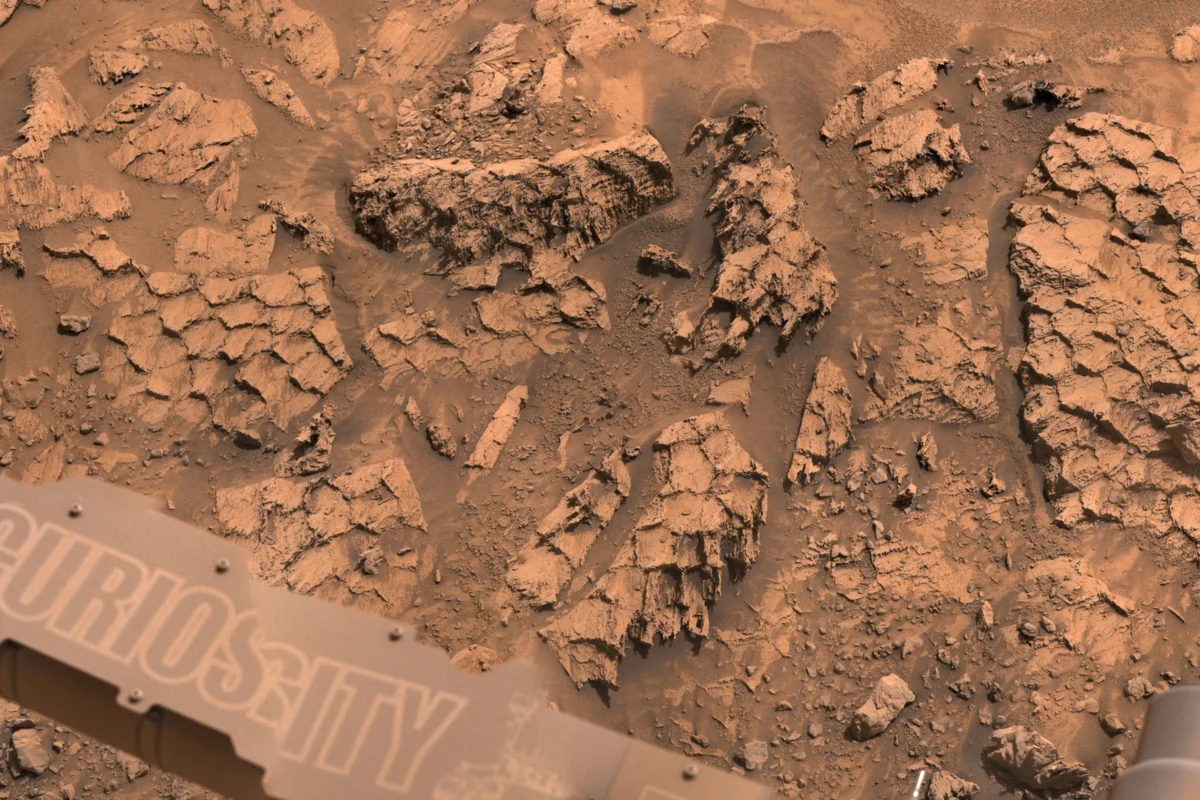
Far across the desolate, rust-hued plains of Mars, NASA’s indomitable Curiosity Rover has recently stumbled upon a geological marvel, capturing images of a landscape so eerily patterned that it evokes the image of a colossal, ancient reptile’s scaly hide. This striking discovery, a sprawling expanse of polygonal rock formations, has captivated scientists and the public alike, prompting a renewed investigation into Mars’ deep geological past and its potential for ancient life. The rover, a veteran explorer of the Red Planet since its landing in 2012, was on an incidental detour, or "side quest" as some have dubbed it, when its sophisticated cameras captured this otherworldly sight.
The captivating images, shared by Kevin M. Gill, a distinguished engineer at NASA’s Jet Propulsion Laboratory, showcase a distinctive, tessellated rock surface that stretches for meters across the Martian ground. These intricate patterns, reminiscent of dried mud cracks or even the segmented shell of an immense tortoise, have left the scientific community pondering their precise origins. While similar polygonal patterns have been observed before on Mars, the sheer abundance and dramatic presentation of these particular formations, captured in high-resolution Mastcam mosaics, mark them as exceptionally significant. The visual spectacle immediately sparked imaginations, transforming the Martian surface into a canvas of cosmic wonder.
Scientists at the space agency have acknowledged the unique nature of this finding. "We’ve seen polygon-patterned rocks like these before, but they didn’t seem quite this dramatically abundant, stretching across the ground for meters and meters in our Mastcam mosaics," stated a recent blog post from the Curiosity mission team. The rover’s ongoing mission involves meticulously collecting a wealth of images and chemical data, crucial for dissecting the various hypotheses that could explain the formation of these intricate, honeycomb-like textures. Each piece of data brings researchers closer to unraveling the secrets embedded within these ancient Martian stones.
One of the most compelling theories posits that these textured scales are the fossilized remnants of ancient mud banks, subjected to relentless cycles of wetting and drying. This process, known as desiccation cracking, is common on Earth in environments where water bodies periodically evaporate, leaving behind cracked sediment. On Mars, this would imply a far different climate approximately 3.8 to 3.6 billion years ago—a period when the planet was significantly wetter and warmer, capable of supporting standing bodies of liquid water and experiencing distinct seasonal changes. Such cyclical conditions would have repeatedly saturated and desiccated the clay-rich soils, causing them to contract and crack into the polygonal shapes now observed. Over eons, these cracks would have been filled with minerals, hardened, and preserved, offering a silent testament to Mars’ aqueous past.
A Nature paper published in 2023, following research conducted by the Curiosity team in Gale Crater, provided critical insights into such phenomena. It highlighted the discovery of similar mud cracks elsewhere in the crater, indicating prolonged periods of wet and dry conditions. These findings are pivotal because sustained, cyclical environmental changes—rather than merely transient presence of water—are thought to be more conducive to the emergence and evolution of microbial life. The repeated exposure to water and air, along with the concentration of organic molecules in the cracks, could have created micro-environments ideal for prebiotic chemistry and the sustenance of early life forms. The "cosmic reptile scales" thus serve as a tangible geological record of a potentially habitable ancient Mars.
Curiosity’s unexpected encounter with these intriguing formations occurred as it navigated towards a specific geological target: a 32-foot-diameter crater, which scientists have christened "Antofagasta." Named after a vibrant city and region in Chile, Antofagasta Crater represents a high-priority site for scientific investigation. Researchers believe this relatively small crater could harbor crucial traces of organic chemicals. These organic molecules are considered the fundamental building blocks of life and are often regarded as "major keys" to unlocking the mystery of whether ancient organisms once thrived on the Red Planet. The search for these chemicals is central to Curiosity’s overarching mission: to determine if Mars ever had the environmental conditions to support microbial life.
The quest for evidence of life on Mars, though painstakingly slow, continues to yield tantalizing clues. Just last year, NASA made headlines by announcing that its other active Mars rover, Perseverance, had discovered peculiar "leopard spots" on rocks within the Jezero Crater. These distinctive patterns, characterized by lighter-colored halos around dark mineral grains, are considered potential biosignatures. While not definitive proof of life, such features could indicate the fossilized remains or chemical traces of long-dead microbes, or the result of biological activity interacting with minerals. The ongoing analysis of these samples, some of which are slated for eventual return to Earth through future missions, holds immense promise for astrobiology.
Curiosity’s journey to Antofagasta Crater, and its subsequent investigation of the "reptilian" terrain, underscores the dynamic and unpredictable nature of planetary exploration. Every new rock, every novel geological formation, presents a fresh puzzle and an opportunity to refine our understanding of Mars’ complex history. The data gathered from these polygonal structures will undergo rigorous analysis, employing Curiosity’s suite of advanced instruments, including the Mastcam (for high-resolution imaging), ChemCam (for elemental analysis of rocks), and SAM (Sample Analysis at Mars, for identifying organic compounds and gases). By combining these diverse data streams, scientists aim to pinpoint the exact mineralogy, chemical composition, and structural characteristics of the "scales," thereby solidifying or refuting the desiccation crack hypothesis.
The implications of confirming such widespread ancient mud cracks are profound. It would further bolster the argument for a Mars that once boasted a dynamic hydrological cycle, with significant surface water that persisted long enough to facilitate repeated wetting and drying. This scenario presents a much more optimistic picture for the planet’s ancient habitability than one where water was merely ephemeral or confined to subsurface environments. It speaks to a Mars that, billions of years ago, might have mirrored early Earth in its potential to nurture life.
As Curiosity continues its methodical traverse across the Martian landscape, each image beamed back to Earth serves as a reminder of humanity’s insatiable curiosity and relentless pursuit of knowledge beyond our home planet. The "cosmic reptile scales" are more than just an intriguing geological formation; they are a window into a bygone era of Mars, a potential testament to a once-vibrant world, and another compelling piece in the grand cosmic mosaic of understanding life’s prevalence in the universe. The silent, ancient patterns on the Martian surface continue to whisper tales of a distant past, urging us to listen and decipher their profound messages.