anjir abdul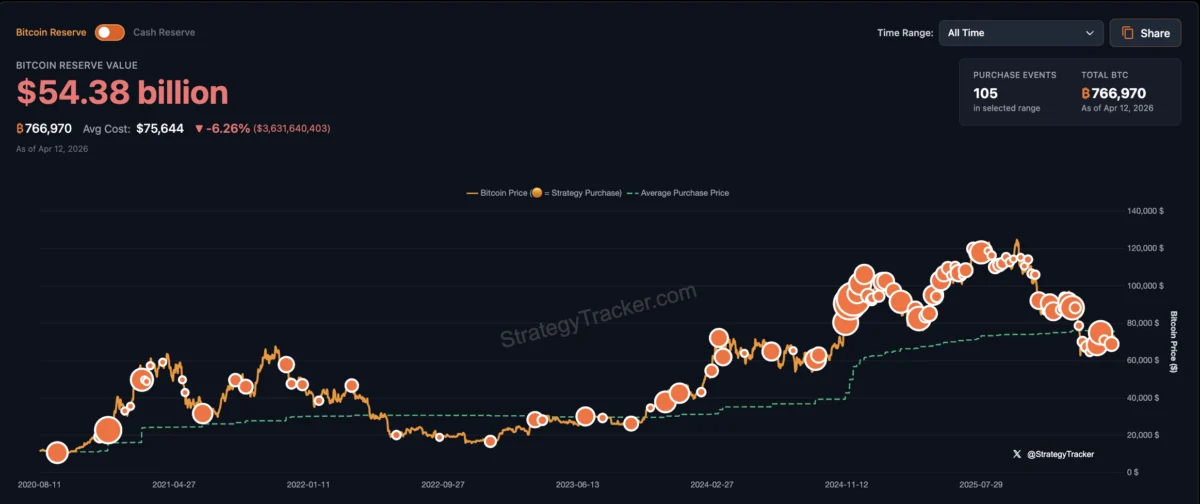
MicroStrategy’s most recent publicly disclosed Bitcoin purchase occurred on April 6, 2026, when the company acquired an impressive 4,871 BTC for more than $329.8 million. This acquisition propelled their total Bitcoin holdings to an astonishing 766,970 BTC, an amount that, at the time of publication, was valued at approximately $54.5 billion based on prevailing market prices, according to data compiled by SaylorTracker. This relentless accumulation strategy has seen MicroStrategy not only weather but actively leverage periods of market downturns. Indeed, the company continued to bolster its Bitcoin reserves even amidst a protracted bear market that had, at one point, pushed Bitcoin’s price down to two-year lows, temporarily placing MicroStrategy’s extensive BTC treasury underwater. This steadfast approach distinguishes MicroStrategy from many corporate entities, solidifying its reputation as one of the most dedicated institutional proponents of Bitcoin.
The financial implications of this strategy are significant and closely watched by investors. MicroStrategy’s average cost of acquisition for its vast Bitcoin holdings currently stands at $75,644 per BTC. This figure, at the time of this writing, is nearly $5,000 higher than the current market price, resulting in considerable unrealized losses on its balance sheet. For the first quarter of 2026, the company reported an estimated unrealized loss of nearly $14.5 billion on its Bitcoin holdings, as detailed in a filing with the US Securities and Exchange Commission (SEC) on April 6, 2026. However, Saylor and MicroStrategy view these figures through a long-term lens, asserting that such fluctuations are transient and do not diminish Bitcoin’s fundamental value proposition as a hedge against inflation and a foundational digital asset. The firm’s commitment to its strategy is evident in its continued accumulation, often funded through sophisticated financial engineering, including convertible note offerings and stock sales, which allow it to acquire Bitcoin without directly impacting its operational cash flow. This leveraged bet on Bitcoin has transformed MicroStrategy’s stock (MSTR) into a de facto Bitcoin ETF for many investors, closely tracking the cryptocurrency’s performance.

MicroStrategy’s aggressive accumulation strategy has profound implications for the broader Bitcoin ecosystem, particularly concerning supply dynamics. The company’s purchasing pace far outstrips the rate at which new Bitcoin is introduced into circulation by miners. In March 2026 alone, while Bitcoin miners collectively produced approximately 16,200 BTC, MicroStrategy astonishingly accumulated 46,233 BTC during the same period – nearly three times the newly mined supply. This disparity fuels the narrative of a potential Bitcoin supply squeeze, a scenario where increasing demand from institutional players like MicroStrategy and the newly launched spot Bitcoin ETFs, coupled with a constricting supply, could lead to significant price appreciation. The upcoming halving event, which further reduces the block reward for miners and thus the rate of new Bitcoin creation, is expected to exacerbate this supply-demand imbalance, reinforcing Saylor’s long-held belief in Bitcoin’s scarcity-driven value.
Saylor has articulated a evolving perspective on Bitcoin’s market dynamics, stating in April 2026, “The global consensus is that BTC is digital capital. The four-year cycle is dead. Price is now driven by capital flows. Bank and digital credit will determine Bitcoin’s growth trajectory.” This statement marks a departure from the traditional understanding of Bitcoin’s price movements, which historically have been characterized by distinct four-year cycles often tied to the halving events. Saylor’s assertion underscores his belief that the increasing institutional adoption, the proliferation of spot ETFs, and the integration of Bitcoin into mainstream financial products are fundamentally altering its market structure. He posits that large-scale capital flows from sovereign wealth funds, corporations, and institutional investors, rather than retail speculation, will be the primary determinants of Bitcoin’s future growth, positioning it as a strategic asset in global finance.
MicroStrategy’s 766,970 BTC reserve unequivocally establishes it as the largest publicly traded corporate holder of Bitcoin by a significant margin, according to BitcoinTreasuries. To put this into perspective, the next largest corporate holder, Twenty One Capital, holds a comparatively modest 43,514 BTC, illustrating MicroStrategy’s unparalleled commitment and dominance in this niche. This leadership position is not merely about volume; it’s a testament to Saylor’s unwavering conviction in Bitcoin’s long-term potential, a conviction that has allowed MicroStrategy to buck the prevailing trends during challenging market conditions.

Indeed, MicroStrategy’s strategy stands in stark contrast to that of other Bitcoin treasury companies and industry players who have shown signs of capitulation or diversification amid a challenging business environment. For instance, MARA Holdings (Marathon Digital), a major Bitcoin mining company, undertook a substantial strategic shift in March 2026. It sold 15,133 Bitcoin for approximately $1.1 billion, using the proceeds to repurchase $1 billion of zero-coupon convertible notes at a discount. Chairman and CEO Fred Thiel commented that this transaction significantly enhanced the company’s “financial flexibility” and increased its “strategic optionality” as MARA expands “beyond pure-play Bitcoin mining into digital energy and AI/HPC infrastructure.” This move by Marathon Digital highlights a divergence in corporate strategies: while some companies are diversifying their assets and operational focus, MicroStrategy remains singularly and aggressively dedicated to Bitcoin as its primary treasury asset. This distinction further solidifies MicroStrategy’s unique position in the corporate landscape, representing an undiluted bet on Bitcoin’s future. The company’s bold stance continues to position it as a bellwether for institutional adoption, attracting both fervent supporters and skeptical critics, yet undeniably influencing the trajectory of Bitcoin’s integration into the global financial system.