Faris Adani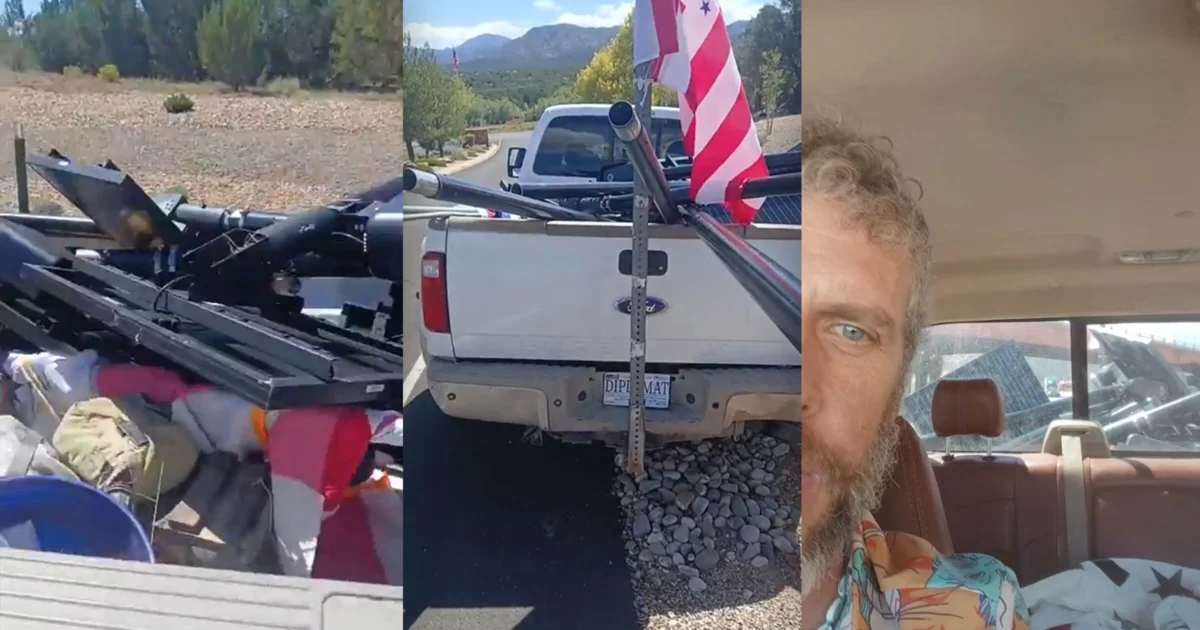
The streets of Albuquerque recently witnessed an extraordinary act of civil disobedience when Jevon Martinez, a local activist, drove his pickup truck, brimming with uprooted automatic license plate readers (ALPRs) manufactured by Flock Safety, directly to the Bernalillo County Sheriff’s Department headquarters, an audacious move that culminated in his arrest but ignited a broader conversation about surveillance technology and citizen rights. Weeks after Bernalillo County officials had announced the termination of their contract with Flock Safety, a decision reportedly influenced by growing public apprehension over privacy implications and the efficacy of the surveillance network, Martinez observed that many of the controversial ALPR cameras remained operational, seemingly left in limbo despite the official cancellation. These ALPR systems, often mounted on poles or traffic lights, are designed to automatically scan and record license plate information from passing vehicles, feeding that data into extensive databases accessible by law enforcement, a capability touted by Flock Safety as a powerful tool for crime prevention and solving. However, for many, including Martinez, these ubiquitous digital eyes represent a creeping encroachment on personal privacy, transforming public spaces into a constant surveillance zone where every movement is tracked and recorded, often without individual consent or specific cause.
Flock Safety, a rapidly expanding surveillance company, has positioned itself as a leader in providing "real-time crime solutions" to communities across the United States, marketing its ALPR cameras as crucial deterrents against various forms of criminal activity, from stolen vehicles to more serious offenses. The company’s pitch often highlights features like its AI-powered capabilities to identify vehicle types, colors, and even missing hubcaps, creating a comprehensive digital fingerprint of every car that passes by its sensors. Proponents argue that such technology is invaluable for swift investigations, allowing law enforcement to quickly piece together vehicle movements linked to criminal incidents, thereby enhancing public safety. However, critics, including privacy advocates and organizations like the ACLU, have consistently raised alarms about the vast databases of sensitive location data that Flock Safety and similar companies collect and retain, often for extended periods. Concerns range from the potential for misuse of this data, such as tracking activists or vulnerable populations, to the inherent bias in algorithms, and the fundamental erosion of anonymity in public life. The lack of robust oversight, clear data retention policies, and transparency regarding data sharing agreements has further fueled public distrust, turning what some see as a public safety tool into a symbol of intrusive governmental reach.
In Bernalillo County, the debate surrounding Flock Safety’s ALPRs had reached a boiling point earlier in the year, culminating in Sheriff John Allen’s decision to sever ties with the company. While the exact reasons for the cancellation were multifaceted, reports from local media like KOB4 suggested a combination of factors, including public outcry, questions about the cost-effectiveness of the system, and perhaps even internal disagreements regarding its implementation and necessity. Many residents had expressed profound discomfort with the idea of their movements being continuously logged and stored, perceiving it as a disproportionate response to local crime rates and a dangerous precedent for a surveillance state. Despite the contract’s termination, the physical infrastructure of Flock cameras remained scattered across the county, silent sentinels that continued to represent the very intrusion the community had rejected. It was this lingering presence that spurred Jevon Martinez to action, transforming him from a concerned citizen into an outspoken and highly visible resistor.
Martinez, whose prior activism suggested a deep-seated belief in individual liberties, saw the abandoned cameras not as forgotten relics, but as symbols of an unresolved conflict, a continued threat to the community’s autonomy. "Since [Bernalillo County Sheriff’s Department] is busy — I know BCSO is busy, everyone who works for BCSO, I know you guys are busy, so I went ahead and helped you out," Martinez quipped in one of a series of videos he subsequently posted to social media, including Facebook. These videos, quickly flagged by KOB4, provided a raw and unfiltered chronicle of his self-appointed mission. Donning a determined demeanor, Martinez filmed himself systematically dismantling the camera towers, pulling them from their concrete moorings, and loading the bulky components into the bed of his pickup truck. The accompanying image, likely a still from one of his social media posts credited to "Johnvon Thechamp via Facebook," vividly captures the scene: a rugged pickup truck, its bed conspicuously overflowing with the metallic remnants and electronic guts of several uprooted Flock cameras, a stark visual testament to his defiant labor.
His actions were not clandestine or furtive; quite the opposite. Martinez actively documented his efforts, turning his dismantling spree into a public spectacle and a direct challenge. In another video, his truck bed crammed to capacity with the detritus of surveillance, he declared, "We got a bunch of these bad boys. Let’s see how much I can get in one day. That’s gonna be the challenge for everyone out there." This statement was not merely a boast but an open invitation, an attempt to galvanize others to join his cause, to reclaim their public spaces from the watchful gaze of automated eyes. He framed his mission in overtly ideological terms, asserting, "Is this a crime? I don’t think so. Neither does the public. I’m just liberating my people from tyranny." This rhetoric resonated deeply with a segment of the population wary of government overreach and the accelerating pace of technological surveillance, positioning Martinez as a modern-day folk hero, a sentiment echoed by news outlets like Futurism, which highlighted how "People Taking Down Flock Towers Are Becoming Folk Heroes, With Communities Circling to Protect Them."
The culmination of Martinez’s audacious project came when he drove his literal truckload of surveillance equipment directly to the Bernalillo County Sheriff’s Department headquarters. His intent, as he presented it, was to "return" the property to its rightful, if neglectful, owners. However, the authorities did not interpret his actions as a helpful gesture. Instead, they met his arrival with a significant and dramatic show of force. Deputies, clad in ballistic-resistant plate carriers and with weapons drawn, swiftly surrounded Martinez’s vehicle, creating a tense standoff. Despite Martinez being unarmed and having committed no violent offense, the officers adopted a confrontational posture, ultimately forcing him out of his truck and into handcuffs. The visual spectacle of heavily armed officers apprehending a man who claimed to be merely returning discarded property raised immediate questions about proportionality and the perception of threats, further highlighting the deep chasm between citizen activism and law enforcement’s interpretation of public order.
Martinez was promptly taken into custody, likely facing charges related to vandalism, theft, or criminal damage, though the specific charges were not immediately detailed in initial reports. The legal ramifications of his actions are complex, situated at the intersection of property law, public protest, and the contentious domain of surveillance technology. While his supporters view him as a champion of privacy rights engaging in a legitimate act of civil disobedience against an intrusive system, authorities are likely to frame his actions as unlawful destruction of property, regardless of the property’s controversial nature or its official abandonment. This incident, therefore, becomes a crucial test case, not just for Martinez, but for the broader legal and ethical frameworks governing citizen resistance to perceived governmental overreach in the digital age. The potential for a jury to sympathize with his motivations, or for prosecutors to pursue charges aggressively, will undoubtedly shape public discourse and influence future acts of defiance.
Jevon Martinez’s bold act in Albuquerque is more than an isolated incident; it is a potent symbol within a growing, national movement challenging the pervasive spread of surveillance technologies like ALPRs. From community meetings debating privacy ordinances to organized efforts to block the installation of new cameras, citizens are increasingly asserting their right to live free from constant digital monitoring. Martinez’s direct confrontation with the instruments of surveillance, followed by his equally direct confrontation with law enforcement, encapsulates the escalating tensions between the desire for public safety, the imperative for individual privacy, and the unchecked proliferation of technology. As companies like Flock Safety continue to expand their footprint, incidents like these serve as powerful reminders that technology does not operate in a vacuum; it is embedded within a social and political context, and its implementation will inevitably face scrutiny, resistance, and acts of profound, symbolic defiance from those who believe their fundamental rights are at stake. Martinez’s journey, from activist to "folk hero" to arrestee, thus becomes a microcosm of the ongoing struggle to define the boundaries of surveillance in an increasingly digitized world.