Faris Adani
Jetson
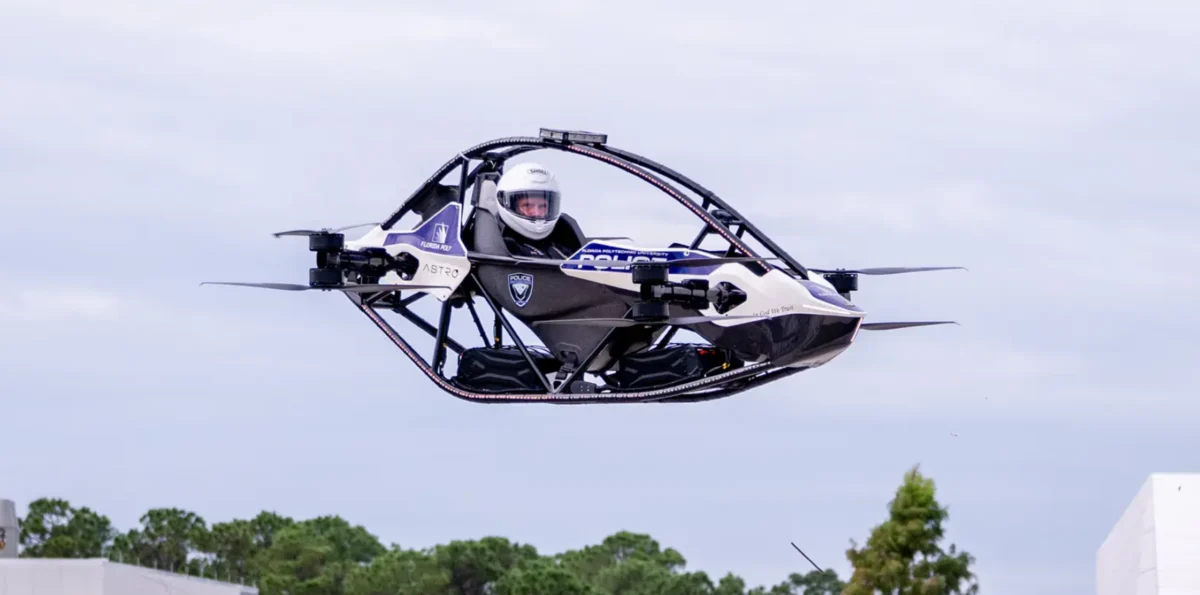
Florida Police Show Off Incredibly Tiny and Goofy Quadcopter That Fits Exactly One Cop at a Time. In an era increasingly defined by the pervasive gaze of advanced surveillance technology, where police forces nationwide are augmenting their capabilities with military-grade imaging drones, AI-integrated surveillance towers, and automatic license plate readers, a peculiar acquisition by a university police department in Florida has sparked widespread bewilderment and critical scrutiny. Florida Polytechnic University, in collaboration with its campus police department and Swedish aerospace firm Jetson, has unveiled the “Astro,” a single-occupant electric vertical take-off and landing (eVTOL) quadcopter, costing a staggering $150,000, which critics are quick to label as an absurd, if not entirely impractical, addition to law enforcement’s high-tech arsenal.
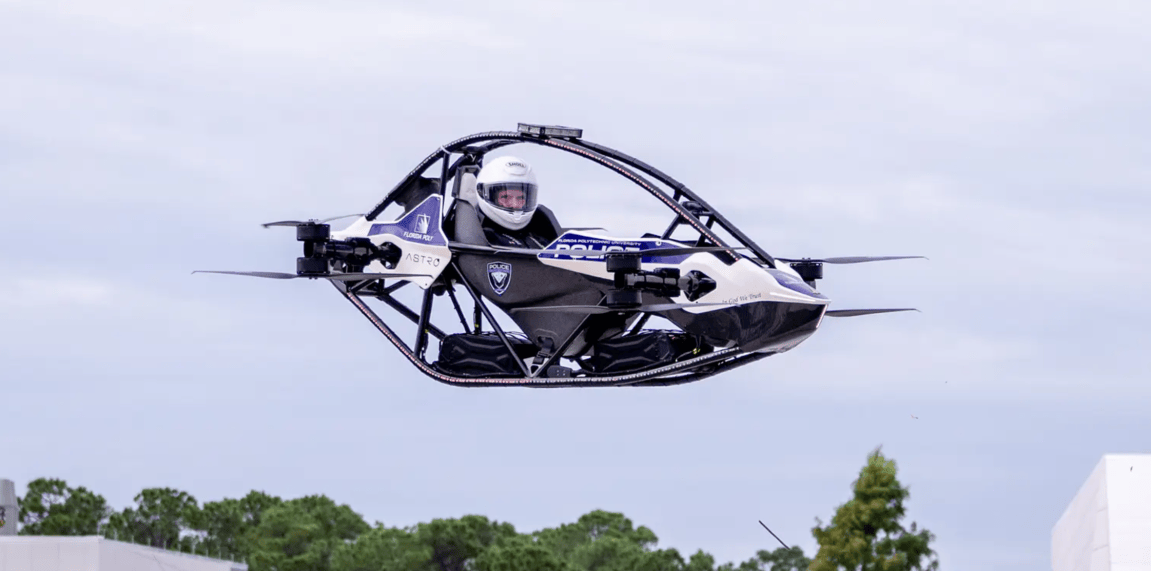
The “Astro,” originally known as the “Jetson ONE,” presents a striking, almost comical, figure. Footage from local station *Fox13* showcases the vehicle in its official police livery: a sleek black and white frame adorned with police decals and a disproportionately small light bar, giving it the appearance of a futuristic toy rather than a serious piece of law enforcement equipment. This personal flying machine, designed to carry just one officer, stands in stark contrast to the more robust and versatile aerial assets typically deployed by modern police forces. The question on many minds is not just *how* it flies, but *why* it was deemed a necessary investment for a university campus.
Delving into the technical specifications of the “Astro” only deepens the skepticism surrounding its practical utility. Without its battery or a pilot, the vehicle weighs a modest 154 pounds. However, its operational limitations are significant: a maximum flight time of just 20 minutes and a top speed clocking in at just under 65 mph. These figures paint a picture of severe constraints for any realistic police operation. A mere 20-minute flight duration means extremely limited patrol capabilities, requiring frequent returns to base for recharging, which can take considerably longer than the flight itself. This drastically curtails its ability to conduct sustained surveillance, pursue suspects over any meaningful distance, or provide continuous support during an incident. Furthermore, its single-occupant design means no space for a partner, essential equipment beyond the pilot’s person, or the transport of individuals, rendering it effectively useless for critical police functions like arrests or victim transport. Adding another layer of concern, the vehicle has yet to receive official approval from the Federal Aviation Administration (FAA), raising questions about its legality for routine operational use and the safety implications of deploying an uncertified aircraft in public airspace.
The acquisition appears even more puzzling when considering the existing technological capabilities of the Florida Polytechnic University Police Department and the nature of crime on campus. The department already boasts a fleet of at least five surveillance drones, some equipped with advanced thermal imaging sensors, providing ample aerial observation capabilities. These drones offer longer flight times, greater versatility, and the ability to operate without risking a human pilot, all at a fraction of the cost of the “Astro.” Moreover, official police records for Florida Polytechnic reveal a campus environment far from a high-crime hotspot. In 2025, the most common offense reported was “liquor law referral,” totaling a mere 13 incidents for the entire year. This low crime rate, coupled with existing, more practical surveillance technologies, makes the $150,000 investment in a single-person, short-duration flying vehicle difficult to justify as a critical public safety enhancement.
The public’s reaction on social media was swift and largely derisive, reflecting the common-sense skepticism many hold about such seemingly ill-conceived projects. One user quipped, “Whoever said ‘when pigs fly’ I have great news for you,” perfectly encapsulating the incredulity. Another questioned, “I’ll be real I’m lost on the utility of this in any capacity. For searching how is an army of drones with video not better lol.” The sentiment was clear: the vehicle’s practical applications for campus security seemed negligible compared to its cost and limitations. Critics were quick to draw parallels to historical follies in aviation, specifically the US Army’s ill-fated “Hiller Flying Platforms” of the 1950s—an equally dubious hovercraft vehicle that, despite its initial futuristic appeal, ultimately failed due to practical constraints, cost, and limited utility. The “Astro” seems to echo this historical pattern of technological exuberance overshadowing functional necessity.
Despite the obvious practical shortcomings, officials involved offered a rhetoric-heavy defense of the purchase. Florida Polytechnic’s police chief, Aaron Murray, stated, “Advanced air mobility is a technology on the rise, and we can either choose to be proactive or reactive as it develops. We want to stay at the forefront of this technology and understand how it can be used to advance public safety and airspace safety altogether.” While the sentiment of embracing innovation is understandable, such vague pronouncements do little to address the specific utility of *this particular* vehicle for *this particular* police department. The language suggests a desire to be seen as cutting-edge, perhaps driven more by public relations or research opportunities than by an identified, pressing operational need. Similarly, Stéphan D’haene, CEO of Jetson, framed the purchase as a “powerful validation” for his company’s progress, emphasizing “operational deployment, institutional acceptance and the development of future aviation talent.” This perspective highlights the manufacturer’s goal of establishing a new category of personal aviation, effectively using the university’s police department as a high-profile test bed and marketing tool, rather than focusing on the immediate practical benefits for law enforcement.
This episode also fits into a broader, ongoing trend of increasing militarization and technological saturation within US police departments. From sophisticated body cameras and facial recognition software to armored vehicles and advanced drones, law enforcement agencies are increasingly adopting technologies that blur the lines between civilian policing and military operations. While some of these tools offer undeniable benefits, the rush to acquire the latest gadget often raises questions about necessity, cost-effectiveness, and potential for over-policing or privacy infringements. The $150,000 spent on the “Astro” represents a significant opportunity cost. That sum could have been allocated to a myriad of other campus safety initiatives: increasing foot patrols, investing in better lighting and security infrastructure, expanding mental health support for students, funding community engagement programs, or even purchasing more conventional, multi-purpose patrol vehicles. The decision to prioritize an experimental, single-use eVTOL over these more established and arguably more impactful solutions invites scrutiny into the department’s strategic planning and fiscal responsibility.
While the “Astro” in its current iteration seems more of a novelty than a game-changer, the broader concept of eVTOLs for public safety does hold future potential. Imagine multi-passenger, longer-range, all-weather capable flying vehicles that could rapidly respond to emergencies in congested urban areas, provide aerial command and control, or assist in search and rescue missions over challenging terrain. However, the path to such capabilities is fraught with regulatory hurdles, technological advancements, and infrastructure development that are still years, if not decades, away. The “Astro” appears to be a premature and under-specified attempt to leap into this future, without fully addressing the fundamental requirements for effective law enforcement operations. It serves as a stark reminder that while technological innovation is exciting, its practical application, especially in critical public services, must be carefully considered against actual needs, cost, and existing, more effective alternatives. Ultimately, the Florida Polytechnic University Police Department’s new flying machine, despite its futuristic appeal, stands as a curious testament to the allure of advanced technology, even when its utility remains firmly grounded in question.