
 isnaini azizah
My anticipation for the film was tinged with a degree of apprehension, having deliberately steered clear of spoilers and acknowledging the extensive media saturation surrounding the Theranos saga. The story has already been dissected through countless articles, the gripping bestseller Bad Blood, and the critically acclaimed Hulu series The Dropout, starring Amanda Seyfried. The question lingered: what fresh insights could a documentary possibly offer? As it turns out, the film provided not just a recounting of events, but a visceral experience that left me unsettled, not solely by the details of Holmes’s elaborate fraud or the unsettling dynamics between the subjects, but by a deeper, more fundamental truth about the limitations inherent in observing and reporting on scientific progress.
For those needing a refresher, Elizabeth Holmes’s trajectory began in 2003 when, at the tender age of 19, she famously dropped out of Stanford University to found Theranos, a diagnostics company. Her audacious claim was that Theranos had developed revolutionary technology capable of performing over 100 diagnostic tests using merely a few drops of blood. This bold assertion, coupled with Holmes’s charisma and vision, attracted significant investment. By 2014, Theranos was valued at an astonishing $9 billion, and Forbes heralded Holmes as the youngest self-made female billionaire, with her net worth soaring to $4.5 billion by the time she was just 30.
The cracks in this seemingly impenetrable facade began to appear in 2015. A pivotal investigation by The Wall Street Journal, spearheaded by reporter John Carreyrou, unearthed disturbing accounts from former Theranos employees. These insiders revealed that the company’s proprietary diagnostic tests were unreliable, and that the vaunted Theranos device had not undergone adequate testing. Even more damning was the revelation that blood samples were, in fact, being analyzed using machines from other companies, a stark contradiction to Holmes’s public pronouncements. This exposé led MIT Technology Review to recognize Theranos as one of the most significant technological failures of 2015.
The consequences for Theranos and Holmes were swift and severe. By 2016, Forbes had drastically revised Holmes’s net worth to zero. That same year, a damning government report detailed the company’s lab’s struggles with fundamental procedures, highlighting instances where patients received inaccurate results even when the company knew them to be erroneous. The unraveling culminated in 2018 when Theranos, along with Holmes and former company president Ramesh Balwani, were formally charged with "massive fraud" by the Securities and Exchange Commission. In 2022, Holmes was sentenced to over 11 years in prison for defrauding investors, and she commenced her sentence in May 2023.
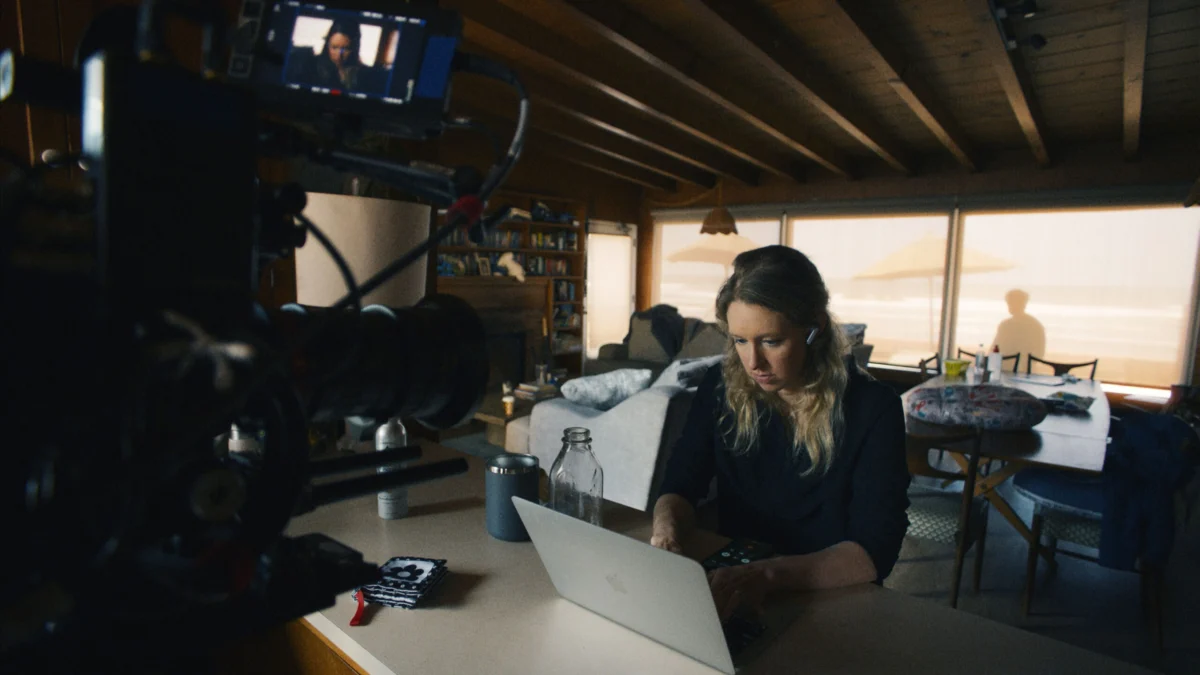
It was approximately a month before Holmes began her prison term that filmmakers Nathan Fielder, Lance Oppenheim, and their collaborators gained unprecedented access to document Holmes and her partner, Billy Evans, in their home, alongside their two young children. The resulting film offers an exceptionally intimate portrayal, particularly in its depiction of the interactions between Holmes, Evans, and Fielder, who himself becomes a central figure in the narrative. As the film’s trailer foreshadows, the documentary is replete with extreme close-ups, creating an almost claustrophobic sense of proximity. For much of the screening, I felt as though I was staring directly into the faces of these individuals, witnessing their palpable attempts to decipher one another. Holmes, notorious for her deceit, had seemingly invited the cameras into her private life in a strategic bid to reshape her public image, presenting herself as an honest individual with a unique intellect. The lingering question for the audience, and perhaps for Fielder himself, was whether this narrative would resonate.
During the film, I found myself grappling with a sense of empathy for Holmes, particularly as she prepared to leave her two young children for an extended prison sentence. Despite my awareness of the factual transgressions, Holmes’s capacity for manipulation was undeniably potent. The documentary vividly illustrates her ability to sow seeds of doubt in Fielder’s mind, and at times, even I, an observer in the darkened cinema, felt a flicker of her persuasive power. Could it be that her intentions were not entirely malicious?
This internal debate was quickly tempered by the recollections of other journalists who had been similarly captivated by Holmes’s charisma. Roger Parloff of Fortune reflected in 2015, a year after profiling Holmes and Theranos, "I blew it. I’m pretty sure she lied to me." Matthew Herper of STAT, who interviewed Holmes in 2015, recently wrote, "I’m pretty sure she lied to me." Even Tyler Shultz, the former Theranos employee turned whistleblower who was acutely aware of the company’s product failures, admitted in 2022 that a mere five-minute conversation with Holmes could leave him feeling as though his work was "changing the world." These accounts serve as a potent reminder of Holmes’s persuasive capabilities, even to those who possessed insider knowledge.
I did not cover the Theranos story extensively during the 2010s. The question inevitably arises: if I had interviewed Holmes under similar circumstances, would I too have fallen prey to her carefully constructed narrative? This introspection leads back to a critical element that was conspicuously absent in the Theranos case: the lack of published, peer-reviewed data. A significant portion of Theranos’s work was classified as a "trade secret," a shroud that prevented external scientific scrutiny.
The scientific community traditionally relies on the rigorous process of publication in peer-reviewed journals. This method involves submitting research findings to anonymous experts in the field for evaluation. These reviewers provide critical feedback, identify potential flaws in methodology or interpretation, and often request clarifications. The goal of peer review is to ensure the accuracy, validity, and rigor of scientific findings before they are disseminated to a wider audience. The assumption is that published scientific papers represent a degree of trust and verification.
However, the reality is that the system is not infallible. Scientists, like all humans, are prone to error and, at times, to intentional misconduct. Some may exaggerate their results, overstate their significance, or even manipulate data to support a preconceived hypothesis. While peer review is designed to catch such infractions, it is not a foolproof mechanism. Numerous scientific findings have subsequently proven irreproducible by other laboratories, collapsing under the weight of contradictory evidence. Many published papers eventually require corrections, and a significant number are ultimately retracted. In 2023 alone, an estimated 10,000 research papers were retracted, a stark indicator of the challenges in maintaining the integrity of scientific literature.
Furthermore, the landscape of scientific communication is evolving. Many researchers now opt to share their work on preprint servers like arXiv, medRxiv, and bioRxiv before submitting it to traditional journals. While this accelerates the dissemination of findings, these platforms bypass the formal peer-review process. Similarly, company press releases, social media posts, and many conference presentations serve as avenues for sharing scientific information, often without the same level of scrutiny. As a journalist, I frequently glean story ideas from conversations and interviews, a process that inherently involves a degree of trust in the information provided by sources.
I confess that there have been instances where I have encountered a scientific claim and, despite the scientist’s assertion, have questioned the veracity of their findings: How can I be absolutely certain they have achieved what they claim? This inherent uncertainty is a constant companion in science journalism.
I strive to uphold the highest journalistic standards, as do my colleagues at MIT Technology Review. This commitment involves conducting my own form of peer review, seeking the opinions of trusted scientists on new claims before publishing a story. Yet, the film You Can See Everything serves as a potent and unsettling reminder of how easily an appealing narrative can overshadow factual scrutiny. While the vast majority of scientists are, I believe, fundamentally honest, and Holmes undoubtedly represents an extreme outlier, it remains imperative for all of us – scientists, journalists, and the public alike – to critically interrogate the information presented to us. The story of Theranos is a cautionary tale, a stark illustration of the fact that even in the seemingly objective realm of science, what you see is not always what you get, and the most crucial truths can often remain hidden beneath the surface, unseen and unverified.