Faris Adani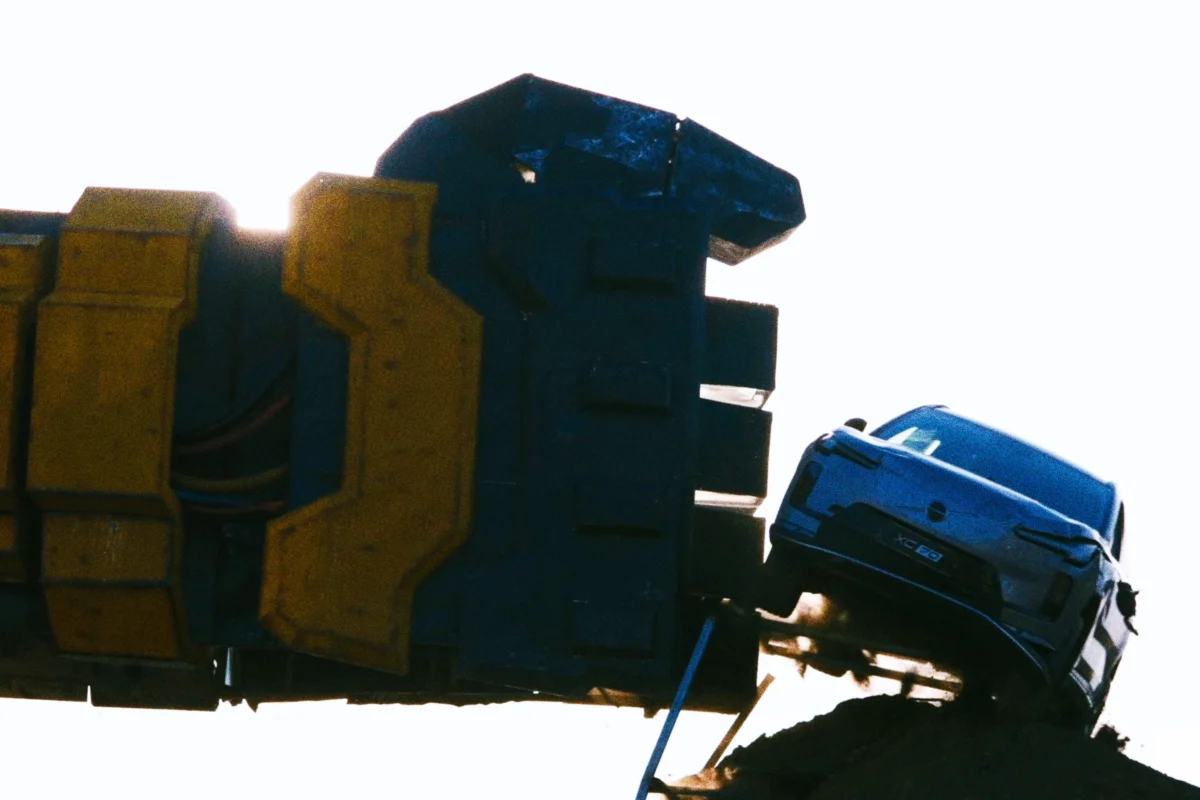
In a breathtaking display of audacious engineering and cinematic flair, Fan Shisan, the Sichuan-based content creator known globally as "Sword man Fan 13," has once again pushed the boundaries of what’s possible in the realm of large-scale DIY projects. Following his viral successes with mesmerizing "flying sword swarms" and gravity-defying "giant sword hoverboards," Fan Shisan has unveiled his latest, most colossal creation: a remote-controlled robot arm, reportedly weighing an astonishing 5.5 tons (5,000 kg). This mechanical marvel, designed with a singular, albeit humorous, purpose – to deliver the "ultimate slap" – has taken center stage in a new video that culminates in the spectacular, if somewhat tragic, destruction of a Volvo XC70.
Fan Shisan has carved a unique niche for himself within the global maker community, blending genuine engineering ingenuity with a showman’s knack for dramatic presentation. His projects are not merely functional; they are theatrical spectacles designed to captivate and entertain. From the intricate choreography of autonomous flying blades that evoke ancient martial arts fantasies to the raw power of personal transport devices seemingly ripped from a cyberpunk future, Fan’s work consistently demonstrates a mastery of fabrication, control systems, and viral content creation. His latest endeavor, the giant robot arm, serves as a testament to this distinctive blend, merging brute force mechanics with remote-controlled precision for maximum visual impact.
"I built a 5,000 kg [5.51 ton] giant robot arm just to see if my friend could survive the ultimate slap!" Fan enthusiastically declares in the video description. This bold, tongue-in-cheek premise sets the stage for a series of increasingly destructive demonstrations. "This beast is fully articulated and ready for action. Watch until the end to see the massive uppercut that literally shocked everyone. This is the most insane DIY engineering project I’ve ever filmed!" His words perfectly encapsulate the blend of ambition, humor, and raw power that defines his work.
The initial glimpses of the colossal robot arm reveal a meticulously crafted, industrial-grade mechanism. Fixed to what appears to be a robust, rotating base, the arm boasts four articulating fingers and a movable thumb, all controlled remotely by Fan using a custom-built, hand-mounted controller. This interface likely employs a sophisticated master-slave system, translating the subtle movements of Fan’s own hand into the powerful, scaled-up gestures of the giant arm. The sheer scale of the components – heavy-gauge steel, powerful hydraulic actuators, and what must be an equally robust power supply – speaks volumes about the engineering effort involved. The ability to articulate individual digits on such a massive scale is a significant technical achievement, showcasing a command of both mechanical design and complex control systems.
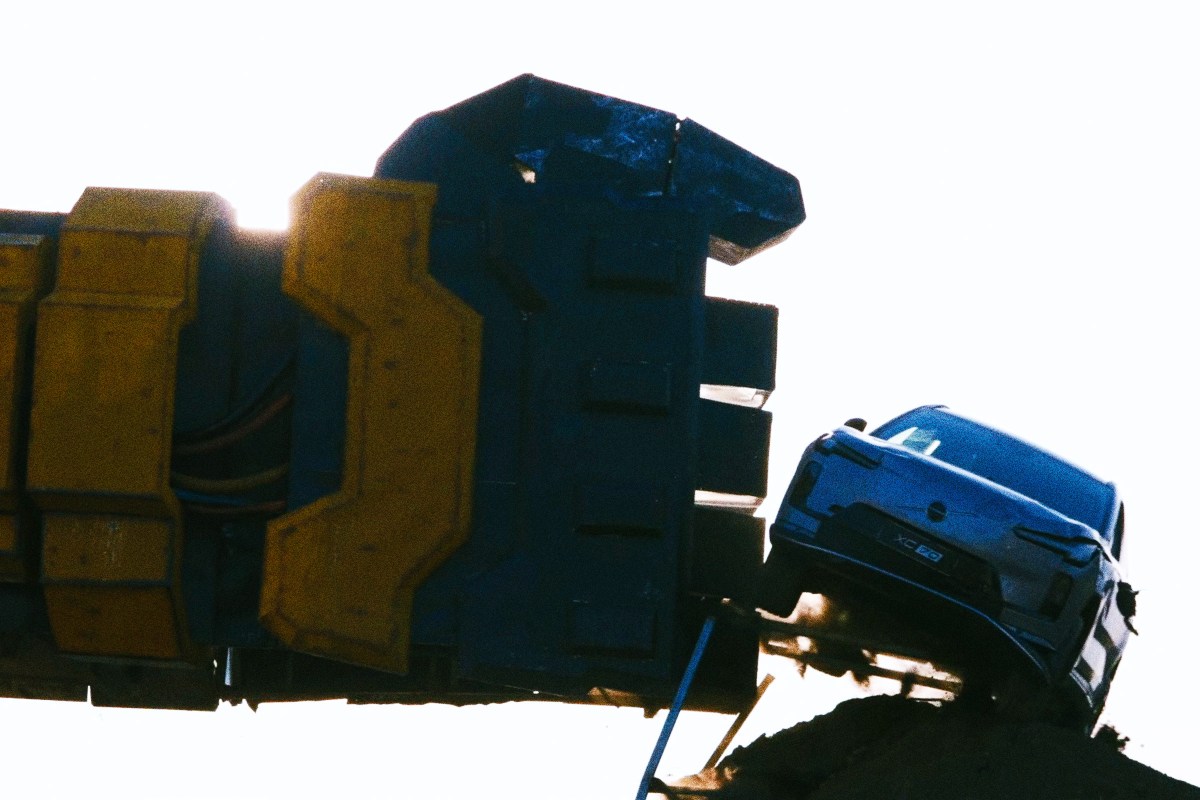
The video begins with the arm’s "warm-up" phase, demonstrating its dexterity and power by delivering a series of dramatic blows. In one particularly striking sequence, the massive appendage swings with incredible force, slapping a sturdy Volvo XC70. The impact is so profound that it visibly rattles the vehicle and, in a fascinating detail, automatically triggers the car’s emergency SOS mode – a stark reminder of the force being wielded, even if the cinematic speed-up enhances the drama. This initial demonstration serves as a powerful proof-of-concept, establishing the arm’s capability to exert significant, car-damaging force.
As Fan declares, "We are just getting warmed up," the video escalates. The arm is shown detached from its rotating base, now seemingly operated by a combustion engine, hinting at a more mobile or self-contained power source. This transition allows for an even more direct and devastating assault on the Volvo. The sheer audacity of a machine of this scale being manipulated in such a manner is captivating. While the exact mechanics of its mobility in this segment are not fully revealed, the presence of a combustion engine strongly suggests a hydraulic pump system, providing the immense power required for rapid, forceful movements independent of a fixed external power source.
The climax of the video involves a series of "uppercuts" that send the long-suffering Volvo careening down a hill. Here, the line between raw engineering and "movie magic" becomes delightfully blurred. While the arm’s destructive power is undeniable, achieving such dynamic shots likely involved a clever combination of practical effects and careful staging. Redditors and engineering enthusiasts have speculated on various methods, from the arm being suspended from a hidden crane, functioning as a controlled battering ram, to the use of winches or pre-set tracks to guide the car’s trajectory post-impact. Regardless of the precise techniques employed, the result is undeniably spectacular: a luxury SUV transformed into a crumpled wreck, its windows shattered and chassis mangled like a discarded toy.
The Volvo’s ultimate fate – totaled, crushed, and virtually unrecognizable – serves as a dramatic conclusion to Fan Shisan’s latest engineering odyssey. This project, more than just a demonstration of brute force, is a fascinating case study in large-scale prop building, remote control technology, and viral content creation. While the arm’s primary function is entertainment, the underlying engineering principles – structural integrity for immense loads, robust hydraulic or pneumatic systems, and precise control interfaces – are far from trivial. Building a fully articulated, 5.5-ton mechanism requires a profound understanding of mechanics, materials science, and systems integration.
Fan Shisan’s work also highlights a vibrant and increasingly influential trend within China’s DIY and maker communities. Across platforms like Bilibili, Kuaishou, and Douyin (TikTok), a plethora of creators are showcasing incredible feats of engineering, often with limited resources but boundless ingenuity. These creators, much like Fan, are driven by a passion for invention, a desire to challenge conventional limits, and the potent allure of viral recognition. They represent a new generation of inventors who are not confined to traditional laboratories or industrial settings, but who instead leverage readily available materials, open-source knowledge, and social media to bring their wildest ideas to life.
The global appeal of Fan Shisan’s videos lies in their ability to tap into a universal fascination with power, destruction, and human ingenuity. There’s an undeniable thrill in watching a mundane object like a car meet its end at the hands (or rather, the giant robot hand) of a human-controlled Goliath. It’s a primal spectacle, filtered through the lens of modern technology and viral media. While Fan’s creations might not have immediate industrial applications in the same way a factory robot does, they serve a different, equally valuable purpose: to inspire, to entertain, and to demonstrate the incredible potential of human creativity when coupled with a willingness to experiment on a grand scale.
In contrast to precision-driven industrial robots designed for repetitive tasks, or complex research robots pushing the boundaries of AI and autonomous navigation, Fan Shisan’s robot arm is a celebration of raw, unadulterated power and mechanical spectacle. It’s a magnificent prop, yes, but one built with serious engineering prowess. It reminds us that innovation isn’t always about efficiency or utility; sometimes, it’s about the sheer joy of creation, the ambition to build something impossibly grand, and the thrill of sharing that marvel with the world. Fan Shisan continues to cement his legacy as a master of the colossal and the captivating, leaving audiences to wonder what impossible feat of engineering he will unveil next, and which unsuspecting object will face his next "ultimate slap."