isnaini azizah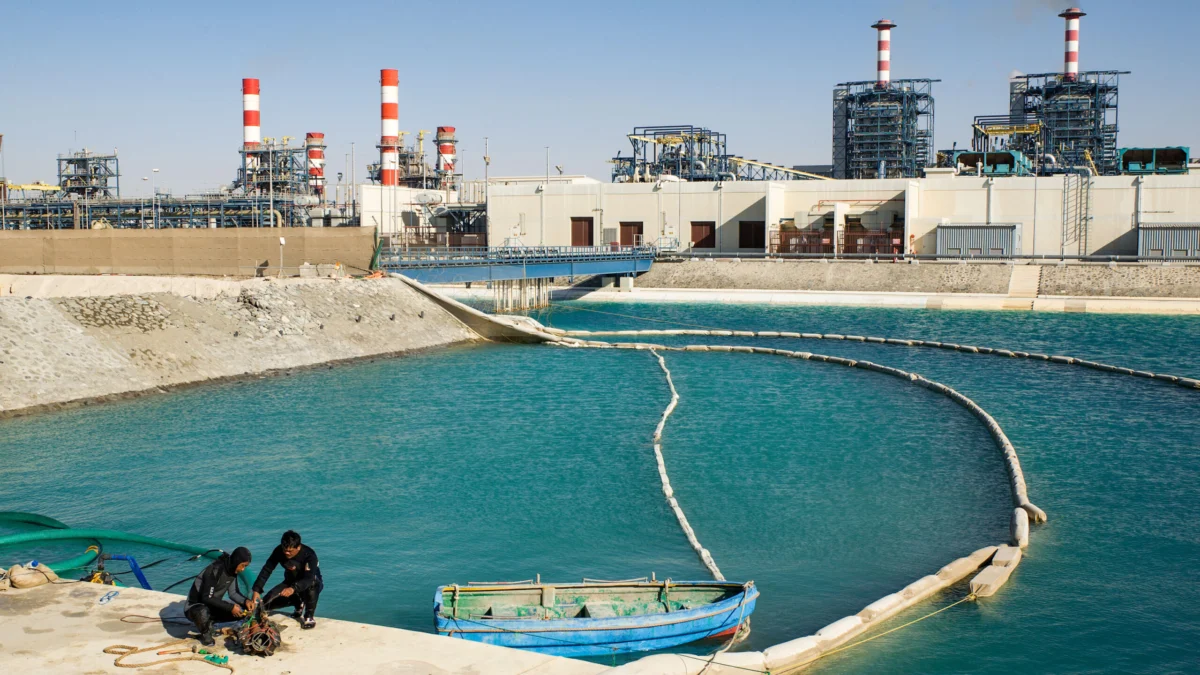
Desalination plants, the critical lifelines for water in the arid Middle East, are increasingly exposed to threats from escalating regional conflicts and the intensifying impacts of climate change. These vital facilities, responsible for transforming saltwater into potable water for millions, are becoming prime targets and vulnerable to environmental disruptions, raising serious concerns about the region’s water security.
The current geopolitical climate has brought the fragility of these essential operations into sharp focus. In early March, Iran’s foreign minister alleged that the United States had attacked a desalination plant on Qeshm Island, located in the strategically important Strait of Hormuz, disrupting water supplies to approximately 30 villages. While the U.S. denied responsibility for the alleged attack, the incident underscored the potential for such infrastructure to become collateral damage or deliberate targets in regional tensions. In the weeks that followed, both Bahrain and Kuwait reported damage to their own desalination facilities, with each nation attributing the attacks to Iran, though Iran again denied involvement.
Adding to these concerns, U.S. President Donald Trump issued a stark warning in late March, threatening the destruction of "possibly all desalination plants" in Iran if the Strait of Hormuz was not reopened. He has since escalated these threats, indicating potential strikes against other crucial civilian infrastructure in Iran, including power plants and bridges.
The Middle East, particularly the Gulf states, relies heavily on desalination technology to meet its water needs for agriculture, industry, and, most critically, drinking water. The mounting attacks and threats highlight the indispensable role of this industry in a region already grappling with severe water stress. Climate change further exacerbates this precarious situation, with rising temperatures and an increase in extreme weather events posing additional risks to these operations.
According to Liz Saccoccia, a water security associate at the World Resources Institute, a staggering 83% of the Middle East is currently experiencing extremely high water stress. Projections indicate this figure could climb to 100% by 2050, highlighting a worsening trend that demands urgent attention.
A Vital Resource with Deep Roots
Desalination technology has been instrumental in providing water supplies across the Middle East since the early 20th century, with its widespread adoption accelerating in the 1960s and 1970s. Two primary categories of desalination plants exist: thermal plants, which utilize heat to evaporate water and leave impurities behind, and membrane-based technologies like reverse osmosis, which force water through specialized membranes that filter out salt and other contaminants.
Historically, early Middle Eastern desalination plants relied on thermal processes, burning fossil fuels to evaporate water. While effective, this method is highly energy-intensive. Over time, filter-based processes, particularly reverse osmosis, have become the dominant choice due to their greater efficiency. While many reverse osmosis plants still depend on fossil fuels, their energy consumption is significantly lower. Since their widespread adoption, membrane technologies have contributed over 15 million cubic meters of daily water capacity, enough to serve millions.
The expansion of desalination capacity has been rapid in recent years. Between 2006 and 2024, Middle Eastern countries collectively invested over $50 billion in building and upgrading desalination facilities, with substantial additional funds allocated to their operation. Currently, nearly 5,000 desalination plants are operational across the region. Future growth is projected to continue, with daily capacity expected to increase from approximately 29 million cubic meters in 2024 to 41 million cubic meters by 2028.
Uneven Vulnerabilities Across the Region
The level of reliance on desalination varies significantly among Middle Eastern nations. Iran, for instance, utilizes desalination for only about 3% of its municipal fresh water, possessing access to groundwater and surface water sources, though these are strained by agricultural demands and drought.
In contrast, Gulf countries – Bahrain, Qatar, Kuwait, the United Arab Emirates, Saudi Arabia, and Oman – possess more limited natural water resources and are thus heavily dependent on desalination. For all but the UAE among these six nations, desalination accounts for over half of their drinking water supply. For Bahrain, Qatar, and Kuwait, this figure exceeds a remarkable 90%.
David Michel, a senior associate in the global food and water security program at the Center for Strategic and International Studies, emphasizes that "The Gulf countries are much, much more vulnerable to attacks on their desalination plants than Iran is." While the sheer number of desalination facilities across the region suggests that the system wouldn’t collapse if a few were disabled, a recent trend toward larger, more centralized plants presents a new vulnerability.
The average desalination plant is now approximately 10 times larger than it was 15 years ago, according to data from the International Energy Agency. The largest plants today can produce up to 1 million cubic meters of water daily, sufficient for hundreds of thousands of people. The shutdown of one or more of these mega-facilities could have a profound impact on the regional water supply.
Escalating Threats to Critical Infrastructure
Desalination facilities are inherently linear, with multiple sequential steps and components. The failure of any single component in this chain can lead to the complete shutdown of an entire facility. Attacks targeting water inlets, transportation networks, and power supplies can also disrupt operations, Michel explains.
Historical precedent illustrates this vulnerability. During the Gulf War in 1991, Iraqi forces intentionally pumped oil into the Gulf, contaminating the water and leading to the shutdown of desalination plants in Kuwait.
Furthermore, the strategic placement of these facilities often places them in close proximity to other conflict targets. Given the significant energy demands of desalination, roughly three-quarters of the region’s facilities are located adjacent to power plants. President Trump’s repeated threats against power plants in Iran heighten the risk of these interconnected infrastructures being targeted. In response, Iran’s military has declared that any attacks on civilian targets would be met with a "much more devastating and widespread" retaliatory strike. International bodies, including the United Nations, the European Union, and the Red Cross, have broadly condemned threats against civilian infrastructure as violations of international law.
Beyond direct conflict, desalination plants face other significant threats. Studies suggest that global warming could lead to more powerful cyclones in the region, and these extreme weather events could force shutdowns or cause equipment damage. Water pollution also poses a substantial risk. Oil spills, whether accidental or intentional, can severely impact desalination operations, as seen in the Gulf War. In 2009, a red algae bloom temporarily closed desalination plants in Oman and the United Arab Emirates for weeks by fouling membranes and blocking water intake from the Persian Gulf and the Gulf of Oman.
Building Resilience for a Water-Scarce Future
Efforts are underway to enhance the resilience of desalination facilities against these growing threats. There is increasing interest in powering these plants, at least partially, with solar energy, which could reduce their dependence on fossil fuels. The Hassyan seawater desalination project in the UAE, currently under construction, is slated to be the world’s largest reverse osmosis plant operating solely on renewable energy.
Another crucial strategy for increasing resilience involves developing more robust strategic water storage systems to meet demand. Qatar, for example, has implemented new policies aimed at improving the management and storage of desalinated water. Collaborative efforts among countries to invest in shared infrastructure and policies could also strengthen the regional water supply.
Preparedness, resilience, and cooperation are paramount for the Middle East as its critical infrastructure, including its water supply, faces escalating threats. Ginger Matchett, an assistant director at the Atlantic Council, warns, "The longer the conflict goes on, the more likely we’ll see significant water infrastructure damage." She expresses concern that "after this war ends, some of the lessons will show how water can be weaponized more strategically than previously imagined." The future security of water in the Middle East hinges on addressing these multifaceted vulnerabilities.