anjir abdul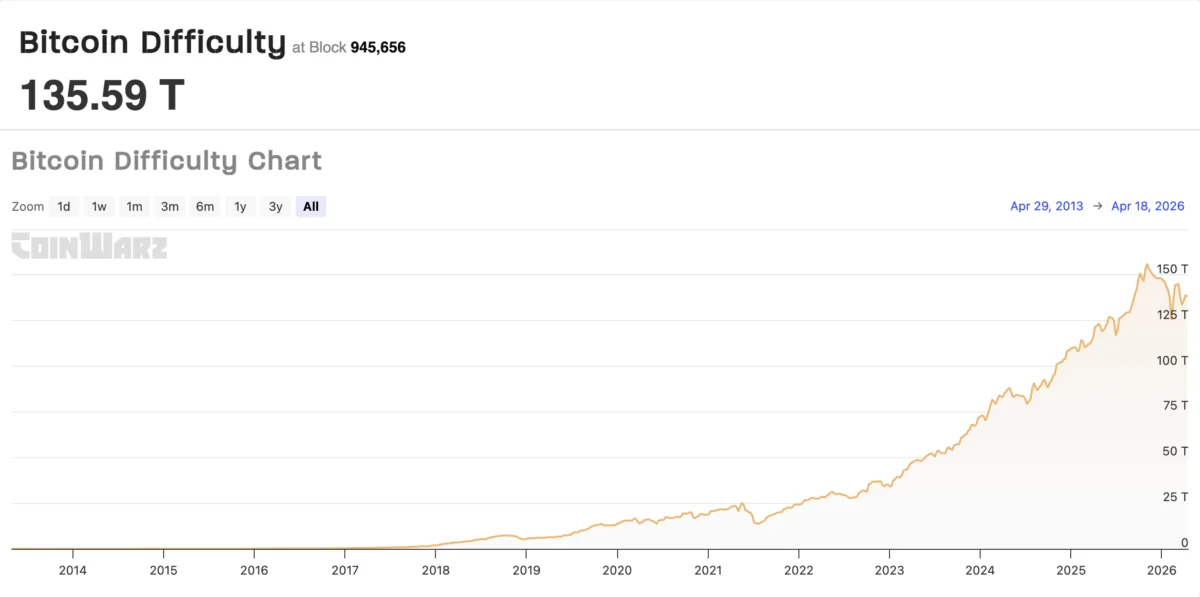
The Bitcoin (BTC) mining difficulty, a crucial metric representing the computational challenge required to add new blocks to the BTC blockchain, experienced a modest but notable decrease on Saturday, settling at approximately 135.5 terahashes (T). This 1.1% dip over the past 24 hours, as reported by CoinWarz, comes amidst a period of significant financial pressure on public mining companies, many of which have been compelled to sell record amounts of their accumulated BTC holdings to cover escalating operational expenses.
This latest adjustment provides a momentary reprieve for miners, making it slightly easier and potentially more profitable in the short term to discover new blocks. Bitcoin’s difficulty adjusts roughly every two weeks (or every 2,016 blocks) to ensure that, on average, a new block is found approximately every 10 minutes. When more miners join the network and the total computational power (hash rate) increases, the difficulty rises to maintain the target block time. Conversely, if miners leave the network or power down their equipment, the hash rate drops, and the difficulty decreases to compensate, preventing block times from becoming excessively long. The current reduction suggests a net decrease in the overall hash rate dedicated to securing the Bitcoin network in the preceding two-week period, indicating that some miners have either gone offline or exited the industry due to unprofitability.
The challenges confronting Bitcoin miners have intensified dramatically over the past year, creating a perfect storm of economic headwinds. The primary drivers include the inherent reduction in block rewards following the April 2024 halving event, which slashed the per-block subsidy by 50%. This structural change significantly reduced miners’ primary revenue stream. Compounding this, a global surge in energy prices, often exacerbated by geopolitical instability and inflationary pressures, has dramatically increased the cost of doing business for energy-intensive mining operations. Furthermore, an extended crypto bear market has suppressed Bitcoin’s price, diminishing the fiat value of the BTC rewards miners do receive. Geopolitical shocks, such as previous crackdowns on mining in certain regions or ongoing regulatory uncertainties, also contribute to an unstable operational environment.
Adding a layer of complexity to this scenario, CoinWarz data also projects that the next Bitcoin difficulty adjustment, estimated to occur around May 1, 2026, will likely see an increase. The projection anticipates the difficulty rising from 135.59 T to 137.43 T, taking place in approximately 1,865 blocks, or about 12 days, 18 hours, and 41 minutes from the time of the initial report. This forward-looking increase suggests that while some miners may have capitulated, others are either bringing more efficient hardware online or the overall network hash rate is expected to rebound, possibly due to a slight recovery in Bitcoin’s price or strategic expansions by well-capitalized entities. The dynamic nature of these adjustments underscores the constant battle for profitability and market share within the highly competitive mining sector.
Public Mining Companies Under Duress: A Record-Breaking BTC Sell-Off

One of the most telling indicators of the current distress within the mining industry is the unprecedented sell-off of Bitcoin by publicly traded mining companies. According to insights from TheEnergyMag, these firms liquidated more BTC in the first quarter of 2026 than in all four quarters of 2025 combined. This stark statistic highlights the severity of the financial pressures they face.
A collective group of prominent public mining entities, including industry giants like Marathon Digital (MARA), CleanSpark, Riot Platforms, Canaan (Cango), Core Scientific, and Bitdeer, reportedly offloaded over 32,000 BTC in total during Q1 2026. To put this figure into historical context, these combined sales significantly surpassed the 20,000 BTC sold in Q2 2022. That period, marked by the catastrophic collapse of the Terra-Luna ecosystem, triggered a profound and extended bear market across the entire crypto landscape. The fact that the current sell-off exceeds even that tumultuous period speaks volumes about the current economic strain on miners.
Miners routinely sell a portion of their earned BTC to cover their operational expenses, which are predominantly denominated in fiat currencies. These costs include electricity, hardware maintenance, facility rent, personnel salaries, and other overheads. However, the current environment has pushed the cost of mining a single Bitcoin for many companies beyond the prevailing spot market prices. This critical imbalance means that many BTC mining operations are now merely "treading water," struggling to maintain solvency and profitability. If the cost of production consistently exceeds the market value of the mined asset, the business model becomes unsustainable.
The implications of this cost-price squeeze are far-reaching. It leads to reduced cash flows, increased reliance on debt or equity financing, and, ultimately, the risk of insolvency for less efficient or undercapitalized operations. The graphic illustrating mining companies’ cost of mining a single BTC further underscores this precarious position, showing how various companies grapple with differing levels of efficiency and expense structures.
CoinShares Report Paints a Bleak Picture: Unprofitability and Consolidation
Further substantiating the challenging market conditions, a comprehensive Q1 2026 mining report from asset manager CoinShares revealed that up to 20% of Bitcoin miners are currently unprofitable under the prevailing economic climate. This substantial figure indicates a significant portion of the network’s hash rate is being generated at a loss, a situation that cannot persist indefinitely.

The CoinShares report explicitly stated that "Q4 2025 marked the most challenging quarter for Bitcoin miners since the April 2024 halving." This period was characterized by a confluence of adverse factors. The authors specifically cited the "sharp" Bitcoin correction in October 2025, which saw BTC’s price plummet from a high of approximately $125,000 to roughly $86,000 by December 2025. This dramatic 31% price drop severely impacted miners’ revenue, as the fiat value of their block rewards diminished substantially. Simultaneously, the rising computational difficulty of adding blocks (prior to the current slight dip) meant that miners had to expend more resources and energy to earn fewer Bitcoin. The combination of falling revenue and increasing costs created an exceptionally tight squeeze on profitability margins.
The Bitcoin halving event, which occurs approximately every four years, is a pre-programmed reduction in the block reward for miners. While designed to control Bitcoin’s supply and ensure its scarcity, it significantly impacts miner economics. The April 2024 halving cut the reward from 6.25 BTC to 3.125 BTC per block. Miners must therefore compensate for this reduction by becoming significantly more efficient, increasing their hash rate to win a greater share of the remaining rewards, or relying on transaction fees for a larger portion of their revenue. In a bear market with high energy costs, the halving makes the profitability challenge even more acute.
This period of intense pressure is likely to lead to significant consolidation within the Bitcoin mining industry. Smaller, less efficient, or highly leveraged operations may be forced to shut down or be acquired by larger, more resilient players. This trend, while potentially leading to greater efficiency and stability for the remaining entities, also raises questions about the decentralization of the network, as mining power could become concentrated in fewer, larger hands.
The current landscape for Bitcoin miners is a testament to the dynamic and often brutal economics of the cryptocurrency world. While the recent slight dip in mining difficulty offers a fleeting moment of relief, the overarching trends of reduced block rewards, high energy costs, and market volatility continue to demand extreme efficiency and strategic adaptability from all participants. Only those with robust operations, access to cheap and sustainable energy, and prudent financial management will likely navigate these turbulent waters and emerge stronger. This ongoing evolution highlights the relentless drive for innovation in hardware and energy solutions that is fundamental to the long-term health and security of the Bitcoin network.
Cointelegraph is committed to independent, transparent journalism. This news article is produced in accordance with Cointelegraph’s Editorial Policy and aims to provide accurate and timely information. Readers are encouraged to verify information independently. Read our Editorial Policy https://cointelegraph.com/editorial-policy