Imroatul Nasiyah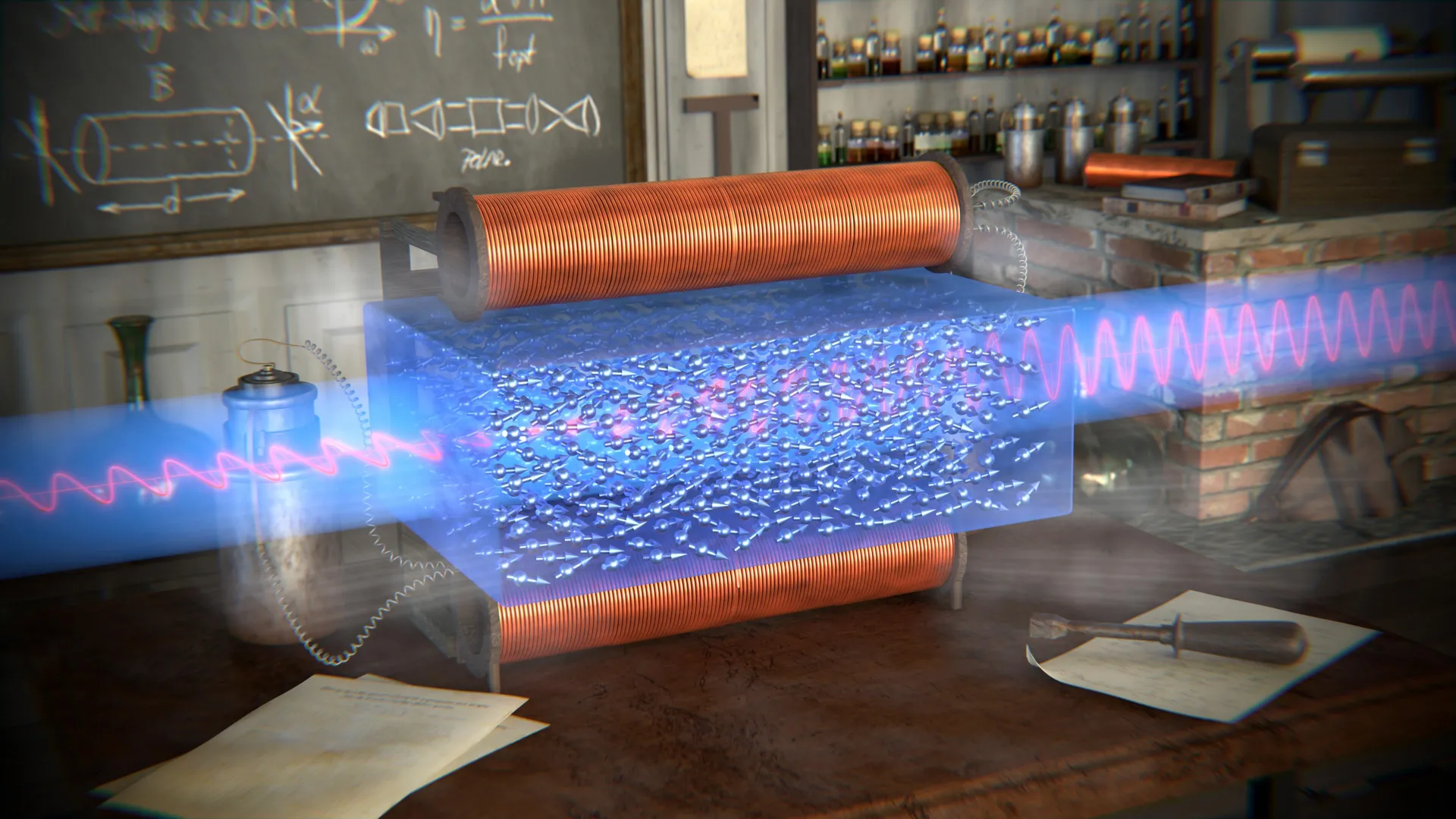
For almost two centuries, the scientific community has attributed the Faraday Effect exclusively to the interaction between the electric field of light and the electric charges within a material. This established paradigm, deeply ingrained in physics education and research, dictated that as light traverses a material subjected to an external magnetic field, its polarization rotates solely due to the electric forces at play. However, the meticulous work conducted by Dr. Amir Capua and Benjamin Assouline at the Hebrew University of Jerusalem’s Institute of Electrical Engineering and Applied Physics has meticulously dismantled this long-standing assumption. Their research provides the first robust theoretical evidence that the oscillating magnetic field inherent to light itself is not merely a passive bystander but an active participant, directly contributing to the observed polarization rotation.
The Faraday Effect, in essence, describes a fascinating interplay between light and magnetism. When light passes through a material that is itself within a static magnetic field, the plane of polarization of the light undergoes a rotation. This rotation is proportional to the strength of the magnetic field and the distance the light travels through the material. Traditionally, the explanation focused on how the external magnetic field influenced the electrons within the material, thereby affecting their interaction with the electric field of the light. Dr. Capua eloquently simplifies this, stating, "In simple terms, it’s an interaction between light and magnetism. The static magnetic field ‘twists’ the light, and the light, in turn, reveals the magnetic properties of the material." The crucial revelation from the new study is that this "twisting" is not solely a one-way street orchestrated by the external field. The light’s own magnetic field is actively involved in this intricate dance.
The researchers’ innovative approach involved delving into the fundamental physics of magnetic interactions and applying advanced theoretical frameworks. Central to their calculations was the utilization of the Landau-Lifshitz-Gilbert (LLG) equation, a cornerstone in understanding the dynamics of magnetic spins within materials. The LLG equation describes how magnetization changes over time, influenced by factors like applied magnetic fields and damping. By adapting and applying this equation to the context of light’s magnetic field, Capua and Assouline demonstrated a profound insight: the oscillating magnetic field of light can, in fact, generate a magnetic torque within a material. This torque acts in a manner analogous to how a static external magnetic field influences spins. This direct magnetic influence, long overlooked, fundamentally alters our comprehension of how light interacts with the magnetic fabric of matter. Dr. Capua elaborates on this paradigm shift, emphasizing, "In other words, light doesn’t just illuminate matter, it magnetically influences it." This is a radical departure from the previous understanding, which viewed light’s role as primarily electromagnetic radiation, with its magnetic component considered negligible in this specific context.
To quantify the significance of this newly identified magnetic contribution, the team applied their theoretical model to Terbium Gallium Garnet (TGG), a widely used and well-characterized crystal employed in the study of the Faraday Effect. TGG is known for its strong Faraday rotation properties, making it an ideal testbed for validating theoretical predictions. Their detailed analysis of TGG revealed that the magnetic component of light is responsible for a substantial portion of the observed polarization rotation. In the visible spectrum, this contribution accounts for approximately 17% of the effect, a figure that, while seemingly modest, is undeniably significant given it was previously considered zero. More remarkably, in the infrared spectrum, the magnetic influence of light escalates dramatically, being responsible for as much as 70% of the Faraday rotation. This stark difference across different regions of the electromagnetic spectrum underscores the varied and often underappreciated roles of light’s magnetic field.
The implications of this discovery are far-reaching and poised to revolutionize several fields of science and technology. Benjamin Assouline articulates this transformative potential, stating, "Our results show that light ‘talks’ to matter not only through its electric field, but also through its magnetic field, a component that has been largely overlooked until now." This new understanding opens up a wealth of possibilities for manipulating and interacting with materials in ways previously unimagined.
In the realm of optics, the ability to precisely control the magnetic interaction of light with matter could lead to the development of novel optical devices with enhanced functionalities. For instance, this could enable more efficient and sophisticated optical modulators, switches, and sensors. The implications for optical data storage are particularly exciting. Current technologies rely on the electric properties of materials. By leveraging the magnetic interaction of light, it might be possible to develop new methods for writing and reading data at higher densities and speeds, potentially leading to the next generation of ultra-fast and high-capacity storage solutions.
The field of spintronics, which focuses on utilizing the spin of electrons in addition to their charge, stands to benefit immensely. Spintronic devices promise lower power consumption and higher operating speeds compared to conventional electronics. The discovery that light’s magnetic field can directly influence atomic spins provides a powerful new tool for controlling and manipulating these spins. This could pave the way for novel spintronic architectures, more efficient spin-based transistors, and magnetic memory devices that are faster and more energy-efficient. Imagine the possibility of using light to directly write magnetic information onto a storage medium without the need for external magnetic fields, a concept that was previously confined to theoretical speculation.
Furthermore, the burgeoning field of quantum technologies, including quantum computing and quantum communication, is a prime area for application. Quantum computers harness quantum phenomena like superposition and entanglement to perform computations that are intractable for classical computers. Spin is a fundamental quantum property, and controlling it with precision is paramount for building stable and scalable quantum bits (qubits). The ability of light’s magnetic field to directly interact with and influence spins offers a novel and potentially more robust pathway for manipulating qubits, developing quantum gates, and realizing fault-tolerant quantum computation. This could accelerate the development of practical quantum computers capable of solving some of the world’s most complex problems in areas like drug discovery, materials science, and artificial intelligence.
The research also has implications for fundamental physics, prompting a re-evaluation of how we understand light-matter interactions at the most basic level. The 180-year-old assumption about the Faraday Effect’s sole reliance on the electric field highlights the importance of continuous scientific inquiry and the potential for long-held beliefs to be revised by new evidence. This discovery serves as a testament to the power of theoretical modeling combined with experimental validation, even when challenging established scientific consensus. The fact that a seemingly subtle magnetic component of light can have such a significant and measurable impact, especially in certain spectral ranges, suggests that there may be other equally profound, yet undiscovered, aspects of light’s behavior waiting to be unearthed. The journey to fully understand the intricate relationship between light and magnetism, a fundamental force of nature, is far from over, and this recent breakthrough by the Hebrew University of Jerusalem team has undoubtedly illuminated a crucial, previously obscured path.