anjir abdul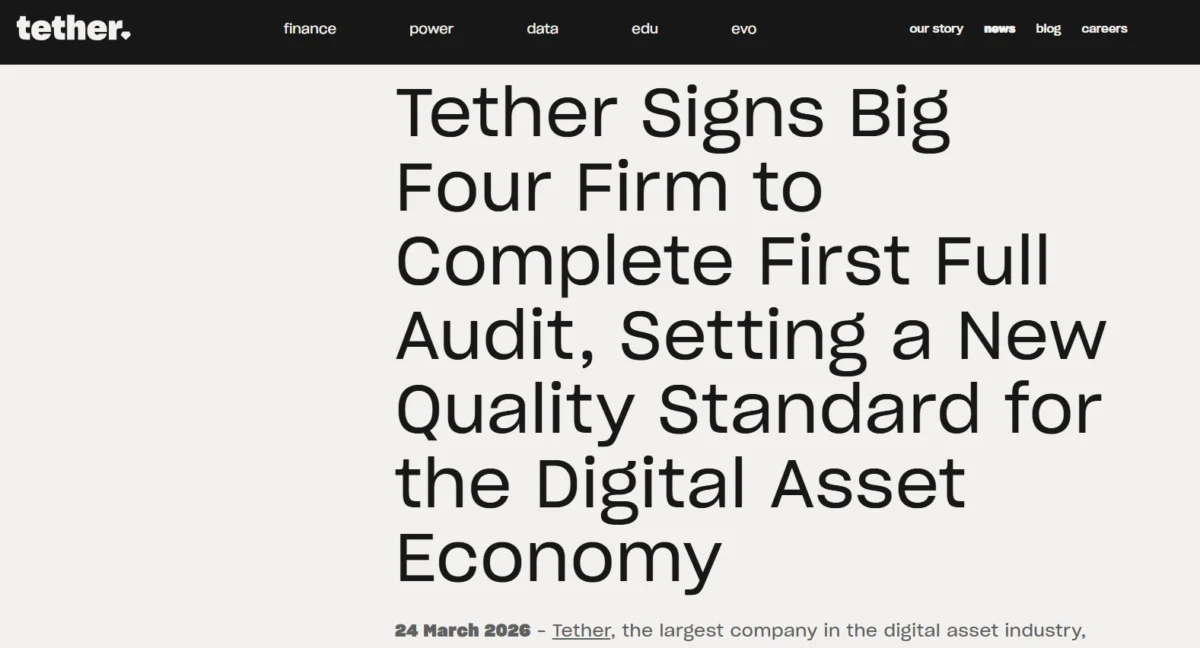
The decision to onboard KPMG for a full financial statement audit follows closely on the heels of Tether’s own announcement earlier in the week, where it disclosed the formal engagement of an unnamed "Big Four" firm for an inaugural audit. That prior announcement, made on Tuesday, hinted at a significant shift in Tether’s approach to financial reporting, building anticipation within the cryptocurrency market regarding the identity of the chosen auditor. The confirmation by the Financial Times now reveals the specific firms entrusted with this monumental task, a development that is expected to reshape perceptions of Tether’s financial stability and operational rigor.
For years, Tether has been a subject of intense scrutiny regarding the full backing of its USDt stablecoin, which boasts an approximate circulation of $185 billion, making it the dominant stablecoin by market capitalization, according to CoinGecko. Despite repeated pledges to undergo a full audit, the company had previously relied on periodic reserve attestations, primarily from BDO Italia, the Italian member firm of the BDO global accounting network. BDO Italia has been responsible for producing USDt assurance reports since 2022, offering snapshots of Tether’s reserves at specific points in time. While these attestations provided some level of insight, they fell short of the comprehensive financial statement audit that critics and regulators have long demanded, which typically examines a company’s entire financial health, including assets, liabilities, equity, revenues, and expenses over a period, along with an assessment of internal controls. The transition from attestations to a full audit by a Big Four firm like KPMG signifies a major leap towards greater transparency and financial accountability.
This strategic pivot comes at a critical juncture for Tether, as the company is reportedly weighing a significant equity raise and actively pursuing an expansion into the United States market. The latter ambition is particularly noteworthy, aligning with the evolving regulatory landscape shaped by proposed legislation such as the Guiding and Establishing National Innovation for US Stablecoins (GENIUS) Act. Should the GENIUS Act or similar frameworks be enacted, they would establish a new federal stablecoin framework in the US, potentially opening avenues for compliant stablecoin issuers. For Tether, navigating the stringent US regulatory environment would undoubtedly necessitate the highest standards of financial transparency and a robust demonstration of its reserves and operational controls, making the KPMG audit an indispensable prerequisite for any meaningful push into the American financial ecosystem.
Tether has consistently emphasized the strength and liquidity of its reserves. In January, the company disclosed that it held more than $122 billion in direct US Treasury securities, with a total Treasury exposure reaching approximately $141 billion when including related instruments such as overnight reverse repurchase agreements. These figures highlight Tether’s significant holdings in highly liquid and secure assets, often surpassing the Treasury holdings of some sovereign nations. Such a robust reserve composition is central to Tether’s claim of USDt’s stability and its 1:1 peg to the US dollar. A full audit by KPMG is expected to independently verify these claims, providing an authoritative and comprehensive review of not just the quantity but also the quality and liquidity of these underlying assets, thereby bolstering investor confidence and potentially mitigating long-standing skepticism.
The scope of a comprehensive audit by KPMG is anticipated to extend far beyond mere snapshots of reserves. It will delve deeply into Tether’s entire balance sheet, meticulously scrutinizing its assets, liabilities, and, crucially, its internal controls. This process involves a detailed examination of the mechanisms and procedures Tether has in place to safeguard its assets, ensure the accuracy of its financial reporting, and prevent fraud. Such an exhaustive review of internal controls is paramount for a company of Tether’s scale and influence within the global financial system, especially given its history of regulatory challenges. Tether itself has grandly billed this upcoming audit as "the biggest ever inaugural audit in the history of financial markets," a testament to the unprecedented scale and complexity of verifying the financial health of the world’s largest stablecoin issuer.

Tether has stated that the chosen "Big Four" firm was selected through a competitive process and that it already operates at "Big Four audit standards." However, the company has not yet publicly committed to a specific timeline for the audit’s completion, leaving stakeholders eager for more details. Cointelegraph reached out to both Tether and KPMG for comment, but had not received a response by publication. PwC, when contacted, declined to comment on the matter, as is typical for accounting firms regarding client engagements.
The significance of the KPMG audit is closely intertwined with Tether’s ambitious funding strategies. Bloomberg reported in September 2025 that Tether was exploring raising as much as $20 billion in fresh equity, a move that would imply a staggering valuation of $500 billion for the company. While Tether CEO Paolo Ardoino subsequently refuted the specific $20 billion figure as "not agreed upon" in an interview with Cointelegraph in February, he maintained the company’s aspirational $500 billion valuation target, grounding it in Tether’s substantial profits and market position. A successful, comprehensive audit by a reputable firm like KPMG would undoubtedly be a cornerstone in validating such a valuation and attracting potential investors for any future equity raise, providing the credibility necessary to convince institutional players and sophisticated investors.
Tether’s journey towards this audit has been marked by a history of regulatory skirmishes and legal settlements, which have fueled skepticism about its transparency. The company previously paid a $41 million fine to the Commodity Futures Trading Commission (CFTC) over allegations that it made "untrue or misleading statements" regarding its reserves. This settlement in October 2021 highlighted the regulatory demand for accurate and verifiable disclosures from stablecoin issuers. In a separate, high-profile case, Tether agreed to an $18.5 million settlement with the New York Attorney General (NYAG) in February 2021. This settlement addressed allegations that Tether had concealed losses and misled investors about the backing of USDt. Under the terms of the NYAG deal, Tether was compelled to provide detailed quarterly reserve reports for a period of two years and eventually dropped its opposition to the public release of these materials, laying the groundwork for increased transparency. These past regulatory actions underscore the intense scrutiny Tether has faced and the imperative for it to now demonstrate robust financial practices through an independent, full audit.
The broader cryptocurrency industry, and particularly the stablecoin sector, has been under increasing pressure globally to enhance transparency and comply with regulatory frameworks. Governments and financial watchdogs worldwide are grappling with how to regulate digital assets, with stablecoins often being a focal point due to their potential to disrupt traditional financial systems and their role in facilitating large volumes of crypto trading. The engagement of KPMG by Tether is thus not just a company-specific event but a potential benchmark for the entire stablecoin industry, setting a new standard for accountability and trust. It could influence other stablecoin issuers to pursue similar levels of scrutiny, thereby contributing to a more mature and credible digital asset market.
In conclusion, Tether’s engagement of KPMG for its first full financial statement audit, alongside PwC’s role in preparing internal systems, represents a monumental step for the company and the broader stablecoin market. It addresses years of calls for greater transparency, positions Tether for potential expansion into the highly regulated US market under frameworks like the GENIUS Act, and could underpin ambitious equity fundraising efforts. While the timeline for completion remains undisclosed, the mere initiation of such a comprehensive review by a Big Four firm signals a new era of accountability for the world’s largest stablecoin, potentially ushering in enhanced investor confidence, reduced regulatory uncertainty, and a more stable foundation for the digital asset economy. This move by Tether could set a precedent for transparency and financial rigor that reverberates throughout the entire crypto industry, ultimately fostering greater institutional adoption and mainstream acceptance of stablecoins.