Faris Adani
Shutterstock/Futurism
The surveillance state costs money, people!
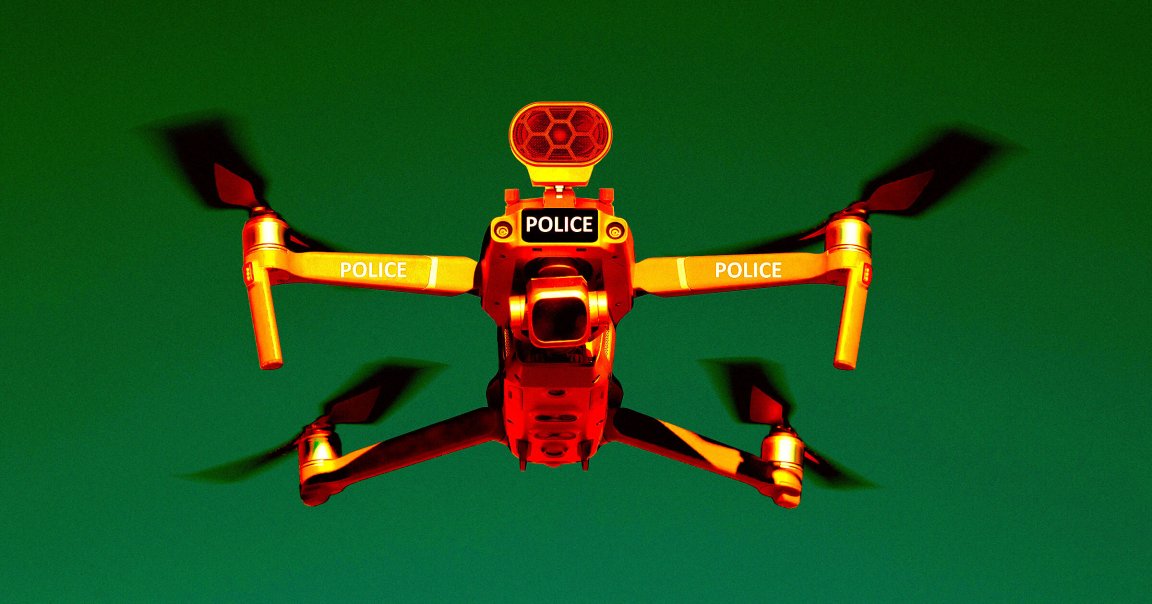
Well, tell that to President Trump. On Thursday, he slapped a 100 percent tariff — he sure loves round numbers and levying imports — on larger foreign-made drones. Trump claimed that this “bolsters national security,” but, ironically, it could be undermining domestic security — at least according to surveillance-happy police departments who’ve gotten used to overlooking their subjects from above, according to a roundup of commentary from Ars Technica. Speaking to the New York Times, Scott Mlakar, chief of the Lake County Drone Unit outside Cleveland, called the tariffs financially onerous and lamented that it would prevent many communities from buying them, adding that his unit uses them to hunt crime suspects at night and search for lost children. “Most of this, in our humble opinion, is lobbying by US manufacturers to eliminate foreign competition,” he said. “This is not national security. It’s protectionism.” The tariff is explicitly designed to target popular Chinese drones, while making exceptions or imposing much lighter tariffs on drones made from allies like Japan, Taiwan, South Korea, and the EU. In particular, these steep duties will apply to drones that use thermal imaging or weigh more than 55 pounds. In addition, the Federal Communications Commission is weighing reclassifying some drone technologies like lidar as “military grade,” Ars noted, which would restrict who can access these drones even further. Drones have a lot of other practical uses beyond law enforcement, obviously, including monitoring wildfires and assisting rescue operations. Amid heightened backlash against Flock, though, they’ve come to be seen as another surveillance apparatus. But weaning the US off Chinese drone tech is supposed to be good for national security, according to the Trump administration. One small problem: a single Chinese company, DJI, makes more than 70 percent of the world’s commercial drones, according to the NYT. Good luck replacing all those. Plenty of other cops are bellyaching about the tariffs, too, extolling how irreplaceable that awesome Chinese made drones have become to their operation. Ars spotted a Texas police officer named Jason Lee, for instance, who complained to the FCC that “there is currently no economically viable domestic replacement” for DJI drones. “More than 80 percent of state and local law-enforcement drone programs surveyed in 2024 used DJI aircraft,” he added. “The fact that a domestic product exists does not necessarily mean it is a viable substitute,” Lee said. “A replacement must be operationally comparable, economically obtainable, supported by an adequate supply chain, and accepted by pilots who must rely on it during real-world incidents.”
In a move that has sent shockwaves through public safety agencies across the United States, the Trump administration has levied a sweeping 100 percent tariff on a specific category of foreign-made drones, primarily targeting those manufactured in China. While the administration asserts this aggressive measure is a critical step to “bolster national security” and protect against potential espionage and data vulnerabilities, law enforcement and emergency services personnel are sounding alarm bells, warning that the policy paradoxically threatens their operational capabilities and, by extension, domestic security. The sudden imposition of such a steep import duty is not merely an economic maneuver; it represents a significant policy shift with profound implications for how local governments combat crime, respond to disasters, and conduct essential surveillance.
The new tariff specifically targets larger drones, defined as those weighing over 55 pounds or equipped with advanced thermal imaging capabilities – features indispensable for many modern police and fire departments. This directive is part of a broader strategy to decouple the U.S. from Chinese technology supply chains, a sentiment echoed by the ongoing trade tensions between the two global powers. While the tariff provides exceptions or significantly lighter duties for drones sourced from allied nations like Japan, Taiwan, South Korea, and the European Union, the reality on the ground is stark: the global drone market is overwhelmingly dominated by Chinese manufacturers, particularly DJI, which commands an estimated 70 percent of the commercial drone market share worldwide. This near-monopoly means that finding viable, immediate alternatives from approved nations or domestic producers is proving to be an insurmountable challenge for many agencies.
Further complicating matters, the Federal Communications Commission (FCC) is reportedly considering reclassifying certain drone technologies, such as lidar, as “military grade.” Lidar, or Light Detection and Ranging, uses pulsed laser light to measure distances and create detailed 3D maps, making it invaluable for accident reconstruction, crime scene analysis, and search and rescue in complex environments. Should this reclassification occur, it would further restrict the availability and use of these advanced drones, regardless of their country of origin, by civilian entities, deepening the operational chasm for public safety departments.
Police chiefs and drone unit commanders are articulating a clear and present danger to their daily operations. Scott Mlakar, chief of the Lake County Drone Unit outside Cleveland, voiced his frustrations to the New York Times, characterizing the tariffs as “financially onerous.” Mlakar highlighted the critical role drones play in his unit, from tracking fleeing suspects in the dead of night using thermal cameras to locating missing children in vast, challenging terrains. He argues that these tariffs will simply price out many communities, particularly smaller departments with limited budgets, from acquiring or replacing these vital tools. Mlakar openly questioned the administration’s stated rationale, suggesting, “Most of this, in our humble opinion, is lobbying by US manufacturers to eliminate foreign competition. This is not national security. It’s protectionism.” This sentiment underscores a growing suspicion among public safety officials that the policy is less about genuine security concerns and more about bolstering nascent domestic drone industries that are not yet equipped to meet current demands.
The operational indispensability of Chinese-made drones, especially those from DJI, is a recurring theme in the backlash. Texas police officer Jason Lee, in a formal complaint filed with the FCC, starkly outlined the predicament: “there is currently no economically viable domestic replacement” for DJI drones. Lee’s testimony, reflecting broader industry data, pointed out that “more than 80 percent of state and local law-enforcement drone programs surveyed in 2024 used DJI aircraft.” This overwhelming reliance is not accidental; DJI drones have historically offered a superior combination of affordability, cutting-edge technology, reliability, and an extensive ecosystem of accessories and software. Features like extended flight times, robust payload capacities, advanced obstacle avoidance, and high-resolution cameras – including thermal imaging – have made them the de facto standard for public safety applications. Lee further elaborated on the criteria for a true replacement: “A replacement must be operationally comparable, economically obtainable, supported by an adequate supply chain, and accepted by pilots who must rely on it during real-world incidents.” He suggests that merely having a domestic product exist does not make it a viable substitute if it fails to meet these rigorous demands.
Beyond law enforcement, the implications of these tariffs ripple through other critical public safety sectors. Fire departments rely on drones to monitor the perimeter and progression of wildfires, identify hotspots, and ensure firefighter safety in smoke-filled environments. Search and rescue teams leverage drones to cover vast areas quickly, locating individuals in distress after natural disasters or in remote wilderness. Agricultural sectors use drones for crop monitoring and precision farming, while infrastructure inspectors deploy them for surveying bridges, power lines, and pipelines. The increased cost translates to higher operational expenses across these diverse applications, potentially slowing technological adoption and hindering efficiency.
The broader debate over surveillance also looms large. Companies like Flock Safety, which quietly sells drone technology capable of scanning license plates, have already drawn significant scrutiny from privacy advocates concerned about the erosion of civil liberties. While drones undeniably offer unprecedented capabilities for public safety, their dual-use nature as tools for both protection and surveillance creates a complex ethical landscape. The tariffs, by making these technologies less accessible, may inadvertently slow the expansion of some surveillance programs, but at the cost of hamstringing legitimate and often life-saving public safety operations.
Ultimately, the Trump administration’s drone tariffs expose a fundamental tension between geopolitical strategy, economic protectionism, and the practical realities faced by domestic public services. While the stated goal of enhancing national security by reducing reliance on potentially adversarial foreign technology is understandable, the immediate consequence is a significant financial burden and operational disruption for the very agencies tasked with ensuring the safety and security of American communities. The question remains whether the burgeoning domestic drone industry can rapidly scale to fill the void left by Chinese manufacturers, or if U.S. taxpayers will simply bear the brunt of higher costs for less capable alternatives, leaving domestic security vulnerable in the interim. The current predicament of surveillance-happy police departments underscores the complex, often contradictory, outcomes of high-stakes trade policies.