Imroatul Nasiyah
The very essence of quantum computing lies in its ability to harness qubits, the quantum analogue of classical bits, to store and process information in ways that far surpass the capabilities of even the most powerful supercomputers. Unlike classical bits, which exist in a definite state of either 0 or 1, qubits can exist in a superposition of both states simultaneously, and can be entangled, meaning their fates are intertwined regardless of distance. This allows quantum computers to explore a vast number of possibilities concurrently, unlocking the potential to solve problems currently intractable for classical machines, such as drug discovery, materials science, complex optimization problems, and breaking modern cryptography.
However, the very quantum phenomena that grant qubits their power also render them extraordinarily fragile. Many of today’s leading quantum computers utilize superconducting circuits as their qubits. These circuits, while effective, are exceptionally susceptible to a barrage of environmental interferences. Electromagnetic noise, akin to the static electricity that causes hair to stand on end when rubbed with a balloon, and stray electrical charges can easily disrupt the delicate quantum states of these qubits. Even the slightest perturbation can cause a qubit to decohere, losing its precious quantum information and introducing errors into the computation. As quantum computers grow in size, with an increasing number of qubits, the challenge of controlling and mitigating these errors escalates exponentially. This inherent sensitivity to noise and the escalating difficulty of error correction as systems scale up represent the primary bottlenecks in realizing the full potential of quantum computing.
The research published in the esteemed journal npj Quantum Information details a paradigm shift in qubit design. The Surrey team’s innovative approach pivots away from conventional superconducting architectures and instead centers on superfluid helium-3. Superfluid helium-3 is a peculiar state of helium that exhibits astonishing quantum mechanical properties, most notably its ability to flow without any viscosity or friction. This frictionless flow is a direct consequence of quantum effects at extremely low temperatures.
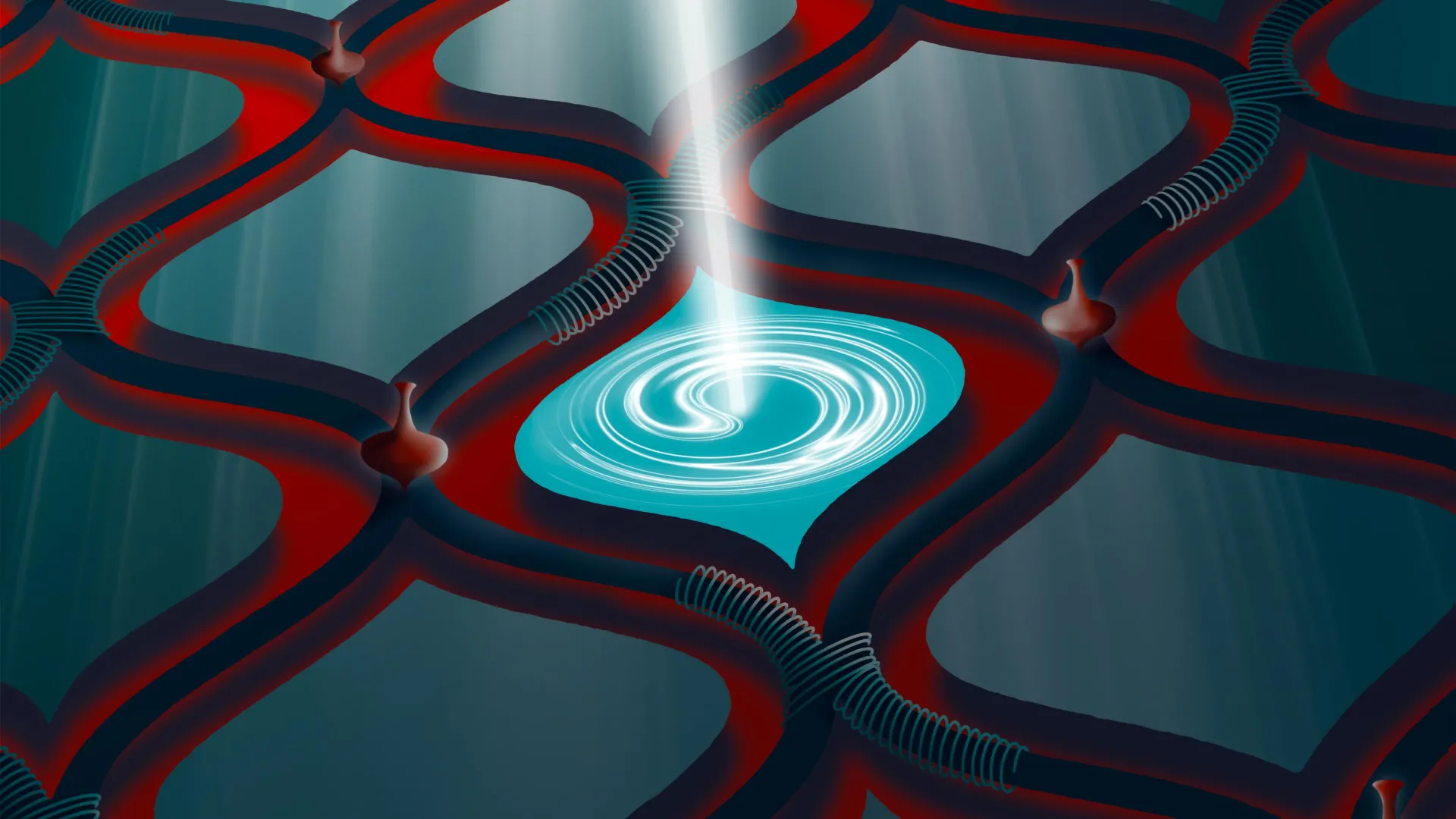
The proposed SHOQ device capitalizes on this unique property. Crucially, the SHOQ device is designed to operate with charge-neutral superfluid helium. The absence of an electric charge in the helium offers a significant advantage: it provides inherent protection against many of the electromagnetic disturbances that plague superconducting qubits. By eliminating this primary source of noise, the SHOQ qubit is theorized to maintain its quantum integrity for longer periods, thereby reducing the incidence of errors. This fundamental design choice addresses one of the most persistent sources of decoherence in current quantum systems.
The calculations undertaken by the Surrey researchers paint a compelling picture of the SHOQ device’s potential. Their theoretical analysis suggests that this superfluid-based qubit could achieve error rates that are approximately 100 times lower than those observed in conventional superconducting qubits. This dramatic reduction in error rates, if experimentally validated, would be a monumental leap forward. It would significantly alleviate the burden of complex and resource-intensive quantum error correction schemes, paving the way for more stable and reliable quantum computations.
Dr. Priya Sharma, a Daphne Jackson Fellow in Hybrid Quantum Systems at the University of Surrey’s School of Mathematics and Physics and the lead author of the study, expressed optimism about the findings. "We are not the first to think about the individual components behind this idea," Dr. Sharma stated, "but what we have done for the first time is bring them together in a microfluidic device and work out the specific details that could enable the device to function as a qubit." She further elaborated on the rigorous theoretical foundation of their proposal: "The maths tells us that it should work. We have taken what we already know about superfluid helium and quantum technologies and turned that into an educated design, with the parameters and specifications needed to build one. The next step is to make a prototype and put those predictions to the test." This underscores the team’s confidence in their theoretical work and their eagerness to translate these predictions into tangible experimental results.
Importantly, the researchers envision the SHOQ device not as a wholesale replacement for existing quantum computing hardware, but rather as a complementary technology that could be integrated with current superconducting quantum systems. This hybrid approach could unlock a powerful synergy, allowing different types of qubits, each with its unique strengths and weaknesses, to perform specialized roles within the same quantum computer. For instance, superconducting qubits might excel at rapid gate operations, while the SHOQ qubits could be employed for tasks requiring extended coherence times and low error rates. This heterogeneous integration could lead to more versatile and efficient quantum computing architectures.
Looking further into the future, the SHOQ device holds significant promise as a form of quantum memory. In this envisioned application, the superfluid-based qubit could serve as a highly stable repository for quantum information. While other, potentially faster but less stable, qubits or classical processors handle the active computations, the SHOQ qubit would reliably store the quantum data for extended periods. This "quantum RAM" functionality is crucial for executing complex quantum algorithms that require intermediate storage of quantum states.
Dr. Eran Ginossar, Associate Professor at the University of Surrey’s Department of Physics and Advanced Technology Institute and a co-author of the study, highlighted the strategic advantage of this hybrid approach: "We don’t necessarily need one type of qubit to do everything. Combining different quantum technologies could allow us to take advantage of the strengths of each." He further emphasized the novel nature of their proposed system: "Superfluid helium gives us a fundamentally different type of quantum hardware to explore. If the predicted performance can be demonstrated experimentally, it could eventually work alongside existing superconducting technologies as part of a larger quantum system." This vision of a modular and integrated quantum computing ecosystem, where specialized qubits contribute to the overall computational power, is a key driver of current research.
The immediate next step for the Surrey team is the ambitious endeavor of building a prototype SHOQ device. This crucial experimental phase will determine whether the theoretical predictions of significantly lower error rates can be realized in a physical system. The project’s momentum is further bolstered by an IAA Commercialisation Fellowship awarded to Dr. Priya Sharma, which will support this vital prototype development.
While the SHOQ device would necessitate operation at extremely low temperatures, a condition that is standard for many quantum computing technologies, researchers have already demonstrated their ability to achieve the necessary cryogenic conditions in previous experiments involving superfluid helium-3. This prior expertise provides a solid foundation for the practical implementation of the SHOQ device.
This pioneering research was a collaborative effort, spearheaded by the University of Surrey and undertaken in partnership with Professor Jens Koch at Northwestern University in the United States. Professor Koch’s involvement is particularly noteworthy, as he was instrumental in the development of the transmon qubit, a superconducting qubit design that has become a cornerstone of many contemporary quantum computing platforms. This collaboration between institutions and with researchers at the forefront of existing quantum technologies underscores the significance and potential impact of the SHOQ device. The path forward involves rigorous experimental validation, but the theoretical underpinnings and the potential rewards of this superfluid qubit breakthrough offer a tantalizing glimpse into a future of more robust and scalable quantum computing.