Imroatul Nasiyah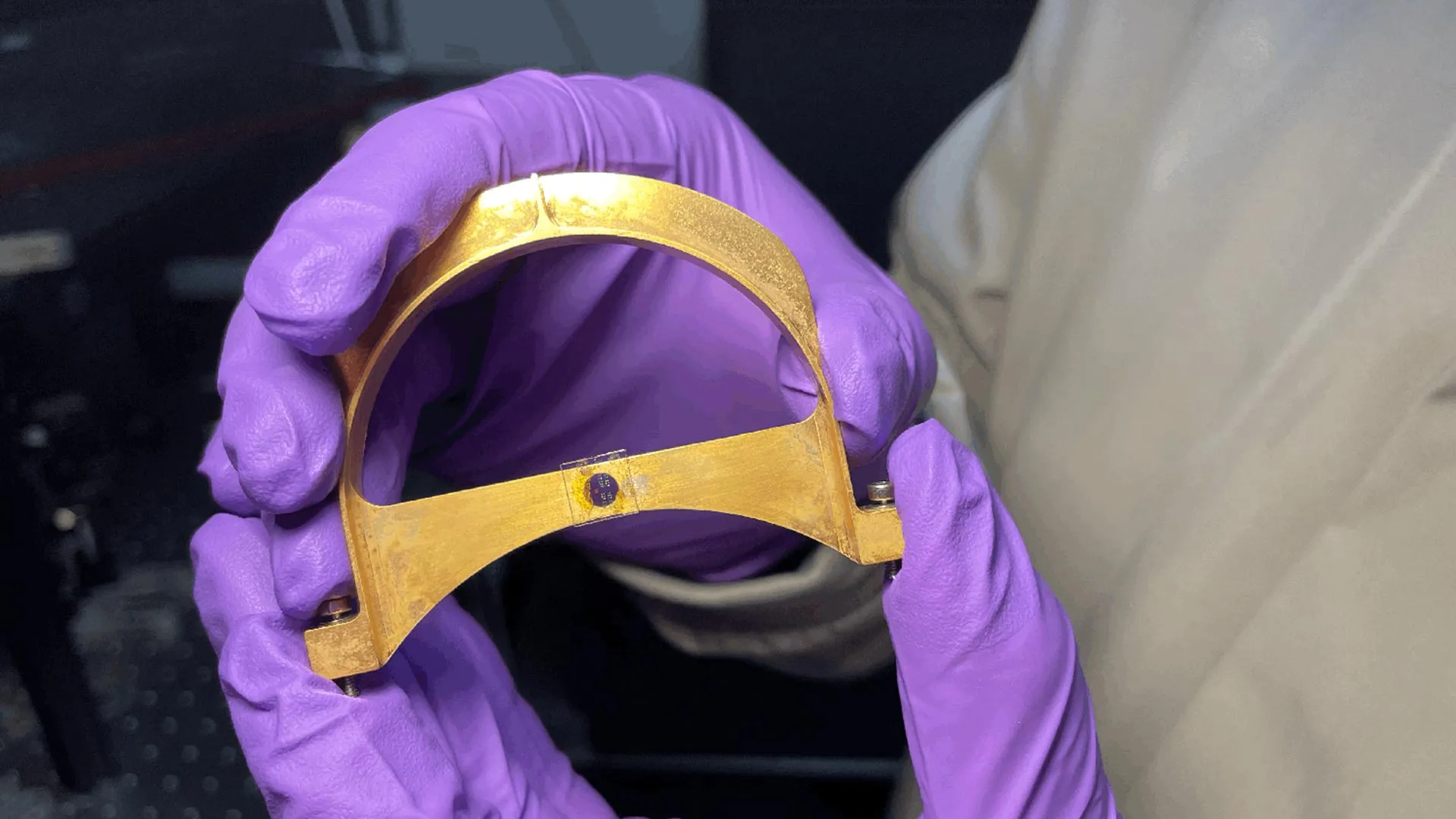
"The material in question is not really new, but the way we use it is," states Jennifer Dionne, a distinguished professor of materials science and engineering at Stanford and the senior author of the study. "It provides a very versatile, stable spin connection between electrons and photons that is the theoretical basis of quantum communication. Typically, however, the electrons lose their spin too quickly to be useful." This challenge, the ephemeral nature of electron spin, has been a significant hurdle in the quantum realm, often necessitating cryogenic temperatures to preserve these delicate quantum states.
The ingenious device achieves this remarkable feat by integrating a precisely patterned thin layer of molybdenum diselenide (MoSe2) with a specially engineered nanopatterned silicon substrate. Molybdenum diselenide belongs to a class of materials known as transition metal dichalcogenides (TMDCs), which have garnered significant attention for their exceptional optical and quantum characteristics. The researchers highlight that the silicon nanostructures are not merely passive components but actively play a crucial role in generating what they term "twisted light."
"The Silicon nanostructures enable what we call ‘twisted light,’" explains Feng Pan, a postdoctoral scholar in Dionne’s lab and the paper’s lead author. "The photons spin in a corkscrew fashion, but more importantly, we can use these spinning photons to impart spin on electrons that are the heart of quantum computing." This "twisted light" is not an arbitrary phenomenon; the patterned structures are astonishingly small, comparable in size to the wavelengths of visible light, rendering them invisible to the naked eye. Dionne further elaborates on this microscopic precision: "The patterned nanostructures are imperceptible to the human eye, about the size of the wavelength of visible light. But they help us manipulate photons very precisely to make them spin — to twist them — in a specific direction, for example, up or down." This controlled manipulation of photon spin is key to its interaction with electron spins.
The generated twisted light serves as a conduit for entanglement with electron spins, thereby creating qubits. Qubits are the fundamental building blocks of quantum information systems, analogous to the bits (zeros and ones) in classical computing. However, qubits possess the extraordinary ability to leverage quantum mechanical phenomena, such as superposition and entanglement, to process and transmit information in ways that are currently unimaginable with classical technology.
Maintaining the stability of these quantum states, known as qubits, is one of the most formidable challenges in the development of quantum technologies. In many existing quantum systems, extreme cooling is indispensable to counteract decoherence, a process where fragile quantum information is lost due to interactions with the environment. The Stanford breakthrough bypasses this significant obstacle by enabling the device to function efficiently at room temperature. This not only simplifies operation but also makes the technology inherently more practical and cost-effective compared to many existing quantum systems, which are burdened by the expense and complexity of cryogenic infrastructure.
The researchers’ choice of TMDC materials was deliberate, driven by their inherent and unusual quantum characteristics. Their collaboration with Stanford experts Fang Liu and Tony Heinz, who specialize in these advanced materials, was instrumental in unlocking their potential. "It all comes down to this material and our Silicon chip," Pan emphasizes. "Together, they efficiently confine and enhance the twisting of light to create a strong coupling of spin between photons and electrons. This stabilizes the quantum state that makes quantum communication possible." This synergistic interaction between the TMDC material and the silicon nanostructures allows for a more robust coupling between light and matter, thereby preserving the delicate quantum properties essential for both communication and computation.
The potential implications of this room-temperature quantum technology are vast and far-reaching. If further developed and refined, it could catalyze significant advancements across a spectrum of fields, including the development of highly secure communication systems, the creation of more sensitive and advanced sensing technologies, the acceleration of high-performance computing capabilities, and the enhancement of artificial intelligence. The ability to transmit quantum information reliably at ambient temperatures could revolutionize how we process and secure data.
Looking ahead, the Stanford team is actively engaged in refining the current device and exploring other TMDC materials and combinations that could yield even superior performance. Their research also extends to investigating whether these room-temperature systems might exhibit novel quantum capabilities that are not currently observable under ambient conditions. A more ambitious, long-term objective is the integration of such devices into larger, interconnected quantum networks. Realizing this vision will necessitate concurrent advancements in supporting technologies, including more efficient light sources, sophisticated modulators, highly sensitive detectors, and robust interconnects that can seamlessly link quantum components.
Ultimately, the researchers harbor the ambitious aspiration of miniaturizing quantum components to the extent that they can be integrated into everyday electronic devices, much like the processors in our smartphones. While this ultimate goal remains a decade or more away, the current work represents a significant stride toward making quantum technology more accessible, practical, and ultimately, ubiquitous. "If we can do that, maybe someday we could do quantum computing in a cell phone," Pan muses with a hopeful smile, underscoring the transformative potential of this research. This breakthrough signifies a pivotal moment in the journey towards unlocking the full promise of quantum technology for the benefit of society.