Faris Adani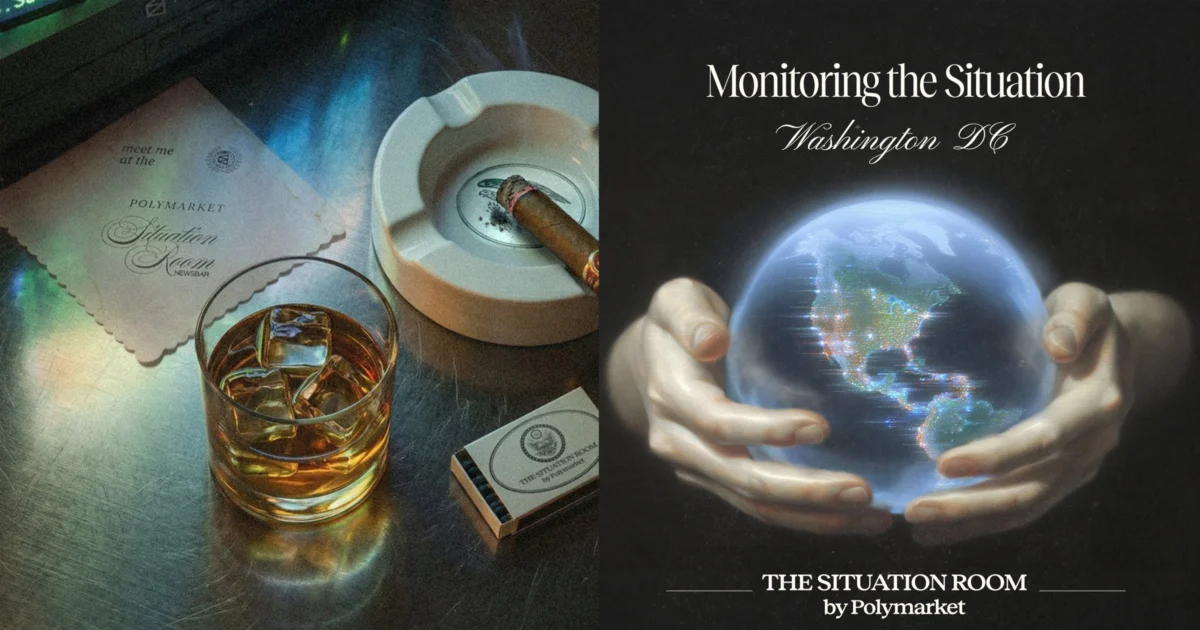
In a move that flouts the unspoken rules of hospitality and plunges headfirst into the ethically murky waters of speculative gambling on global events, Polymarket, the controversial prediction market platform, has announced the grand opening of its "Situation Room" bar in Washington D.C. This audacious venture, positioned just two blocks from the White House, is provocatively dubbed "the world’s first bar dedicated to monitoring the situation." Far from the calming sports highlights typically found in watering holes, Polymarket’s taproom promises an intoxicating blend of real-time news feeds, stock tickers, flight radars, and, most disturbingly, live screens broadcasting the odds on everything from geopolitical crises to ongoing conflicts. The establishment, a brazen marketing escalation, epitomizes a disturbing trend: the commodification of global instability for profit, inviting patrons to literally drink and bet on the world’s woes.
The concept itself is a jarring departure from traditional social spaces. Imagine stepping into a bar not to escape the daily grind, but to immerse oneself deeper into it, albeit through the lens of a high-stakes casino. Polymarket’s mock-up images, shared on X (formerly Twitter), depict an environment plastered wall-to-wall with dynamic digital displays. Here, Bloomberg terminals hum alongside live X feeds, weather stations track distant storms, and flight radars trace the paths of aircraft, all culminating in prominent Polymarket screens inviting wagers on the next major headline. The company itself paints a vivid, if somewhat unsettling, picture: "imagine a sports bar… but just for situation monitoring — live X feeds, flight radar, Bloomberg terminals, and Polymarket screens." This isn’t a place for casual banter; it’s designed for the hyper-informed, the politically obsessed, and, most pointedly, the gambler seeking to capitalize on uncertainty.
Polymarket operates on the principle of prediction markets, where users buy and sell shares corresponding to the probability of future events. If a share is trading at 70 cents, it implies a 70% perceived chance of that event occurring. When the event resolves, winning shares pay out $1.00. While proponents argue that prediction markets aggregate the "wisdom of crowds" to forecast outcomes more accurately than polls or expert opinions, their application by Polymarket has consistently pushed ethical boundaries. The platform allows users to gamble on a vast spectrum of real-life scenarios: the outcomes of elections, the trajectory of economic indicators, the success or failure of political policies, and, most controversially, the duration and results of "real-life wars" and "geopolitical events." This is where the label "degenerate war profiteers" gains its sharpest edge.
Consider the implications: individuals are incentivized to track and bet on human suffering. Whether it’s the outcome of military engagements in the Middle East, the likelihood of an invasion in Venezuela, or the nuanced results of a high-stakes election, these are not abstract sporting contests. They represent lives, livelihoods, and the very fabric of global stability. When a user profits from correctly predicting the escalation of a conflict or the fall of a government, it raises profound moral questions. Does this foster a detached, even exploitative, relationship with global events? Does it normalize the idea that tragedy is just another market to be played? The "Situation Room" essentially creates a physical manifestation of this digital ethical dilemma, bringing the cold calculations of speculative markets into a public, social space, blurring the lines between news consumption and gambling addiction.
The timing and location of this "Situation Room" are particularly telling. Washington D.C. is the epicenter of American political power and global decision-making. Placing a gambling establishment, even a temporary one, two blocks from the White House, where policies influencing these very "situations" are forged, is a provocative statement. It suggests a desire to attract not just casual gamblers, but potentially political operatives, lobbyists, journalists, and D.C. insiders who are deeply invested in, and perhaps even privy to information about, the events being wagered upon. This proximity raises questions about insider trading in a different form, where knowledge of policy shifts or geopolitical developments could translate directly into financial gain on the prediction market.
Polymarket’s ability to even open such an establishment in the US is a recent development. For years, prediction markets like Polymarket operated in a legal gray area or were outright banned for US citizens due to concerns over gambling regulations. However, in late 2025, Polymarket secured "full regulatory approval" from the Commodity Futures Trading Commission (CFTC), a significant milestone that legitimized its operations within the United States. This approval, while granting access to a massive market, came with a "tighter leash." Unlike international users who can bet pseudonymously using crypto wallets, US citizens are now required to submit their full name, address, and social security number before participating. This Know Your Customer (KYC) requirement, intended to prevent illicit activities and ensure accountability, creates a stark contrast with the platform’s more anonymous global user base, highlighting the regulatory tightrope such platforms walk.
The "Situation Room" is not Polymarket’s first foray into aggressive, attention-grabbing marketing. Earlier in the year, the prediction market scene saw a bizarre "grocery store war." Rival platform Kalshi initiated a marketing stunt involving "free pop-up grocery stores" in New York City, designed to mock Mayor Zohran Mamdani’s city-run grocery store policy. Polymarket, never one to be outdone, swiftly retaliated by opening its own "free grocery store" in downtown Manhattan. These stunts, while generating buzz, underscore a brand identity built on disruption, spectacle, and a slightly irreverent, even confrontational, approach to public engagement. The D.C. bar is merely the latest, and perhaps most audacious, escalation in this marketing arms race, solidifying Polymarket’s image as a provocateur in the financial tech space.
The establishment is a short-term takeover of Proper Twenty-One, a sports bar, emphasizing its temporary, pop-up nature. This strategy aims for maximum impact and media attention without the long-term commitment of a permanent venue. The choice of a sports bar for this transformation is ironic, given the traditional aversion to news in such settings. Here, the "game" isn’t football or basketball; it’s the volatile, unpredictable theater of global events. The target demographic seems to be an unsettling blend of the politically engaged, the data-obsessed, and those who thrive on the adrenaline rush of high-stakes gambling, all wrapped up in a package designed to look sophisticated and informed.
Unsurprisingly, the announcement of the "Situation Room" has been met with a mixed bag of reactions online. While some commenters expressed interest, finding the concept appealing for its unique blend of information and speculation, a significant portion voiced strong criticisms, often comparing it unfavorably to a traditional gambling parlor. "New age casino. Get people drunk so they place more polymarket bets lol," one X user wrote, perfectly encapsulating the cynical view of its true purpose. Another commenter, with a darker sense of humor, quipped, "Can we bet on when the bar goes out of business or how many women get roofied there," highlighting deeper societal anxieties associated with establishments that encourage intoxication and high-risk behavior. These reactions underscore a fundamental discomfort with the premise: that human affairs, especially those fraught with suffering and uncertainty, should be reduced to betting odds and viewed as a source of entertainment or profit.
Polymarket’s "Situation Room" in Washington D.C. represents more than just a new bar; it’s a cultural statement, a physical manifestation of a digital phenomenon that challenges our ethical boundaries. It invites us to consider what kind of society we are building when the pursuit of profit from predicting global instability is not only normalized but celebrated in a public venue, just steps from the corridors of power. As the grand opening approaches this coming Friday, the establishment stands as a stark, neon-lit symbol of a world increasingly willing to gamble on its own future, regardless of the human cost.