anjir abdul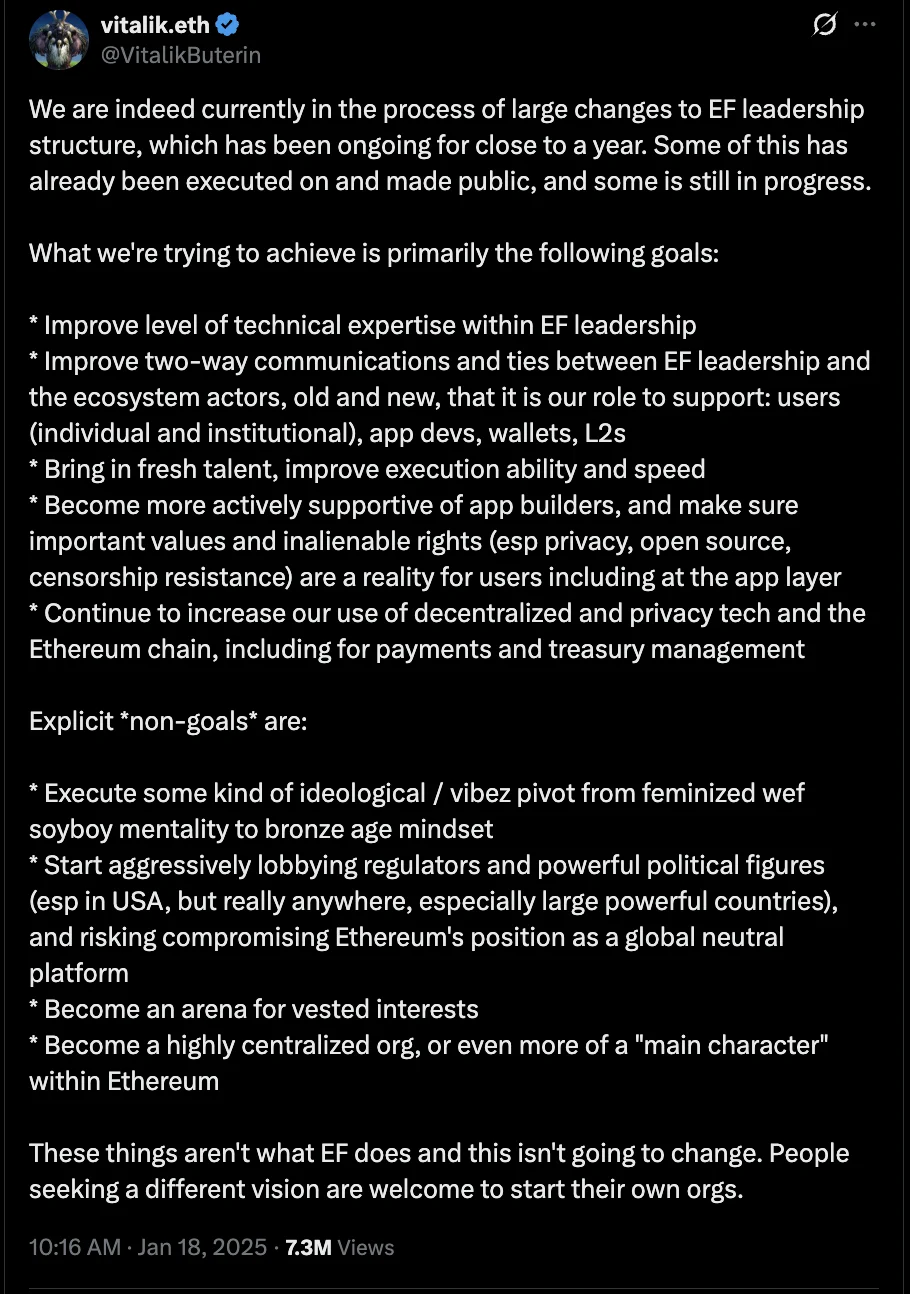
Josh Stark, a highly influential researcher and project manager at the Ethereum Foundation, the pivotal non-profit organization responsible for stewarding the development and growth of the Ethereum ecosystem, announced Thursday his departure after five years of dedicated service. His exit marks a significant moment for the Foundation, given his prominent position and the broader context of recent leadership shifts within the organization.
Stark’s announcement, shared via a post on X, provided no specific reason for his decision, stating candidly that he has “no plans for the future.” Instead, he expressed an intention to dedicate time to personal pursuits, focusing on family and friends. This period of personal reflection comes after half a decade at the forefront of one of the most transformative technological movements of our time. In his farewell message, Stark eloquently captured the pioneering spirit of the Ethereum community:
“The Ethereum ecosystem has reliably done things the world told us were impossible. It is easy to forget how much real fear and doubt there was that Ethereum would never launch, that decentralized finance (DeFi) would never work, or that Proof of Stake would never ship.”
This statement serves as a powerful reminder of the numerous hurdles and skepticism Ethereum faced throughout its journey. The very concept of a global, decentralized computer was met with profound doubt, yet Ethereum launched successfully, laying the groundwork for an entirely new paradigm. The rise of decentralized finance (DeFi), which allows users to interact with financial services without traditional intermediaries, was initially dismissed as a niche experiment but has since grown into a multi-billion-dollar industry, fundamentally reshaping how we perceive and interact with money. Perhaps the most ambitious and technically challenging feat, the transition from Proof of Work to Proof of Stake (often referred to as “The Merge”), was a multi-year endeavor that many considered insurmountable. Its successful implementation showcased the unparalleled dedication and ingenuity of Ethereum’s core developers and researchers, including individuals like Stark, who played crucial roles in guiding such complex projects to fruition.
Stark’s importance within the Foundation cannot be overstated. He was one of only four individuals listed as “Management” on the organization’s public organizational chart, which illustrates that nearly all of the Foundation’s extensive staff reported into this small leadership group. This structural detail underscores his deep involvement in strategic direction, resource allocation, and the overall operational oversight of Ethereum’s core development efforts. His role encompassed not just research but also the intricate project management required to coordinate a globally distributed team working on a constantly evolving, cutting-edge protocol. Cointelegraph made an attempt to reach Stark for further comment regarding his departure, but did not receive a response by the time of publication.

The departure of Josh Stark from the Ethereum Foundation is undoubtedly the most high-profile exit from the organization since Ethereum co-founder Vitalik Buterin announced a series of sweeping leadership changes and a new strategic direction for the Foundation in 2025. This earlier shakeup set the stage for a period of transition, and Stark’s exit can be seen as a continuation of this evolving landscape. Moreover, his announcement follows closely on the heels of another significant departure: just a day prior, Trent Van Epps, another valued Foundation contributor, publicly disclosed his resignation from the organization last week. These consecutive exits, particularly from key management and contributing roles, suggest a potential period of internal restructuring or a shift in the Foundation’s operational dynamics, prompting further scrutiny from the broader Ethereum community.

Related: Ethereum Foundation nearly reaches 70,000 staked ETH goal
The Ethereum Foundation Underwent a Significant Shakeup in 2025
The groundwork for the current shifts was laid in January 2025, when co-founder Vitalik Buterin initiated a comprehensive overhaul of the Ethereum Foundation. This decision was a direct response to mounting criticism from various factions within the Ethereum community concerning the long-term strategic direction and perceived centralization of the ecosystem. Critics often pointed to concerns about development velocity, the Foundation’s role in decision-making, and the need for greater decentralization not just in the protocol but in its governance and stewardship.
Buterin’s vision for the revitalized Foundation encompassed several key objectives. Foremost among them was the injection of “fresh talent” into the organization, aiming to bring in new perspectives and innovative approaches to problem-solving. Alongside this, a critical goal was to foster “greater decentralization” within the Foundation’s internal operations and its interaction with the wider ecosystem, ensuring that decision-making power was not overly concentrated. From a technical standpoint, Buterin emphasized the need to “develop the protocol for faster transaction throughput and increased transaction speeds,” recognizing the persistent challenges of scalability that Ethereum faced as its user base expanded. These goals reflected a commitment to both operational efficiency and the core tenets of blockchain technology.
However, Buterin also clearly delineated the boundaries of the revamped Ethereum Foundation’s mandate. He explicitly stated that the Foundation would not engage in “ideological disputes,” nor would it actively “lobby US lawmakers in Washington” or represent “vested interests.” This stance was a deliberate effort to maintain the Foundation’s neutrality and focus on its technical stewardship role, rather than becoming entangled in political or commercial battles. In a pointed message, Buterin underscored this philosophy, asserting:
“These things aren’t what EF does, and this isn’t going to change. People seeking a different vision are welcome to start their own orgs.”

This declaration reinforced the idea that while the Ethereum Foundation would continue to support core protocol development and research, it would not act as a central authority dictating the entire ecosystem’s direction. Instead, it encouraged independent initiatives and diverse organizations to emerge and pursue their own visions within the broader Ethereum landscape. This approach aligns with the decentralized ethos of Ethereum itself, promoting a healthy, competitive environment for innovation.
The structural changes officially materialized in March 2025, when the Ethereum Foundation formally announced its new leadership. Hsiao-Wei Wang, a respected Ethereum Foundation researcher, and Tomasz Stańczak, CEO of Nethermind, a prominent Ethereum execution client, were appointed as co-directors of the organization. This dual leadership structure was intended to bring a blend of internal research expertise and external client development perspective to the Foundation’s helm. However, this new arrangement proved to be relatively short-lived for one of the appointees, as Stańczak stepped down from his role in February 2026. Hsiao-Wei Wang, however, remains a key figure, continuing her tenure as a member of the Ethereum Foundation’s management board, as indicated by the most recent organizational chart.
The successive departures of key figures like Josh Stark, Trent Van Epps, and previously Tomasz Stańczak, particularly in the wake of a significant organizational restructuring, naturally raise questions about the internal dynamics and future trajectory of the Ethereum Foundation. While such transitions are not uncommon in rapidly evolving tech sectors, their frequency and timing can signal a period of recalibration for the Foundation. For an ecosystem as vast and critical as Ethereum, the stability and clear direction of its primary non-profit steward are paramount. The Foundation’s ongoing challenge will be to maintain its pivotal role in coordinating research, development, and community initiatives while navigating these leadership changes and continually adapting to the demands of a decentralized and increasingly complex global network. The Ethereum community will undoubtedly be watching closely to see how these developments influence the Foundation’s capacity to continue driving innovation and supporting the protocol’s long-term health and decentralization goals.
Magazine: Back to Ethereum: How Synthetix, Ronin and Celo saw the light
Cointelegraph is committed to independent, transparent journalism. This news article is produced in accordance with Cointelegraph’s Editorial Policy and aims to provide accurate and timely information. Readers are encouraged to verify information independently. Read our Editorial Policy https://cointelegraph.com/editorial-policy