Pradipta eManuel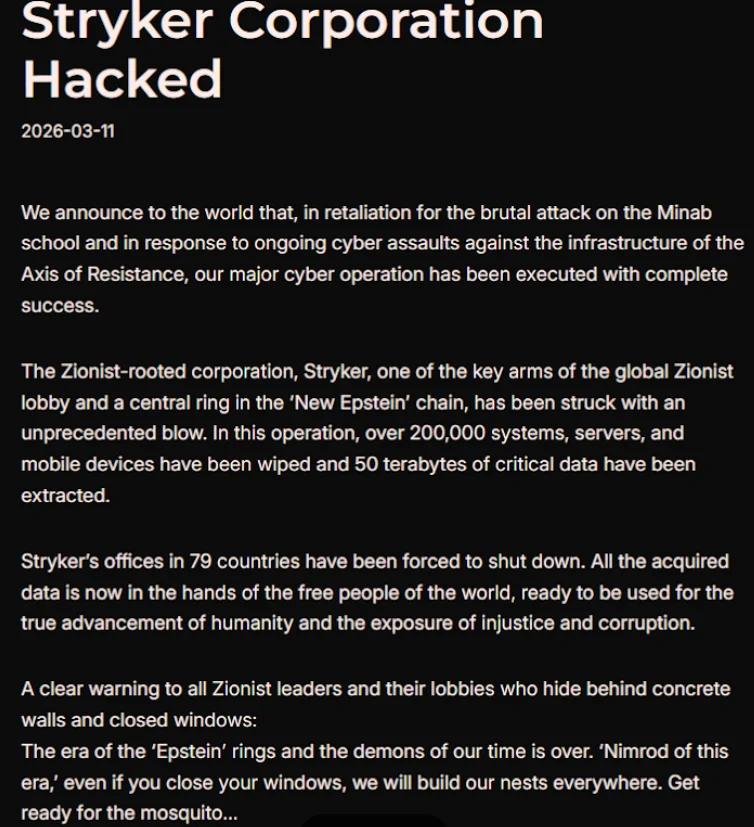
A sophisticated cyberattack, claimed by an Iran-linked hacktivist group known as Handala, has crippled operations at Stryker, a major global medical technology company. The attackers allege they have wiped data from over 200,000 systems, servers, and mobile devices across Stryker’s offices in 79 countries, forcing a shutdown of operations and leading to the dismissal of over 5,000 workers at its Irish hub. A voicemail at Stryker’s U.S. headquarters cited a "building emergency," a likely euphemism for the widespread system disruption.
Stryker, headquartered in Kalamazoo, Michigan, is a significant player in the medical and surgical equipment market, with reported global sales of $25 billion last year and a workforce of 56,000 employees spread across 61 countries. The Handala group, which has been linked by cybersecurity firm Palo Alto Networks to Iran’s Ministry of Intelligence and Security (MOIS) and is believed to be an online persona of the MOIS-affiliated actor Void Manticore, posted a lengthy manifesto on Telegram detailing their alleged actions. In the statement, Handala declared that "All the acquired data is now in the hands of the free people of the world, ready to be used for the true advancement of humanity and the exposure of injustice and corruption."
The motivation behind the attack, according to Handala, is retaliation for a missile strike on February 28th that resulted in the deaths of at least 175 people, primarily children, at an Iranian school. The New York Times reported on the same day as the news broke that an ongoing military investigation has attributed responsibility for that deadly Tomahawk missile strike to the United States.
Palo Alto Networks’ research indicates that Handala primarily focuses its hack-and-leak activities on Israel, but has expanded its scope to include other targets when it aligns with a specific agenda. The group has previously claimed responsibility for attacks on fuel systems in Jordan and an Israeli energy exploration company. Researchers at Palo Alto Networks described Handala’s recent activities as "opportunistic and ‘quick and dirty’," with a strategic focus on exploiting supply-chain vulnerabilities, such as targeting IT or service providers, to gain access to downstream victims. This is followed by the dissemination of "proof" posts to bolster credibility and intimidate targets.
The Handala manifesto specifically referred to Stryker as a "Zionist-rooted corporation," a label that may stem from Stryker’s 2019 acquisition of the Israeli company Ortho-Space. This ideological framing underscores the geopolitical undertones often associated with Iran-backed cyber operations.
The ramifications of this attack extend beyond Stryker’s internal operations, posing a significant threat to the healthcare supply chain. A healthcare professional at a major U.S. university medical system, speaking anonymously, confirmed that they are currently unable to order essential surgical supplies normally sourced through Stryker. "This is a real-world supply chain attack," the expert stated, emphasizing that "Pretty much every hospital in the U.S. that performs surgeries uses their supplies." This highlights the critical dependency of hospitals on medical device manufacturers like Stryker.
The American Hospital Association (AHA) is actively monitoring the situation. John Riggi, national advisor for the AHA, confirmed awareness of the cyberattack and ongoing information exchange with the healthcare field and federal government to assess the nature of the threat and its potential impact on hospital operations. As of the latest reports, Riggi stated that the AHA was not aware of any direct impacts or disruptions to U.S. hospitals. However, he cautioned that this could change as hospitals evaluate their reliance on Stryker’s services, technology, and supply chain, particularly if the attack’s duration extends.
Further underscoring the impact, a memo from Maryland’s Institute for Emergency Medical Services Systems dated March 11th indicated that Stryker had acknowledged that some of its computer systems were affected by a "global network disruption." In response to the attack, several hospitals have taken the precautionary measure of disconnecting from Stryker’s various online services. This includes LifeNet, a critical service that enables paramedics to transmit EKGs to emergency physicians, thereby expediting treatment for heart attack patients upon arrival at the hospital. Timothy Chizmar, the state’s EMS medical director, noted in the memo that while some hospitals have temporarily suspended their connection to Stryker systems, including LIFENET, others have maintained their connection. He advised that in cases where ECG transmission is impossible, emergency medical services should initiate radio consultations and describe the ECG findings.
The exact method of data destruction is still being investigated, but initial reports suggest a departure from traditional wiper malware. A trusted source, speaking on condition of anonymity, revealed to KrebsOnSecurity that the attackers may have leveraged Microsoft’s cloud-based management service, Microsoft Intune, to issue a "remote wipe" command against all connected devices. Intune is designed to help IT teams enforce security and data compliance policies, providing a centralized console for monitoring and controlling devices regardless of their location. Evidence supporting this theory emerged on Reddit, where users claiming to be Stryker employees reported being instructed to urgently uninstall Intune. The defacement of login pages on affected devices with the Handala logo, as reported by the Irish Examiner, further corroborates the widespread nature of the attack.
The implications of this attack are far-reaching, extending beyond the immediate operational paralysis of a major medical technology firm. It serves as a stark reminder of the vulnerability of critical infrastructure and supply chains to sophisticated cyber threats, particularly those with state-sponsorship. The potential for cascading effects within the healthcare sector, where patient care can be directly impacted by disruptions to the supply of essential medical devices and equipment, is a significant concern that will continue to be monitored closely.