anjir abdul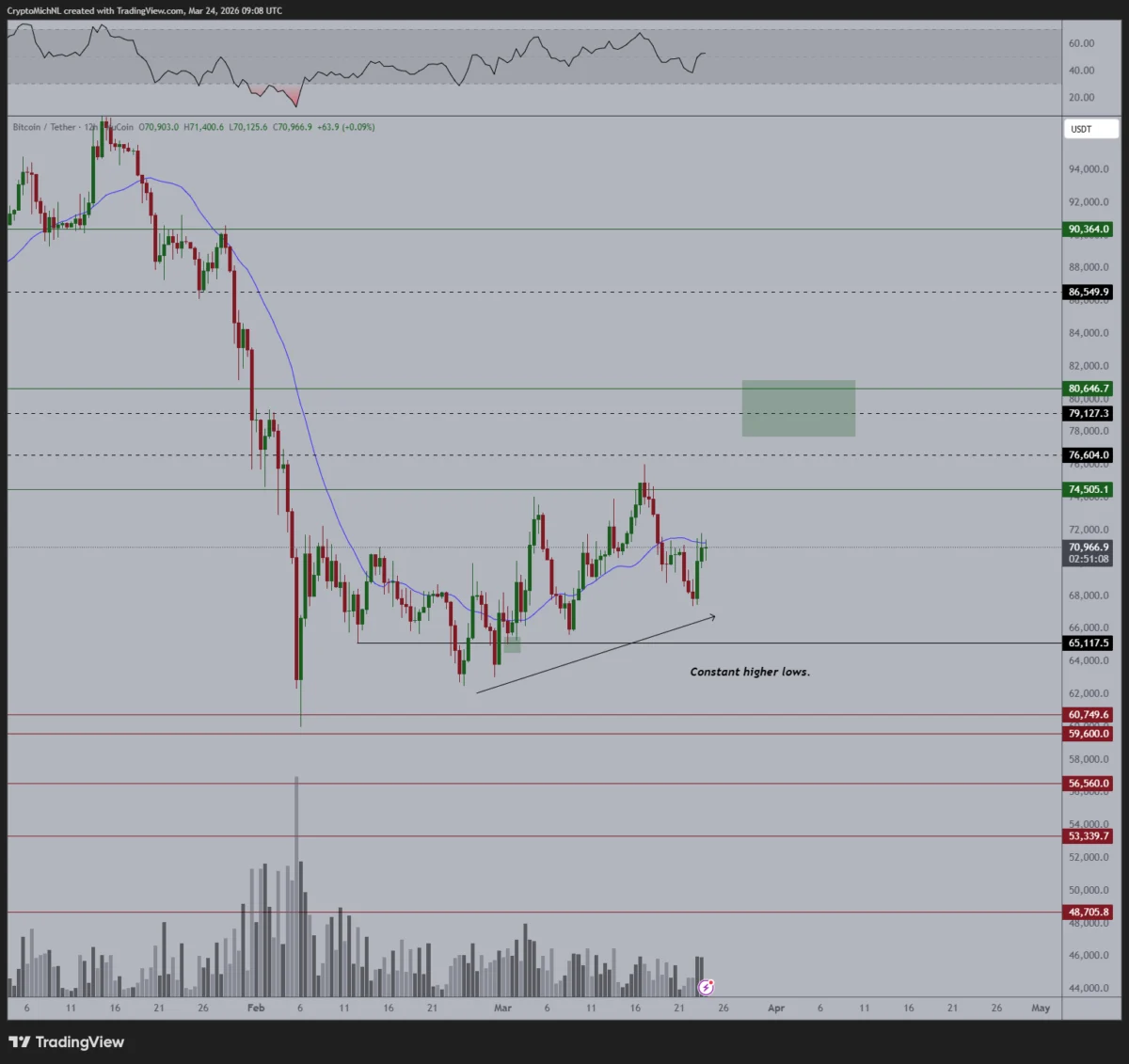
The market pullback on Tuesday was directly linked to renewed anxieties over potential conflict in the Middle East. Data from TradingView illustrated a 1.5% daily loss for BTC/USD, marking a retreat from its recent sprint towards $71,800. This reversal underscored the persistent vulnerability of even robust assets like Bitcoin to sudden shifts in the global geopolitical landscape. The $70,000 threshold holds considerable psychological and technical significance for Bitcoin, having acted as both a strong support and resistance level in recent months. Its breach often signals a shift in short-term sentiment, prompting closer scrutiny from traders and analysts.

The broader financial markets mirrored Bitcoin’s cautious sentiment. US stock markets opened lower, with the tech-heavy Nasdaq Composite Index, often a barometer for risk appetite, shedding nearly 1%. This reflected a general flight from risk assets as investors sought safer havens amid the uncertainty. Gold, traditionally a prime safe-haven asset, surprisingly failed to capitalize significantly on the tensions, struggling to break past $4,450. This muted reaction from gold could be interpreted in several ways, perhaps indicating a more complex interplay of factors or a temporary diversion of capital into other perceived safe assets, or even a skepticism regarding the long-term impact of the current geopolitical flare-up.
Meanwhile, oil prices, which are highly sensitive to Middle Eastern stability due to critical shipping lanes like the Strait of Hormuz, showed considerable volatility. After an initial drop at the week’s start, fueled by rumors of potential de-escalation between Iran and its adversaries, crude oil prices began inching back toward $95 per barrel. This upward trajectory was spurred by fresh reports of Israeli strikes on Lebanon, reigniting fears over potential disruptions to oil passage through the Strait of Hormuz, a vital chokepoint for global energy supplies. Higher oil prices typically translate to increased inflationary pressures, a factor that central banks closely monitor and which can influence interest rate policies, thereby impacting the attractiveness of risk assets like cryptocurrencies and stocks.

In its latest "Market Color" analysis, trading company QCP Capital offered insights into the prevailing market sentiment, highlighting the delicate balance being struck by global political leaders. The firm suggested that US President Donald Trump was actively navigating a complex geopolitical environment, aiming to maintain market stability despite ongoing military actions. "Trump is navigating an increasingly complex geopolitical minefield and now has very little room to manoeuvre," QCP Capital wrote, emphasizing the constrained policy options available. The analysis further elaborated on the tightrope walk: "With equities hovering near key support and inflation pressures lifting rate-hike expectations, he cannot afford to unsettle markets." This suggests that political decisions are being heavily influenced by the need to prevent further market destabilization, a factor that could limit the scope of military responses and potentially cap the duration of the current risk-off environment.
Despite the prevailing macro headwinds, QCP Capital noted a "surprising resilience" in Bitcoin’s price action. This observation challenged the conventional wisdom that Bitcoin would simply mirror traditional risk assets during periods of global uncertainty. The firm speculated on potential reasons for this resilience, including "lower leverage across the system," which implies that the cryptocurrency market may be less susceptible to cascading liquidations that often exacerbate downturns. More intriguingly, QCP Capital posited that this resilience "could also signal the very early stages of a regime shift for BTC, where it no longer competes with traditional risk assets in the same way." This "regime shift" theory suggests a potential decoupling of Bitcoin from traditional equities, where it might begin to be perceived more as a distinct asset class, perhaps akin to digital gold or an independent store of value, rather than merely a high-beta tech stock proxy. Such a shift, if it materializes, would have profound implications for Bitcoin’s long-term investment thesis and its role in diversified portfolios.

Building on a cautiously bullish outlook, prominent crypto trader Michaël van de Poppe highlighted positive technical signals for Bitcoin. He pointed to a consistent pattern of "higher lows" for BTC/USDT since a significant market correction in early February. In technical analysis, higher lows are a fundamental indicator of an uptrend, suggesting that buyers are stepping in at progressively higher price points, indicating underlying strength and sustained demand. "Bitcoin constantly prints higher lows since the crash early in February. It’s a great sign and it shows that we’re about to witness more strength," van de Poppe told his X followers. He projected potential targets for Bitcoin, suggesting that if current support levels hold, the cryptocurrency could "be able to reach $77-80K." However, he tempered his optimism with a crucial caveat: "It doesn’t say that we’re out of the woods entirely, as those higher lows trigger a lot of liquidity if the markets get there." This acknowledges the potential for market makers or large players to "hunt" for stop-loss orders placed below these higher lows, which could temporarily drive prices down before a rebound.
Conversely, not all analysts shared this cautiously bullish sentiment. Trader Jelle, for instance, warned of a potential "Bart Simpson" chart pattern unfolding on lower time frames. This colloquial term refers to a price action characterized by a sharp, sudden pump, followed by a period of sideways consolidation (the "head"), and then a rapid, equally sharp dump back to the original level (the "hairline"). Such a pattern is often indicative of market manipulation or a liquidity grab, and its appearance typically signals impending bearish price movement. Jelle’s warning suggested that the recent surge might be unsustainable and prone to a swift correction.

Adding another layer of skepticism, trader and analyst Rekt Capital expressed reservations about the reliability of a key long-term trend line, specifically the 200-week exponential moving average (EMA). As Cointelegraph previously reported, this significant technical indicator, positioned around $68,300, had recently demonstrated inconsistent behavior, failing to act as either definitive support during price dips or strong resistance during rallies. The 200-week EMA is traditionally viewed as a robust measure of an asset’s long-term trend, with sustained price action above it indicating a bullish trend and vice-versa. Its failure to confirm a clear role is therefore noteworthy. Rekt Capital summarized his concerns on X, stating, "The 200-week EMA is acting as both an unreliable resistance and an unreliable support, never truly confirming a clear role. Which thus could lend itself to further meandering in and around here before ultimately breaking down into additional Macro Downside over time." This assessment suggests that Bitcoin might be entering a period of prolonged sideways trading or even face further downside risk, rather than a clear upward trajectory, until a more decisive interaction with this crucial moving average is established.
In conclusion, Bitcoin’s recent stumble below $70,000 highlights the ongoing interplay between volatile geopolitical events and the cryptocurrency’s evolving market dynamics. While immediate pressures from Iran war tensions, rising oil prices, and broader stock market caution weigh heavily, some analysts point to Bitcoin’s "surprising resilience" and the potential "early stages of a regime shift." This emerging narrative suggests that Bitcoin might be gradually decoupling from traditional risk assets, positioning itself as a more independent store of value. Technical indicators present a mixed picture: Michaël van de Poppe’s observation of higher lows offers a cautiously bullish outlook towards potential targets of $77-80K, contingent on holding current levels. However, warnings from traders like Jelle about "Bart Simpson" patterns and Rekt Capital’s skepticism regarding the 200-week EMA’s reliability introduce notes of caution, suggesting potential for further short-term volatility or even a protracted period of sideways movement. Investors are thus navigating a complex landscape, where the promise of a rebound coexists with significant macro uncertainties and conflicting technical signals, necessitating careful monitoring of both global events and Bitcoin’s intricate price action.

This article does not contain investment advice or recommendations. Every investment and trading move involves risk, and readers should conduct their own research when making a decision. While we strive to provide accurate and timely information, Cointelegraph does not guarantee the accuracy, completeness, or reliability of any information in this article. This article may contain forward-looking statements that are subject to risks and uncertainties. Cointelegraph will not be liable for any loss or damage arising from your reliance on this information.