anjir abdul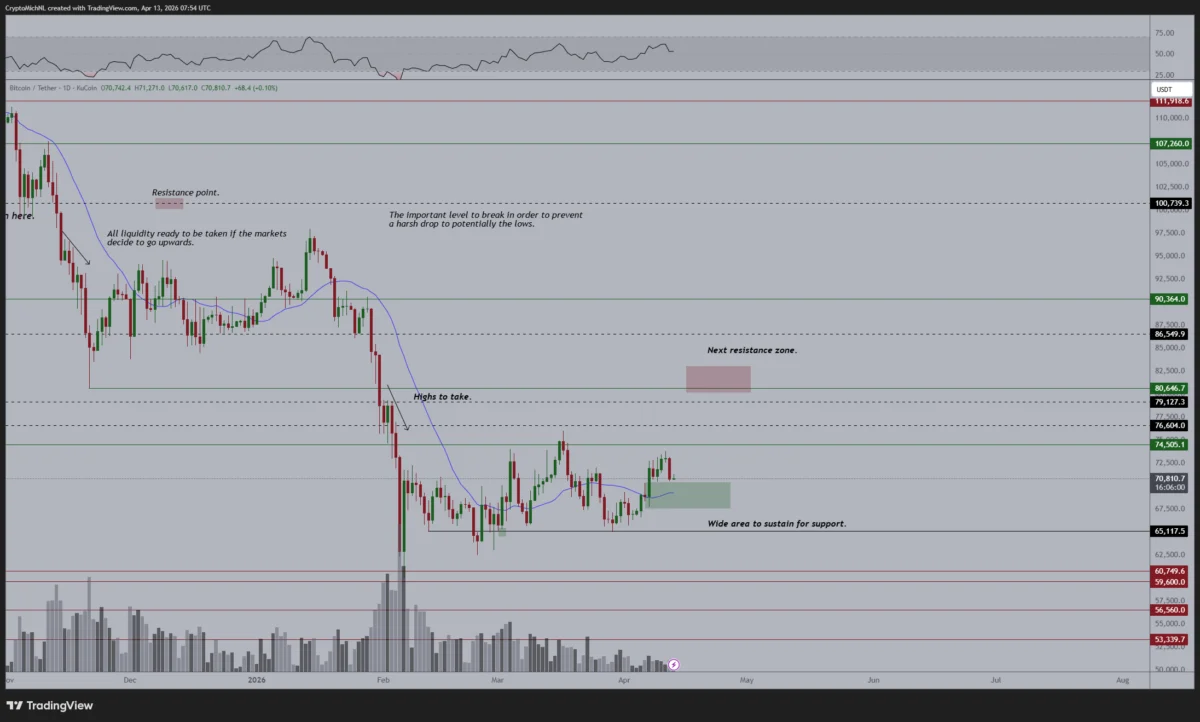
A critical shift in Bitcoin’s derivatives market dynamics has positioned latecomers who opened short positions above the $70,000 mark over the past weekend directly in the crosshairs of potential liquidation, following a significant wave of leveraged long positions being closed on Monday. This deleveraging event, often seen as a healthy market reset, has created a fertile ground for a potential short squeeze, especially given Bitcoin’s underlying valuation metrics suggest it remains significantly undervalued despite recent price movements.
The latest data from the Bitcoin futures market paints a clear picture of this leverage reset. On Monday, the weekly change in Bitcoin futures market open interest (OI) plummeted to -2.46%. This represents a sharp reversal from the 8.9% increase observed just a few weeks prior, on March 31, signaling a substantial decline in overall market leverage. Such a contraction suggests that a considerable amount of speculative capital has exited the market, reducing the immediate risk of cascading liquidations that often accompany overleveraged environments.
Beyond the immediate market mechanics, multiple long-term Bitcoin valuation metrics are currently flashing historic lows. Market analysts, including notable figures in the crypto space, are estimating that nearly 90% of the potential downside has already been absorbed and priced into Bitcoin’s current valuation, indicating a strong floor might be forming. This confluence of deleveraging and fundamental undervaluation presents a compelling narrative for a potential rebound, with late short positions facing an increasingly precarious outlook.
Bitcoin Futures Leverage Reset Meets Rising Short Bias

Bitcoin researcher Axel Adler Jr. provided insightful analysis into the weekly fluctuations of aggregate Bitcoin futures open interest, measured in BTC. The metric had peaked at a robust 8.9% on March 31, coinciding with Bitcoin’s push above the $73,000 threshold, reflecting heightened speculative activity and bullish sentiment. However, a dramatic reversal occurred, with the metric flipping to a stark -7.2% by April 4, marking the sharpest contraction witnessed in the recent period. As of Monday, the seven-day change stood at -2.46%, with the total open interest hovering near 318,000 BTC.
This pronounced shift into negative territory began manifesting on Sunday, signaling the initial stages of a broader deleveraging phase. What makes this particular contraction noteworthy, as Adler highlighted, is Bitcoin’s ability to maintain its price stability above the $70,000 level throughout this process. This resilience suggests that a substantial portion of long-side leverage was closed voluntarily or through orderly liquidations, rather than a frantic, cascading liquidation event that would typically trigger a sharp price crash. This orderly exit of long positions without a significant price drop can be interpreted as a sign of underlying market strength and a maturing investor base.
It’s crucial to understand that open interest data, by its nature, does not differentiate between voluntary position closures and forced liquidations. Therefore, the observed reduction is broadly characterized as a comprehensive leverage reset, cleansing the market of excess speculation. This "flushing out" of leverage is often considered a healthy development, clearing the path for more sustainable price discovery. Markets that shed excessive leverage tend to be more resilient and less prone to dramatic swings, setting the stage for more organic growth.
Adding another critical layer to this market analysis is the funding rate data. The seven-day average funding rate across major cryptocurrency exchanges, including Binance, Bybit, and OKX, has undergone a significant transformation. It tumbled from a positive 0.33% on March 31 to a negative -0.1738% by April 13. Funding rates are periodic payments made between long and short traders in perpetual futures contracts to keep the contract price pegged to the underlying asset’s spot price. A positive funding rate means long positions are paying shorts, indicating bullish sentiment, while a negative rate means shorts are paying longs, signaling bearish sentiment or an expectation of price decline.
The deeper negative values observed on platforms like Bybit and OKX are particularly telling, pointing to an increasingly strong short-side tilt in the market. This scenario implies that sellers are actively paying buyers to maintain their short positions, indicating a collective expectation among these traders that Bitcoin’s price is more likely to fall. However, this positioning against the current uptrend or stable price environment creates a perilous situation for these short-sellers. If the price holds steady or begins to recover, the continuous payments to long positions erode their profitability, and a sudden upward movement could trigger a rapid unwinding of these short bets, commonly known as a "short squeeze."

The current market setup thus paints a nuanced picture: an initial phase saw long positions exiting the market, often a precursor to price corrections. However, instead of a deep plunge, the price stabilized above $70,000, and subsequently, short positions aggressively stepped in, perhaps anticipating further downside. This combination – a stable price resisting a drop after longs are cleared, coupled with a growing negative funding rate indicating a strong short bias – creates ideal conditions for late short exposure to be "squeezed" out of the market should renewed demand for BTC emerge. A short squeeze occurs when a heavily shorted asset suddenly rises in price, forcing short-sellers to buy back their positions to cover their losses, which further fuels the price increase. This phenomenon can lead to rapid and significant upward price movements.
Data Says Bitcoin Is Still Undervalued
Beyond the immediate dynamics of the derivatives market, several long-term valuation metrics suggest that Bitcoin, despite its recent run-up, remains fundamentally undervalued. Michaël van de Poppe, founder of MN Capital and a respected voice in crypto analysis, highlighted three such long-term indicators that are currently flashing extreme lows, typically seen at significant market bottoms.
The first is the Puell Multiple Z-Score, an indicator that compares the daily issuance value of Bitcoin (miner revenue) in USD to its 365-day moving average. It essentially measures the profitability of Bitcoin miners and helps identify periods where miners are selling more or less than average. Currently, this metric is at its lowest reading in a decade. Historically, similar low levels have coincided with major Bitcoin price bottoms, notably in 2018, 2020, and 2022, signaling periods where selling pressure from miners has exhausted, and the asset is ripe for accumulation. This suggests that the market has absorbed significant selling from miners, who are often forced to sell newly minted BTC to cover operational costs, particularly during downturns.
The second metric is the Spent Output Profit Ratio (SOPR) Z-Score. This indicator tracks whether coins are being sold at a profit or a loss by comparing the price at which coins were last moved on the blockchain to their current selling price. A SOPR value above 1 indicates that coins are being sold at a profit, while a value below 1 indicates sales at a loss. The SOPR Z-Score, which normalizes this data, has reached its lowest point on record. This unprecedented low indicates widespread realization of losses across the market, a characteristic often observed near the exhaustion phases of bear markets or significant corrections. When a large percentage of market participants are selling at a loss, it typically signifies that capitulation has occurred, and those who were unwilling to hold through deeper drawdowns have already exited. This clears the way for new, conviction-driven buyers.

Finally, the Market-Value-to-Realized-Value (MVRV) Z-Score has also printed its weakest reading ever. The MVRV Z-Score compares Bitcoin’s market capitalization (market value) to its realized capitalization (realized value), which is the sum of all coin prices when they last moved on-chain. It essentially gauges whether the market is overvalued or undervalued relative to the average cost basis of all coins. A low MVRV Z-Score means the market value is close to or below the realized value, placing the BTC price near the aggregate cost-basis zones of most investors. Historically, extreme lows in the MVRV Z-Score have marked excellent long-term buying opportunities, as they indicate that the market is trading below its "fair value" based on the collective cost of acquisition.
Collectively, these three powerful on-chain metrics paint a comprehensive picture of a market that has undergone a significant reset. They indicate that most investors are no longer sitting on substantial unrealized profits, and much of the earlier euphoric buying that often accompanies market tops has cooled considerably. This type of broad market reset typically follows periods of heavy selling pressure, where short-term traders and weak hands exit their positions. As these participants leave, coins tend to shift into the hands of long-term holders, often referred to as "strong hands" or "smart money," who have a much longer investment horizon and higher conviction in Bitcoin’s future value. This transfer of ownership from speculative traders to long-term accumulators lays a robust foundation for future price appreciation.
While the market still shows visible liquidity around the $64,000 to $66,000 price levels, indicating potential support or areas where bids might accumulate, the $74,000 mark has proven to be a tested ceiling in recent weeks. Despite these immediate resistance and support zones, Van de Poppe remains optimistic about the broader market outlook. He stated, “For sure, markets can tumble and sweep the lows for liquidity, but I don’t think we’ll see much more downside in the markets, or at least 90% of the downside is already captured.” This sentiment reinforces the idea that the worst of the correction or consolidation phase might be behind us, and the market is now poised for a more sustained recovery, especially as the recent deleveraging clears the path.
In conclusion, the Bitcoin market is currently in a fascinating and potentially pivotal phase. The derivatives market has undergone a healthy deleveraging, with long positions cleared, yet the price has demonstrated remarkable resilience above $70,000. This has left a growing contingent of short-sellers in a vulnerable position, especially with negative funding rates indicating their collective bearish bias. Simultaneously, fundamental on-chain metrics are screaming undervaluation, suggesting that Bitcoin’s current price does not fully reflect its intrinsic value, and that the market has absorbed the vast majority of potential downside. This unique confluence of technical deleveraging and fundamental undervaluation sets the stage for a potential short squeeze, where any renewed buying pressure could trigger a rapid ascent, forcing late shorts to cover and fueling a significant upward price movement in Bitcoin. Investors should closely monitor these intertwined dynamics as the market navigates this critical juncture, with the odds increasingly stacked against those betting on further significant declines.
This article is produced in accordance with Cointelegraph’s Editorial Policy and is intended for informational purposes only. It does not constitute investment advice or recommendations. All investments and trades carry risk; readers are encouraged to conduct independent research before making any decisions. Cointelegraph makes no guarantees regarding the accuracy or completeness of the information presented, including forward-looking statements, and will not be liable for any loss or damage arising from reliance on this content.