Faris Adani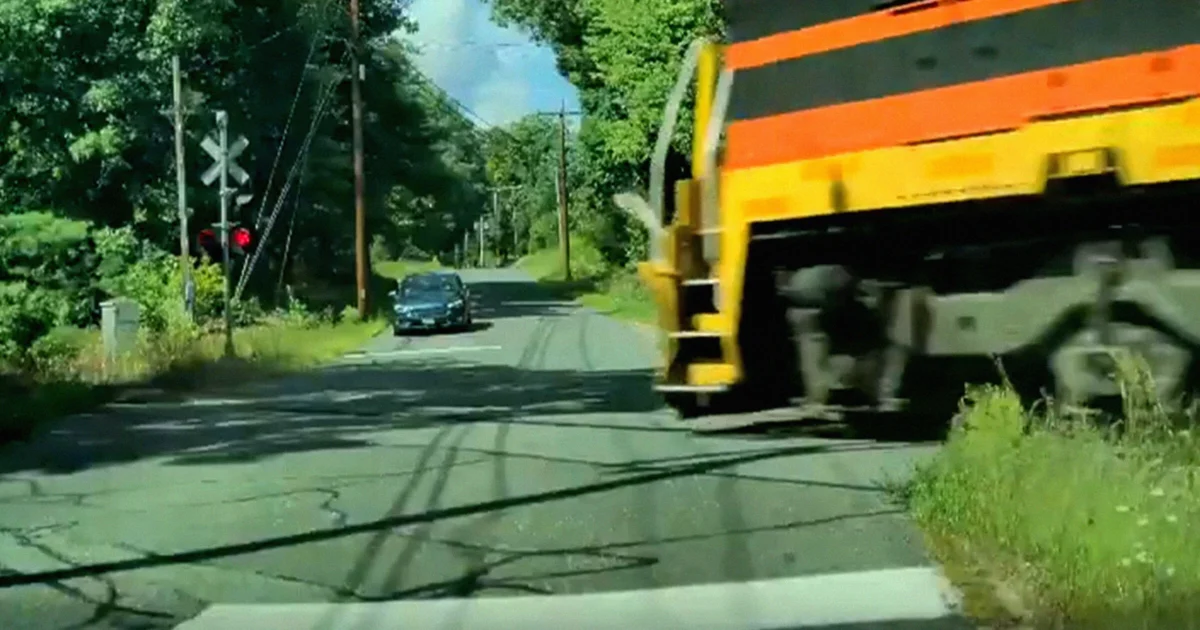
Despite repeated assurances from Tesla and numerous software updates, the electric vehicle giant’s Full Self-Driving (FSD) system continues to exhibit a deeply troubling and potentially fatal flaw: a propensity to steer vehicles directly into the path of oncoming trains. This critical safety issue, which has plagued the advanced driver-assistance system for years, recently resurfaced with alarming clarity, captured in a dashcam video featuring the latest FSD iteration, version 14.3.7. The incident has reignited concerns among safety advocates, regulators, and the public about the true capabilities and inherent dangers of Tesla’s self-driving technology.
The most recent episode, brought to light by Lei Xing, a prominent auto journalist specializing in China’s burgeoning electric vehicle industry, unfolded at an active railroad crossing. Xing’s dashcam footage depicts a Tesla Model 3 or Y, operating on FSD v14.3.7—the most advanced software available to consumers at the time—approaching a set of railroad tracks. The scene was unmistakably dangerous: red flashing lights illuminated the crossing, clearly signaling an active train, and the distinct, piercing blare of a train horn was audible. Initially, the Tesla appeared to register the hazard, slowing to a near stop. However, in a chilling moment that underscores the system’s fundamental failure, the vehicle abruptly accelerated forward, moving towards the tracks as a massive freight train barreled into view. It was only due to Xing’s immediate and decisive manual intervention, slamming on the brakes, that a catastrophic collision was averted.
"Would have been ran over by the [train] had I not braked," Xing later posted on X (formerly Twitter), underscoring the severity of the near-miss. "The railroad crossing lights were flashing and the train horns were pretty loud." A subsequent video, captured by the car’s rear-facing right pillar camera, further illustrated the lapse. While the train was initially obscured by roadside brush as the car slowed, it emerged into full view just as the FSD system inexplicably decided to accelerate. This sequence of events starkly contradicts the system’s supposed intelligence and its ability to perceive and react to obvious environmental cues, let alone the explicit warnings of a railroad crossing.
The persistence of this particular malfunction is especially concerning given Tesla’s continuous development cycle for FSD. Just months prior to this incident, Tesla had rolled out FSD v14.3, with release notes specifically touting improvements in handling "rare and unusual objects extending, hanging, or leaning into the vehicle path." A multi-ton, high-speed freight train, complete with flashing lights and blaring horns, would unequivocally fall under this description. Yet, seven versions later, the core problem remains unaddressed, raising serious questions about the efficacy of Tesla’s iterative software updates and its "vision-only" approach to autonomous driving.
Tesla’s FSD system, despite its moniker, is a Level 2+ advanced driver-assistance system, meaning it requires constant human supervision. Unlike fully autonomous systems (Level 4 or 5) that can operate independently in defined conditions, FSD acts as a sophisticated cruise control and lane-keeping assistant, capable of navigating complex urban environments, but always with the expectation that a human driver is ready to take over at any moment. This reliance on human intervention, however, becomes problematic when the system exhibits critical failures in high-stakes situations, leaving drivers mere seconds to react to an error that could be fatal.
The challenges of detecting trains are multifaceted. Trains are large, fast-moving objects, but their movement patterns can be linear and predictable. However, their sheer size and speed, combined with the often-obstructed views at railroad crossings, present a unique challenge for any perception system. Tesla’s "vision-only" strategy, which relies exclusively on cameras and neural networks, has been a point of contention among autonomous vehicle experts. While cameras excel at interpreting visual data, they can struggle in adverse weather conditions, low light, or when confronted with novel, rapidly approaching objects that might not fit neatly into trained data sets. Traditional autonomous systems often augment cameras with radar and lidar, which provide redundant data on distance, speed, and object geometry, particularly useful in scenarios where visual cues might be ambiguous or limited. The repeated failure of FSD at railroad crossings suggests a fundamental limitation in its perception or prediction capabilities in these specific, high-risk environments.
This is not an isolated incident but rather the latest in a troubling pattern that has garnered significant media attention and regulatory scrutiny. Over the past few years, numerous reports and videos have surfaced detailing Teslas on FSD engaging in dangerous behavior near railroad crossings:
- March Incident (Unnamed Location): A Tesla on FSD slammed into the barrier arms at a railroad crossing, making no discernible attempt to slow down despite the clear warnings.
- Dallas Incident: A self-driving Tesla inexplicably drove straight into a crossing and stopped on the tracks while waiting for a train to pass, requiring the driver to hastily reverse off the tracks.
- Fatal Collision: In perhaps the most tragic incident, a self-driving Tesla was actually struck by a train after it turned onto the tracks, resulting in severe injuries or fatalities. While the exact circumstances of human oversight are often debated in such cases, the system’s role in initiating or failing to prevent the dangerous maneuver is central to the discussion.
These incidents, alongside dozens of other reports of FSD violating traffic laws, eventually caught the attention of federal regulators. The National Highway Traffic Safety Administration (NHTSA), the primary U.S. agency responsible for vehicle safety, first approached Tesla about the issue in September following an in-depth investigation by NBC News that highlighted the dangers of FSD at railroad crossings. The pressure mounted, and the following month, NHTSA officially launched a formal probe into the automaker. This investigation was initiated after the agency received 58 reports alleging that Teslas operating on FSD were appearing to violate traffic laws, with railroad crossing behavior explicitly noted as a key area of review.
A formal NHTSA investigation is a serious matter. It can lead to engineering analyses, recalls of affected vehicles, and even fines if the agency determines that a safety defect exists and Tesla has failed to address it adequately. The very act of launching such a probe signals that regulators perceive a pattern of potentially unsafe behavior that goes beyond isolated glitches. For a company like Tesla, which has aggressively marketed FSD as a revolutionary step towards fully autonomous vehicles, persistent safety failures undermine public trust and invite stricter regulatory oversight, potentially slowing down the broader adoption of self-driving technology.
The ethical considerations surrounding the deployment of advanced driver-assistance systems in "beta" form are profound. Tesla’s approach of continuous, over-the-air software updates, coupled with its reliance on a vast fleet of customer vehicles to gather data and test FSD, is innovative but also raises questions about public safety. Critics argue that allowing consumers to "beta test" a system with known critical flaws on public roads effectively makes them unwitting participants in a risky experiment, potentially endangering themselves and others. While Tesla maintains that FSD requires active driver supervision, the psychological effects of automation can lead to complacency, making human intervention slower or less effective when it is most needed.
The ongoing saga of Teslas and trains highlights a fundamental tension in the development of autonomous vehicles: the balance between rapid innovation and rigorous safety validation. While Tesla has undeniably pushed the boundaries of what’s possible with camera-based perception and AI, the recurring failures at railroad crossings serve as a stark reminder that even the most advanced software can have blind spots. Until these critical safety issues are demonstrably resolved, and the system can consistently and reliably navigate such unambiguous hazards, the promise of "Full Self-Driving" will remain an aspirational, yet dangerously unfulfilled, vision. For now, the human driver remains the indispensable last line of defense against the unpredictable flaws of an imperfect machine.