Imroatul Nasiyah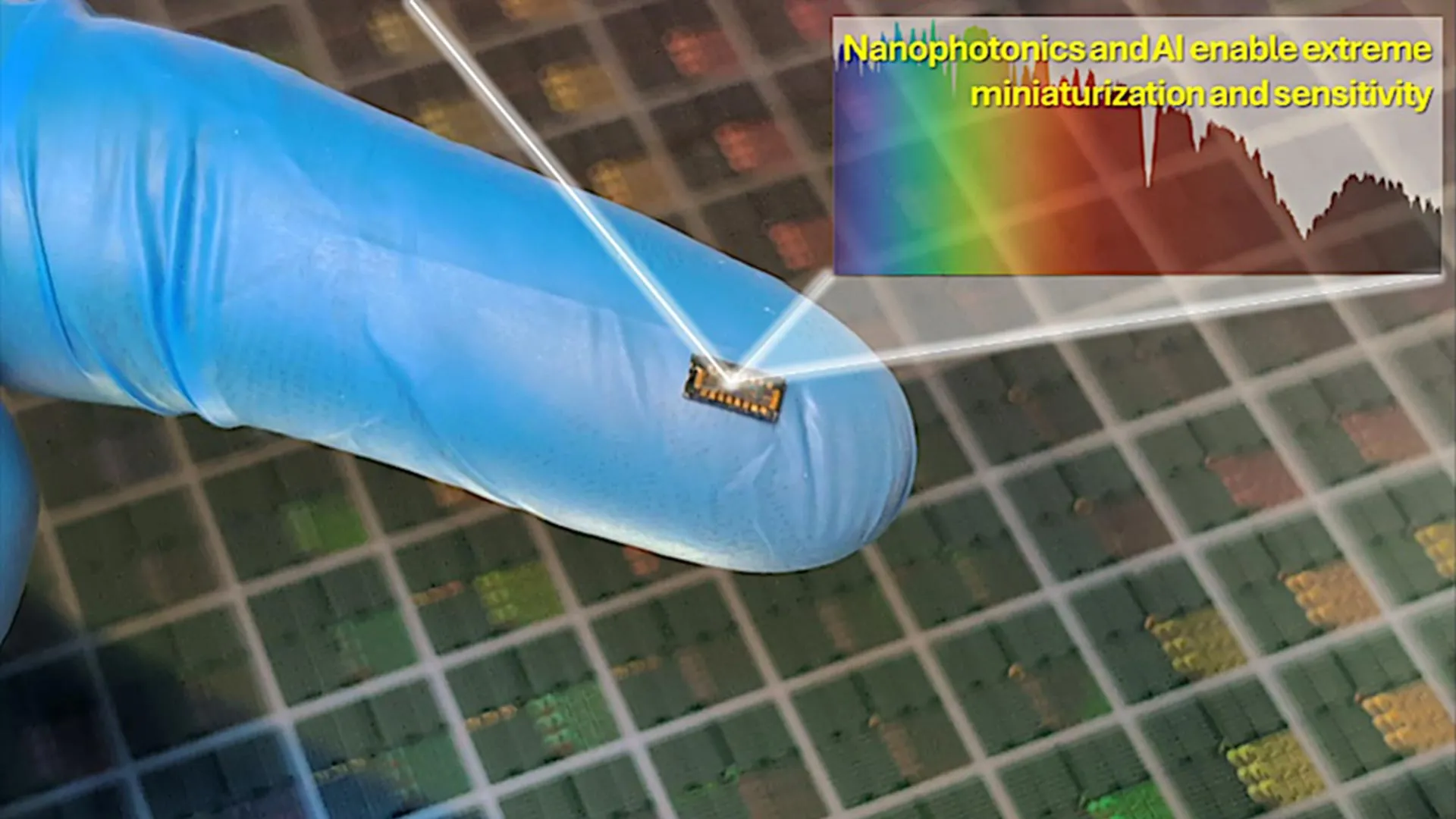
Now, a groundbreaking development from researchers at the University of California, Davis (UC Davis) promises to shatter these limitations, offering a dramatically more compact and accessible alternative. In a landmark publication in the esteemed journal Advanced Photonics, the UC Davis team has unveiled a spectrometer-on-a-chip so infinitesimally small that its dimensions approach that of a single grain of sand. This revolutionary device represents a paradigm shift in spectroscopic analysis, fundamentally departing from the established reliance on bulky optical components for physical light separation. Instead, the new system ingeniously harnesses the power of artificial intelligence (AI) in conjunction with a compact array of meticulously engineered sensors to computationally reconstruct the light spectrum. This fusion of advanced sensing and intelligent processing bypasses the need for traditional optical dispersion, paving the way for unprecedented miniaturization.
Replacing Bulky Optics With AI: A Computational Spectroscopic Revolution
The core innovation of this miniature spectrometer lies in its radical departure from the conventional method of physically spreading light into a visible rainbow. Rather than relying on prisms or gratings, the chip is equipped with a modest yet highly specialized array of 16 unique silicon detectors. Each of these detectors has been meticulously designed and engineered to exhibit a distinct and subtle response to incoming light. Crucially, these detectors do not directly isolate individual colors. Instead, they capture a complex ensemble of encoded signals. These signals, while seemingly obscure on their own, contain deeply embedded spectral information, acting as a form of encrypted data about the light’s composition.
To better understand this sophisticated approach, consider an analogy: imagine a group of highly specialized tasters, each trained to discern unique nuances and subtle flavors within a complex culinary mixture. Individually, each taster might only grasp a fragment of the overall flavor profile. However, when their collective observations and assessments are pooled and synthesized, they provide a comprehensive and detailed understanding of the entire dish. Similarly, in this spectroscopic system, each silicon detector captures only a partial, encoded representation of the light spectrum. But when the data from all 16 detectors are aggregated, they generate a rich tapestry of information that is sufficiently detailed for the AI to accurately reconstruct the original light spectrum.
The second indispensable component of this revolutionary system is a sophisticated, fully connected neural network. This AI model has undergone an intensive training regimen, being exposed to thousands of diverse spectral examples. Because the signals emanating from the silicon detectors are inherently noisy and highly encoded, the neural network is tasked with learning the intricate and often non-linear relationship between these raw detector signals and the actual, true spectrum of light. This computational prowess allows the system to elegantly solve what researchers term an "inverse problem"—a class of problems where one infers causes from observed effects. By successfully navigating this inverse problem, the AI-powered spectrometer can reproduce spectral data with remarkable accuracy, achieving a resolution of approximately 8 nanometers (nm), all without the need for any bulky optical hardware. This computational reconstruction is a monumental leap forward, enabling unprecedented miniaturization and portability.
Expanding Silicon’s Reach Into the Infrared Range: Unlocking New Applications
A significant and transformative breakthrough underpinning this technology emerged from the innovative modification of the surface of standard silicon photodiodes. Researchers achieved this by applying specialized photon-trapping surface textures (PTSTs). Silicon, while an excellent material for detecting visible light, typically exhibits limited performance when it comes to capturing near-infrared (NIR) light, which encompasses wavelengths extending up to approximately 1100 nm. The near-infrared spectrum is of paramount importance for a wide array of advanced applications, particularly in biomedical imaging. This is due to NIR light’s superior ability to penetrate human tissues more deeply than visible light, allowing for non-invasive imaging of subsurface structures and physiological processes.
The ingeniously engineered PTST surfaces fundamentally alter the behavior of light as it interacts with the chip. Instead of allowing NIR photons to pass unimpeded through the relatively thin silicon layer, the textured surface causes the light to scatter repeatedly. This repeated scattering significantly increases the probability that the silicon will absorb the incident photons. Consequently, this modification renders the chip sensitive across a much broader spectral range than conventional silicon sensors, effectively extending its utility into the crucial near-infrared region and beyond. This enhanced spectral coverage unlocks a vast new landscape of potential applications that were previously unattainable with standard silicon-based spectroscopic devices.
Capturing Ultrafast Light Interactions: Illuminating Fleeting Phenomena
The innovative architecture of this AI-powered spectrometer extends its capabilities far beyond simple color detection. The chip incorporates high-speed sensors that are adept at measuring photon lifetimes with an extraordinary degree of temporal precision. This exceptional temporal resolution empowers the device to detect and analyze ultrafast interactions between light and matter – phenomena that occur on timescales so short that they often elude detection by traditional spectrometers entirely. These fleeting interactions can provide invaluable insights into fundamental chemical processes, dynamic molecular behavior, and the intricate mechanisms of energy transfer.
The ability to capture these transient events opens exciting new avenues for advanced forms of sensing and imaging. Researchers anticipate that this capability will enable the development of sophisticated diagnostic and analytical tools that were previously confined to the realm of highly specialized, large-scale, and prohibitively expensive research equipment. This democratization of advanced spectroscopic capabilities promises to accelerate scientific discovery and technological innovation across numerous fields.
Tiny Footprint With Big Potential: A Future of Ubiquitous Spectroscopy
The culmination of these engineering marvels is a complete system that occupies a minuscule footprint of just 0.4 square millimeters. Remarkably, this incredibly compact size does not come at the expense of performance. The chip maintains high sensitivity and exhibits robust resistance to electrical noise – a perennial challenge for the development of portable, low-cost electronic devices. Even when operating in environments characterized by significant electrical interference, the AI-assisted design proves adept at preserving clear signal quality, ensuring reliable and accurate spectral measurements.
By masterfully combining the power of machine learning with enhanced silicon light detection capabilities, this groundbreaking technology is poised to revolutionize the field of sensing. It paves the way for the creation of compact, real-time hyperspectral sensing devices that can be seamlessly integrated into a wide array of applications. The potential applications are vast and transformative, spanning from portable medical diagnostic tools that can identify diseases at their earliest stages to wearable health monitors that continuously track physiological biomarkers. Furthermore, this technology holds immense promise for environmental remote sensing, enabling detailed analysis of atmospheric composition and water quality from compact, deployable platforms. In the realm of food quality analysis, it could offer rapid, on-site assessments of freshness, ripeness, and the presence of contaminants, ensuring safer and higher-quality food products. The advent of this AI-powered spectrometer chip marks a significant milestone, shrinking the power of laboratory analysis to a size that can fit on the tip of a finger, heralding a future where sophisticated chemical analysis is not only accessible but ubiquitous.