Imroatul Nasiyah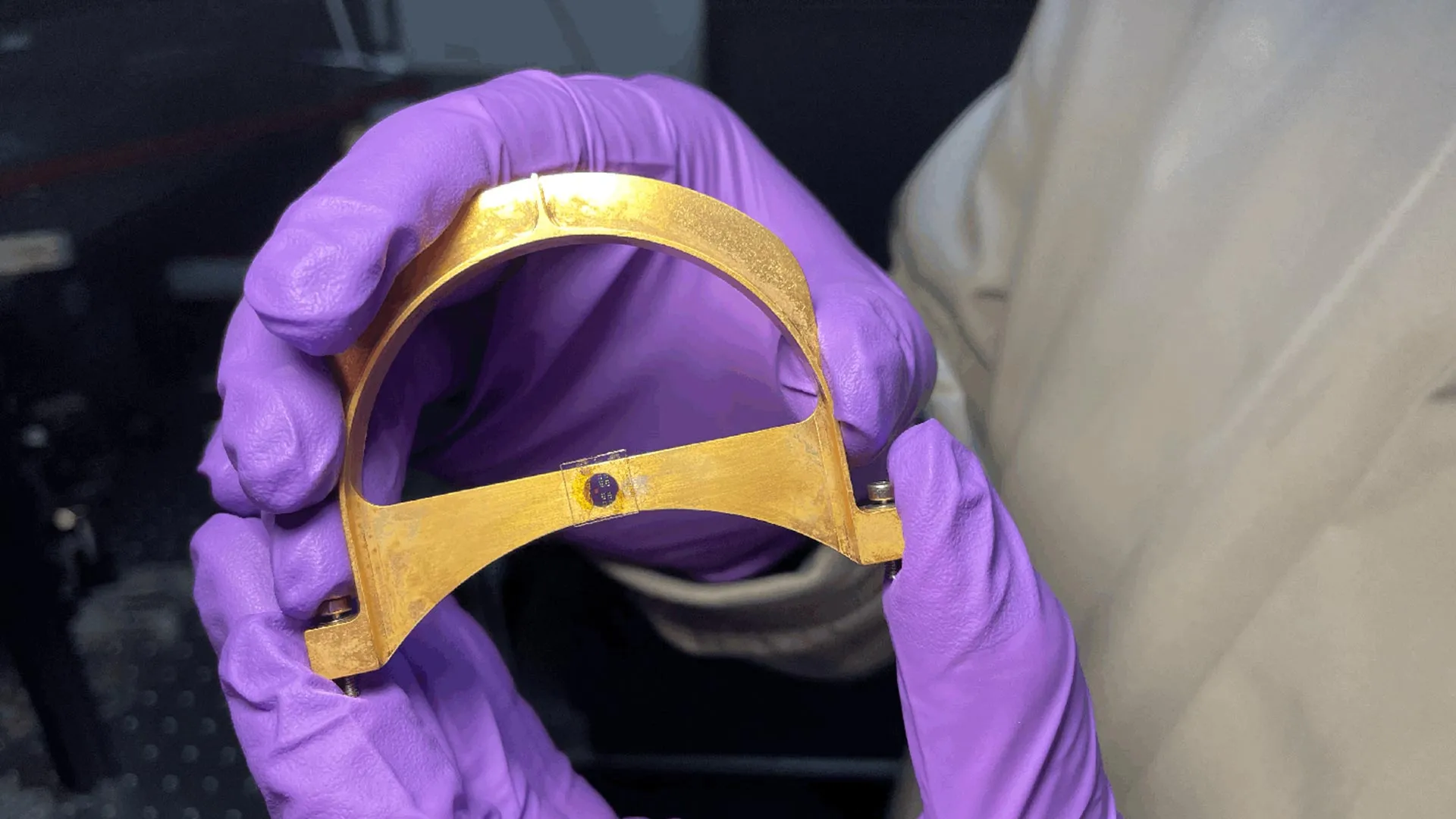
Jennifer Dionne, a distinguished professor of materials science and engineering at Stanford and the senior author of the study published in the prestigious journal Nature Communications, elaborated on the novelty of their approach. "The material in question is not really new, but the way we use it is," she stated. "It provides a very versatile, stable spin connection between electrons and photons that is the theoretical basis of quantum communication. Typically, however, the electrons lose their spin too quickly to be useful." This loss of "spin," a quantum property analogous to angular momentum, is a critical hurdle that their new device effectively overcomes.
The ingenious device is a carefully orchestrated combination of a thinly patterned layer of molybdenum diselenide (MoSe2) and a nanopatterned silicon substrate. Molybdenum diselenide belongs to a fascinating family of materials known as transition metal dichalcogenides (TMDCs). These materials have garnered considerable attention for their exceptional optical and quantum properties, making them ideal candidates for advanced technological applications. However, it is the silicon nanostructures, meticulously engineered on the substrate, that are the true catalysts for this breakthrough.
According to the research team, these silicon nanostructures are instrumental in generating what they have termed "twisted light." Feng Pan, a postdoctoral scholar in Dionne’s lab and the lead author of the paper, provided further insight: "The Silicon nanostructures enable what we call ‘twisted light.’ The photons spin in a corkscrew fashion, but more importantly, we can use these spinning photons to impart spin on electrons that are the heart of quantum computing." This "twisted" or "vortex" light possesses orbital angular momentum, which can be transferred to the electrons, influencing their quantum spin state.
Dionne further emphasized the remarkable scale of these engineered structures. "The patterned nanostructures are imperceptible to the human eye, about the size of the wavelength of visible light," she explained. "But they help us manipulate photons very precisely to make them spin — to twist them — in a specific direction, for example, up or down." This precise control over photon spin is crucial for establishing and maintaining the entangled states necessary for quantum computation. The ability to precisely guide and manipulate light at this nanoscale level is a testament to the sophistication of the fabrication techniques employed by the Stanford team.
The practical implications of this twisted light are profound. Researchers can leverage this phenomenon to induce entanglement with electron spins, effectively creating qubits. Qubits are the fundamental units of information in quantum computing, analogous to the bits in classical computing, but with the extraordinary ability to exist in multiple states simultaneously, a phenomenon known as superposition. In conventional computing, information is represented by binary digits, either a 0 or a 1. Quantum technologies, however, harness quantum mechanical effects, allowing qubits to represent 0, 1, or a combination of both, leading to exponentially greater processing power for certain types of problems.
One of the most significant and persistent challenges plaguing the advancement of quantum technologies is the maintenance of stable quantum states. In many existing quantum systems, the delicate quantum information encoded in qubits is extremely susceptible to environmental disturbances, a process known as decoherence. To counteract this, researchers have historically relied on cryogenic cooling, often requiring temperatures near absolute zero (-459 degrees Fahrenheit or -273 degrees Celsius) to minimize thermal vibrations and other noise sources that can disrupt these fragile states. This reliance on extreme cooling not only makes quantum computers incredibly expensive to build and operate but also limits their portability and widespread adoption.
The Stanford team’s new device circumvents this major obstacle by functioning effectively at room temperature. This eliminates the need for costly and complex cryogenic infrastructure, a critical step towards democratizing quantum technology. Furthermore, the researchers highlight the compact design of their device, which is also relatively inexpensive and practical when compared to the complex and bulky systems prevalent in current quantum research. This combination of room-temperature operation and reduced cost has the potential to accelerate the development and deployment of a wide range of quantum applications.
The potential applications stemming from this breakthrough are vast and transformative. If further developed and scaled, this technology could contribute significantly to advancements in several critical fields:
- Secure Communications: Quantum communication networks, leveraging entanglement, offer the promise of inherently secure communication channels that are impossible to eavesdrop on without detection.
- Advanced Sensing: Quantum sensors, built upon principles of quantum mechanics, can achieve unprecedented levels of sensitivity and precision for detecting minute changes in physical quantities, leading to breakthroughs in medical imaging, navigation, and fundamental scientific research.
- High-Performance Computing: Quantum computers have the potential to solve certain complex problems that are intractable for even the most powerful supercomputers today, including drug discovery, materials science simulations, and financial modeling.
- Artificial Intelligence: Quantum computing could revolutionize machine learning algorithms, enabling the development of more powerful and efficient AI systems capable of tackling complex pattern recognition and optimization tasks.
The selection of TMDC materials was a deliberate choice driven by their inherent and unusual quantum characteristics. The research team’s collaboration with Stanford colleagues Fang Liu and Tony Heinz, who are experts in these specialized materials, was instrumental in realizing the device’s potential. "It all comes down to this material and our Silicon chip," Pan emphasized. "Together, they efficiently confine and enhance the twisting of light to create a strong coupling of spin between photons and electrons. This stabilizes the quantum state that makes quantum communication possible." This synergistic interaction between the TMDC and the silicon nanostructures allows for a significantly stronger coupling between light and matter, which is crucial for preserving the delicate quantum properties required for communication and computing tasks.
Looking towards the future, the researchers are not resting on their laurels. They are actively engaged in refining the existing device and exploring other TMDC materials and novel material combinations that could offer even greater performance enhancements. A particularly exciting avenue of research involves investigating whether these room-temperature systems might unlock entirely new quantum capabilities that are currently only observable under extreme conditions.
A long-term vision for the Stanford team is the integration of such devices into larger, more complex quantum networks. Achieving this ambitious goal will necessitate continued advancements in supporting technologies, including more efficient light sources, sophisticated modulators, highly sensitive detectors, and robust interconnects. The ultimate aspiration is to miniaturize quantum components to such an extent that they can be seamlessly integrated into everyday electronic devices. While the prospect of quantum computing within a smartphone may be a decade or more away, as Pan optimistically suggests, this recent work represents a significant and tangible step towards making quantum technology more accessible, practical, and ultimately, ubiquitous. This breakthrough signifies a pivotal moment in the quest to harness the power of quantum mechanics for the benefit of humanity.