anjir abdul
The research, conducted by esteemed economists Michael Weber, Bernardo Candia, Olivier Coibion, and Yuriy Gorodnichenko, leveraged an extensive dataset compiled from repeated surveys involving as many as 25,000 U.S. households per wave. Their meticulous analysis revealed that expectations about future crypto returns explain a far greater proportion of the variation in cryptocurrency ownership than a broad spectrum of traditional demographic characteristics such as age, income, or gender. This finding starkly contrasts with traditional financial markets, where demographic and financial profiles typically hold more sway in predicting asset ownership. For crypto, the conviction in future gains reigns supreme.
One of the paper’s most illuminating contributions is its demonstration of how easily these beliefs can be influenced. Through a randomized information experiment, the researchers showed that simply providing individuals with data about Bitcoin’s (BTC) recent performance could significantly alter their investment intentions. Participants who were exposed to information about Bitcoin’s past 12-month returns subsequently increased their desired crypto portfolio allocation by approximately 2 percentage points. This represented a remarkable 47% increase relative to the 4.3% desired allocation observed in the control group. More tellingly, actual subsequent crypto purchases also rose by about 2.5 percentage points among this informed cohort. The authors explicitly state that "providing information about recent Bitcoin returns induces some households to start buying cryptocurrency," underscoring the potent psychological impact of past performance data.
This mechanism offers a powerful lens through which to view the dynamics of speculative bubbles. The study posits that positive returns serve as a powerful magnet, attracting new participants into the market. These new inflows of capital, in turn, push prices higher, further reinforcing bullish expectations and drawing in even more buyers, thereby creating a self-perpetuating cycle. The authors succinctly put it: "Positive returns attract new participants, which raises the price further." This feedback loop, driven by easily swayed beliefs, can lead to rapid price appreciation that may not always be tethered to underlying fundamentals, explaining much of crypto’s characteristic boom-and-bust cycles.

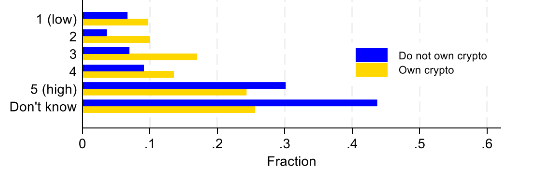
The study also shed light on a pervasive lack of understanding surrounding cryptocurrency. A striking 87% of individuals who did not own crypto in the researchers’ 2021 survey admitted they had no idea what return to expect from it over the subsequent year. Even among crypto owners, this figure remained substantial at 54%. This widespread informational void creates fertile ground for belief-driven markets, where individuals are more susceptible to narrative, sentiment, and recent price action rather than rigorous fundamental analysis.
For those willing to venture a forecast, the divergence in expectations was stark. Crypto owners anticipated an average return of 22% over the coming year, a stark contrast to the mere 7% expected by non-owners. Furthermore, owners tended to perceive crypto as less risky than their non-owning counterparts, highlighting a potential cognitive bias or a selective interpretation of risk information. This significant gap in expected returns proved to be an exceptionally powerful predictor of ownership. A mere one-percentage-point increase in an individual’s expected crypto return was associated with a 0.8-percentage-point increase in the probability of owning cryptocurrency. This demonstrates that conviction in future gains, rather than traditional financial metrics or personal circumstances, is the paramount factor driving crypto adoption.
While the study emphasizes the primacy of beliefs, it doesn’t entirely dismiss demographic factors. The demographic profile of crypto investors does remain distinct, albeit less explanatory than return expectations. Individuals under 40 were 13 percentage points more likely to own cryptocurrency than those over 60, even after accounting for other characteristics. Men exhibited a 4 percentage point higher likelihood of crypto ownership compared to women, and higher-income and wealthier households also showed a greater propensity to participate in the crypto market. However, these factors, while present, played a secondary role to the powerful influence of perceived future returns.
The information experiment’s findings are particularly consequential for market participants and regulators alike. The effect of providing information about past Bitcoin returns was concentrated among those who previously cited a lack of sufficient information as their reason for not owning crypto. Crucially, those who already harbored a negative view of crypto as a "bad investment" generally remained unmoved by the information treatment. This suggests that while new, uninformed potential investors are highly susceptible to positive past performance data, deeply entrenched negative beliefs are more resistant to change. This dynamic implies that market rallies are particularly effective at expanding the investor base by converting the "information-deficient" rather than the "crypto-skeptics."
Beyond investment behavior, the paper also explored the spillover effects of crypto wealth into household consumption patterns. The researchers observed that a doubling in Bitcoin’s price made a household whose entire financial portfolio was in crypto 1.4 percentage points more likely to purchase a durable good. This is roughly equivalent to a 7% increase relative to the unconditional probability of such a purchase. However, this effect did not extend to ordinary, day-to-day spending. This led the researchers to a striking comparison: crypto gains appear to be treated more like "gambling income" or lottery winnings than a permanent increase in wealth. This suggests a different psychological accounting for crypto profits, where they are viewed as windfall gains rather than a sustained boost to financial well-being, influencing discretionary, one-off purchases more than fundamental lifestyle changes.
The broader implication of the Cleveland Fed’s research is that crypto’s inherent volatility may stem less from conventional market fundamentals and more from a unique blend of widespread disagreement, a significant knowledge gap, and the iterative learning process among investors. The authors conclude that cryptocurrency stands out because it is largely poorly understood by a significant portion of the population, leading investors to form sharply divergent views about its future prospects. Crucially, new information, particularly regarding past returns, can profoundly alter both these expectations and subsequent investment behavior.
The paper’s final assertion resonates deeply: "The absence of common information and beliefs about crypto across investors suggests that price volatility will continue to be one of the most defining characteristics of this new asset for the foreseeable future." For the crypto markets, this suggests a potentially uncomfortable but realistic conclusion: the trajectory of future retail demand may not solely hinge on Bitcoin’s price performance in isolation, but critically on how that past performance is communicated and perceived by the ever-evolving pool of potential investors. This research underscores the behavioral economics at play in the digital asset space, emphasizing that understanding investor psychology and information dissemination is as crucial as analyzing market data for predicting the future of cryptocurrency.