anjir abdul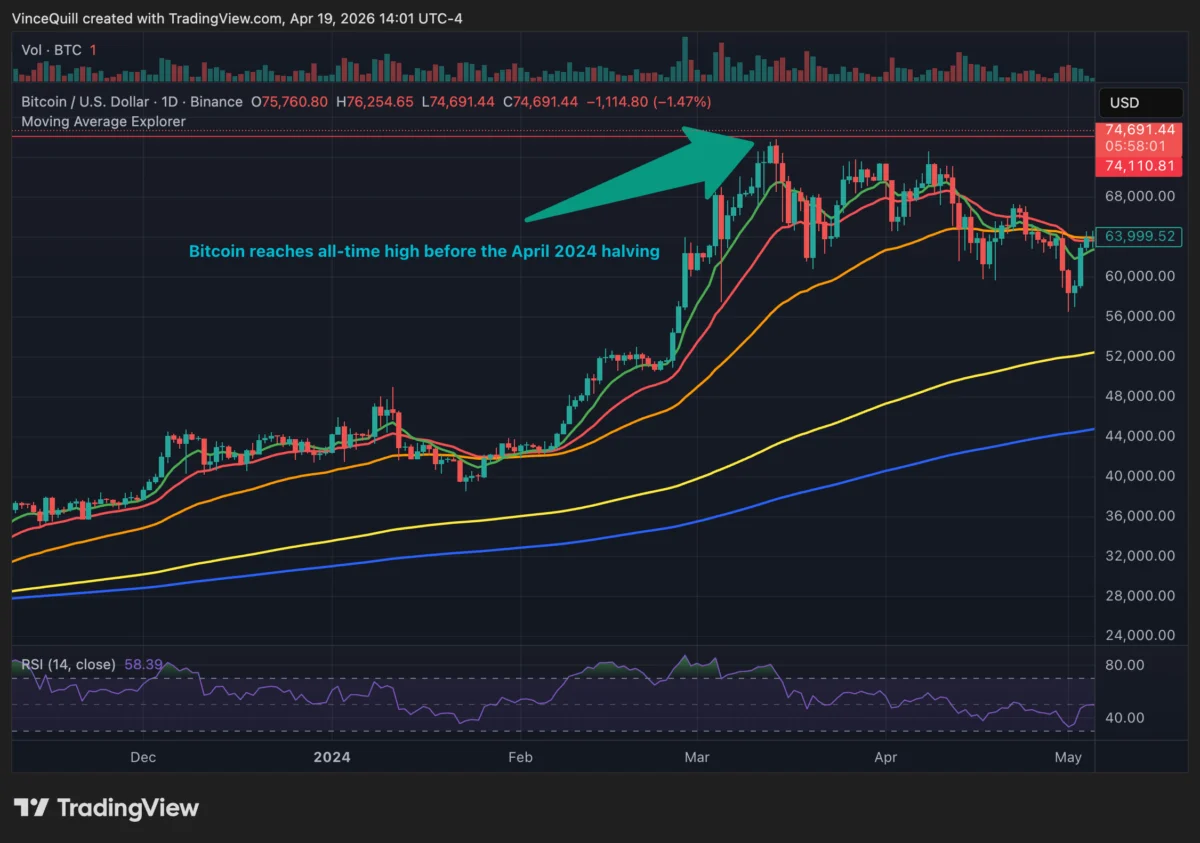
The current Bitcoin (BTC) market cycle, initiated by the highly anticipated April 2024 halving event, is demonstrating significantly weaker performance compared to its three predecessors, a stark observation made by Alex Thorn, the esteemed head of firmwide research at investment firm Galaxy. Thorn’s comprehensive analysis reveals a dramatic underperformance characterized by notably dampened volatility and a considerably lower upside potential, prompting market participants to question the future trajectory of the world’s leading cryptocurrency.
Thorn’s methodology involved a direct comparison of Bitcoin’s price action since the pivotal April 2024 halving against the market cycles that followed the halvings in 2012, 2016, and 2020. Historically, Bitcoin halvings, which reduce the rate at which new BTC is created, have been perceived as catalysts for significant price rallies due to the resulting supply shock. However, the current, or fourth, cycle appears to be diverging from this established pattern. While past cycles were defined by explosive growth and extreme price swings, the period post-April 2024 has shown a markedly different character. Thorn highlighted that a hypothetical all-time high above $125,000 projected for October 5, 2025, would represent an increase of merely 97% from the 2024 halving price of approximately $63,000. This figure stands in stark contrast to the historical gains seen in previous cycles, painting a picture of diminished returns.
To put this into perspective, the 2012 halving cycle witnessed an astounding price increase of about 9,294%, propelling Bitcoin from its post-halving base to a peak of roughly $1,163. The subsequent 2016 halving cycle, while not as explosive, still delivered an impressive climb of approximately 2,950%, culminating in an all-time high near $19,891. Even the more recent 2020 halving cycle, amidst a backdrop of increasing institutional interest and global economic shifts, saw Bitcoin’s price surge by about 761%, leading to a peak around $69,000. These historical figures underscore the "dramatic underperformance" of the current cycle, where a projected doubling of the price (97% gain) pales in comparison to the thousands-of-percent rallies of earlier periods.
"Cycle four is dramatically underperforming prior cycles," Thorn succinctly stated in an X post, articulating the core of his research. His sentiment was encapsulated in a probing question that resonates with many in the crypto community: "Is this the new normal, or is it the new normal until it isn’t?" This rhetorical query encapsulates the uncertainty and speculative nature that continues to define the crypto market, even as Bitcoin matures. It forces a reevaluation of long-held assumptions about halving-driven price dynamics and the very nature of Bitcoin’s market evolution.

The observed decrease in volatility across successive BTC halving cycles is a significant trend, suggesting a fundamental shift in traditional market dynamics. This evolving landscape indicates that Bitcoin’s price may increasingly be influenced by a broader array of factors beyond the immediate supply shock of a halving or the widely recognized four-year market cycle theory. As the asset matures and gains wider acceptance, its price action could become more aligned with conventional financial assets, responding to macroeconomic indicators, regulatory developments, and institutional capital flows rather than purely endogenous events like halvings.
Empirical data further supports the notion of reduced volatility. The 30-day Bitcoin Volatility Index, a key metric for gauging market fluctuations, provides compelling evidence. This index, which spiked to a substantial 9.64% on April 2, 2020, during the lead-up to the third halving, has remained notably subdued in the current cycle. It has not surpassed 3.11%, a reading last recorded on August 24, 2024. More recently, the latest 30-day estimate for this crucial volatility gauge stands at an even lower 1.75%, according to data compiled by Bitbo. This sustained decline in volatility suggests that Bitcoin is becoming a less speculative and potentially more stable asset, a characteristic often associated with market maturity. While some investors might lament the absence of the dramatic price swings that characterized earlier cycles, others might view this as a sign of Bitcoin solidifying its position as a legitimate, albeit still nascent, asset class.
However, Thorn’s analysis, while robust, has not gone without scrutiny. Critics argue that the current cycle’s performance is unfairly judged by overlooking a critical "historic anomaly": the premature all-time high (ATH) Bitcoin achieved before the April 2024 halving. This unprecedented event saw Bitcoin surpass its previous ATH, reaching above the $70,000 level in March 2024, approximately one month prior to the halving. This pre-halving rally significantly altered the typical cycle dynamics, which traditionally see Bitcoin consolidate or even decline slightly before the halving, only to surge dramatically afterward.
The primary catalyst for this pre-halving price pump was the monumental approval of spot Bitcoin exchange-traded funds (ETFs) in the United States in January 2024. This regulatory landmark opened the floodgates for institutional capital, allowing traditional investors to gain exposure to Bitcoin through regulated and easily accessible investment vehicles. The influx of billions of dollars from institutional players, coupled with renewed retail interest, propelled Bitcoin to new heights ahead of schedule, fundamentally reshaping the market’s structure and timing. This direct injection of demand, independent of the halving’s supply-side mechanics, effectively pulled forward much of the price appreciation that might have otherwise occurred post-halving.
This historic anomaly of BTC hitting a new all-time high before the halving undeniably skewed the current cycle’s post-halving price performance. Critics of Thorn’s analysis contend that comparing the post-halving gains of this cycle to those of previous cycles without accounting for this pre-halving surge presents an incomplete picture. They argue that a substantial portion of the expected "halving rally" was front-loaded due to the ETF approvals, leading to a more subdued performance in the immediate aftermath of the actual halving event. If the ETF-induced rally had not occurred, and Bitcoin had followed a more traditional pre-halving pattern, the post-halving percentage gains might have appeared more robust, even if not matching the parabolic growth of the earliest cycles.

Beyond just volatility, Bitcoin drawdowns have also become noticeably less severe in this cycle, a further testament to declining market volatility, according to insights from Fidelity Digital Assets. In previous Bitcoin bear markets, declines of a staggering 80% to 90% from peak to trough were not uncommon, as noted by Zack Wainwright, a research analyst at Fidelity Digital Assets. These brutal corrections were a hallmark of Bitcoin’s early, highly speculative phases, wiping out significant portions of market capitalization and testing the resolve of even the most ardent HODLers.
However, the current market dynamics present a different scenario. Bitcoin’s recent pullback from its all-time high (which, in this context, refers to the post-halving hypothetical high above $125,000, aligning with the analyst’s projection, though the actual high prior to the halving was around $73,000) down to approximately $60,000 represented a decline just north of 50%. While a 50% drawdown is significant for any asset, it is considerably less dramatic than the 80-90% corrections seen historically. This reduction in the severity of drawdowns reinforces the narrative of a maturing asset, one that, while still susceptible to significant price movements, is exhibiting greater resilience and stability. Institutional participation, increased liquidity, and a broader investor base are likely contributing factors to this newfound stability, cushioning the falls and preventing the extreme capitulation events of the past.
Looking ahead, market participants and analysts offer varying perspectives on Bitcoin’s immediate and long-term future. In March, Jan van Eck, CEO of the prominent asset management company VanEck, expressed his belief that BTC was "close to bottoming out." He projected a gradual price recovery, anticipating a more consistent upward trend to begin in 2026. This outlook suggests a period of consolidation or slow growth following the current cycle’s "underperformance," before a potential resurgence. Such a prediction aligns with the idea of a more mature market, where explosive, rapid gains are replaced by steadier, more sustainable appreciation.
At the time of this report, Bitcoin was trading at approximately $74,703, reflecting an almost 5% gain over the preceding seven days, according to TradingView data. This modest recovery indicates that despite the analytical concerns regarding its cyclical underperformance, Bitcoin continues to attract demand and maintain a strong market presence. The question posed by Alex Thorn—whether this subdued performance is "the new normal"—remains central to understanding Bitcoin’s evolution. If it is, investors may need to temper their expectations for multi-thousand percent returns in future cycles, instead preparing for a more incremental, yet potentially more stable, growth trajectory akin to traditional asset classes. This shift, driven by institutional integration and reduced volatility, could redefine Bitcoin’s role in global finance, transforming it from a highly speculative digital asset into a more mainstream store of value and investment vehicle. The unfolding narrative of Bitcoin’s fourth halving cycle, therefore, serves as a critical barometer for its ongoing journey towards widespread adoption and financial integration.