anjir abdul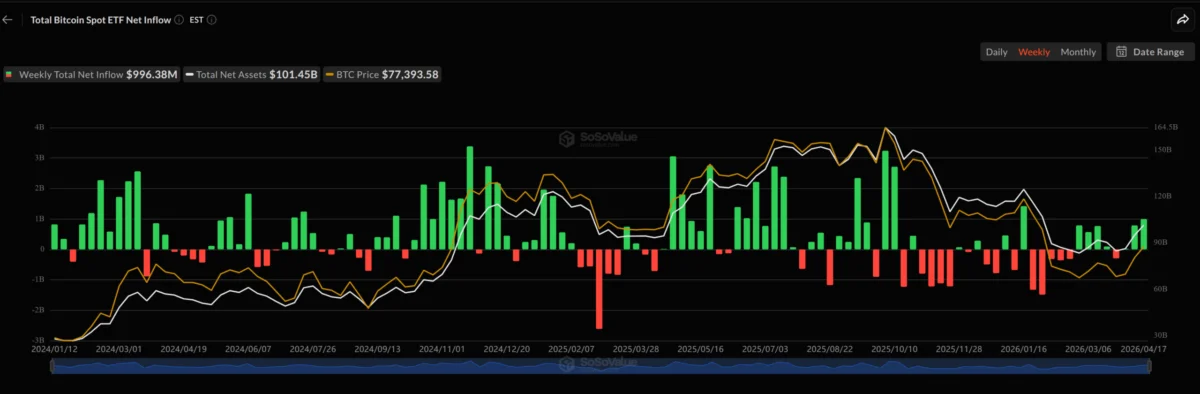
Spot Bitcoin exchange-traded funds (ETFs) recorded nearly $1 billion in net inflows over the past week, signaling their strongest performance in more than three months as global market sentiment emphatically shifts toward risk assets amidst evolving geopolitical landscapes and a nuanced monetary policy outlook. This impressive intake underscores a renewed institutional and retail appetite for Bitcoin, positioning it as a compelling alternative in a complex economic environment.
Data meticulously compiled and disseminated by SoSoValue, a prominent analytical platform tracking cryptocurrency ETF flows, reveals that spot Bitcoin (BTC) ETFs collectively attracted an astounding $996 million in total net inflows last week. This figure represents the highest weekly intake witnessed since early January, a period marked by the initial euphoria surrounding the launch of these instruments, when inflows soared to approximately $1.4 billion. The consistent growth in these vehicles highlights their increasing integration into traditional investment portfolios and their role in mainstream cryptocurrency adoption.
The week’s performance was particularly robust towards its latter half, with Friday alone accounting for a colossal $663.9 million in inflows, marking the strongest single-day performance of the entire week. This substantial influx on the final trading day propelled the weekly total significantly. Earlier in the week, momentum began building with notable gains: Tuesday saw $411.5 million in inflows, followed by a substantial $186 million on Wednesday. Thursday experienced a more modest, yet still positive, $26 million in inflows. It’s worth noting that the period commenced with a $291 million outflow on Monday, suggesting that initial investor caution quickly gave way to a powerful wave of buying interest as the week progressed. This pattern of initial caution turning into aggressive accumulation often precedes significant market movements and reflects a dynamic re-evaluation of risk-reward scenarios by market participants.

The cumulative effect of these inflows saw total net assets across all spot Bitcoin ETFs climb impressively above $101 billion by Friday’s close. This milestone signifies the growing scale and influence of these investment products within the broader financial ecosystem. Concurrently, trading activity experienced a sharp and commensurate increase, with daily volumes nearing an impressive $4.8 billion. Such elevated trading volumes not only indicate high liquidity but also reflect intense investor engagement and conviction, suggesting that the capital flowing into these ETFs is active and responsive to market developments. The sustained high volume is crucial for institutional investors who prioritize ease of entry and exit, further cementing the appeal of these regulated investment products.
The surge in Bitcoin ETF inflows is not an isolated event but rather a reflection of broader shifts in global financial markets, particularly a reassessment of geopolitical risks and their economic ramifications. According to astute analysts at Bitunix, a prominent cryptocurrency exchange and research firm, markets are increasingly pricing in how geopolitical tensions evolve rather than merely whether they persist. This subtle yet critical distinction implies that investors are becoming more adept at discerning the potential for de-escalation or containment of conflicts, rather than defaulting to extreme risk-off postures.
A primary driver for this shift, as highlighted by Bitunix, has been discernible signs of de-escalation, particularly concerning the complex and often volatile US-Iran relations. Reduced perceived risks of widespread regional conflict or significant global supply disruptions have attenuated the demand for traditional safe havens like the US dollar. In times of heightened uncertainty, the dollar typically strengthens as investors flock to its perceived safety. However, a weakening dollar, as observed, often correlates with increased capital flows into alternative assets, including commodities, emerging markets, and cryptocurrencies like Bitcoin, which are often perceived as higher-beta plays or stores of value independent of traditional fiat systems.

Furthermore, the analysts pointed out that the Federal Reserve continues to adopt a judiciously cautious approach to monetary policy, particularly regarding interest rate adjustments. Expectations for aggressive rate cuts remain limited, indicating that the era of ultra-loose monetary policy is not immediately returning. Simultaneously, burgeoning concerns regarding US debt demand and persistently high long-term yields are beginning to erode confidence in what have historically been considered "risk-free" assets, such as government bonds. This confluence of factors contributes to additional downward pressure on the dollar and, by extension, provides a tailwind for flows into alternative assets, with Bitcoin emerging as a prime beneficiary. Investors are increasingly seeking uncorrelated assets that can potentially offer both growth and a hedge against the diminishing appeal of traditional fixed-income instruments.
From a cryptocurrency market structure perspective, Bitunix analysts characterize Bitcoin’s current position as a "classic liquidity redistribution phase." They elaborate that Bitcoin continues to trade within a clearly defined range, with significant resistance observed above the $75,000 mark and robust support forming near the $72,000 level. Their analysis, informed by liquidation heatmaps, suggests that "the market is building a new equilibrium range rather than extending a directional trend." This implies a period of consolidation where large players are accumulating or distributing Bitcoin within this range, absorbing volatility and setting the stage for a potential future breakout, either upwards or downwards, once a new consensus price is established. This dynamic suggests that the market is currently in a phase of price discovery and re-anchoring after its recent highs, with institutional inflows helping to solidify this new foundational range.
The immediate catalyst for Friday’s impressive surge in Bitcoin’s price and subsequent ETF inflows was a pivotal geopolitical announcement. On Friday, Iran’s foreign minister publicly declared that the Strait of Hormuz, one of the world’s most strategically vital oil transit routes, had been reopened to commercial shipping for the duration of the current ceasefire. This crucial development was swiftly confirmed by US President Donald Trump, adding significant weight to the announcement. The decision to reopen the strait immediately eased widespread fears of severe supply disruptions in global energy markets, particularly given that a substantial portion of the world’s seaborne oil passes through this narrow waterway.
The market reaction was immediate and pronounced across asset classes. Bitcoin, often sensitive to global risk perceptions and liquidity, surged dramatically, climbing above the $77,000 threshold in a swift upward movement. Concurrently, the price of Brent crude oil, a global benchmark for oil prices, experienced a sharp decline, falling roughly 10% to settle around $85 per barrel. This inverse correlation underscores Bitcoin’s growing role as an asset that benefits from reduced global tensions and increased risk appetite, mirroring how other growth-oriented assets perform in such scenarios. When geopolitical risks subside, capital often flows out of perceived safe havens (like oil, in this context, if disruption fears are high) and into assets with higher growth potential, like Bitcoin.
The ongoing success of spot Bitcoin ETFs, particularly the consistent inflows, also needs to be contextualized within the broader narrative of institutional adoption and Bitcoin’s post-halving dynamics. The recent Bitcoin halving event, which reduces the supply of new Bitcoin entering the market, historically precedes significant price appreciation. While the immediate post-halving period often sees a consolidation phase, sustained institutional inflows via ETFs can provide a robust demand floor, absorbing the reduced supply and setting the stage for future rallies. Leading ETFs, such as BlackRock’s IBIT and Fidelity’s FBTC, have been instrumental in this surge, consistently attracting billions in assets under management (AUM) and demonstrating strong trading volumes. Their performance is closely watched as a barometer of institutional interest.
Furthermore, the comparison to gold ETFs is becoming increasingly pertinent. Just as gold ETFs revolutionized access to the precious metal for institutional and retail investors, Bitcoin ETFs are doing the same for the digital asset. As confidence wanes in traditional "risk-free" assets dueenced by inflation concerns and fiscal policies, Bitcoin is increasingly viewed as a "digital gold" – a potential hedge against inflation and a store of value that is decentralized and immune to the direct control of any single government. The current macroeconomic climate, characterized by persistent inflationary pressures and unprecedented government debt levels globally, makes Bitcoin an even more attractive proposition for investors seeking diversification and protection of purchasing power.
Looking ahead, the sustained inflows into spot Bitcoin ETFs, coupled with easing geopolitical tensions and a nuanced monetary policy outlook, paint a cautiously optimistic picture for Bitcoin’s trajectory. While analysts from Bitunix note the current "liquidity redistribution phase" and a "new equilibrium range," the underlying demand demonstrated by these ETF flows suggests a strong foundation. Potential headwinds could include a sudden resurgence of geopolitical tensions or a more hawkish-than-expected shift from the Federal Reserve. However, the tailwinds, including continued institutional adoption, the scarcity effect of the halving, and Bitcoin’s growing recognition as a legitimate asset class, appear to be gaining strength. The ability of Bitcoin to quickly rebound and attract significant capital in the wake of market volatility underscores its growing maturity and its pivotal role in the evolving global financial landscape. As the world navigates complex economic and geopolitical currents, Bitcoin’s appeal as a resilient, independent, and potentially high-growth asset continues to expand, solidifying its place in diverse investment portfolios.