anjir abdul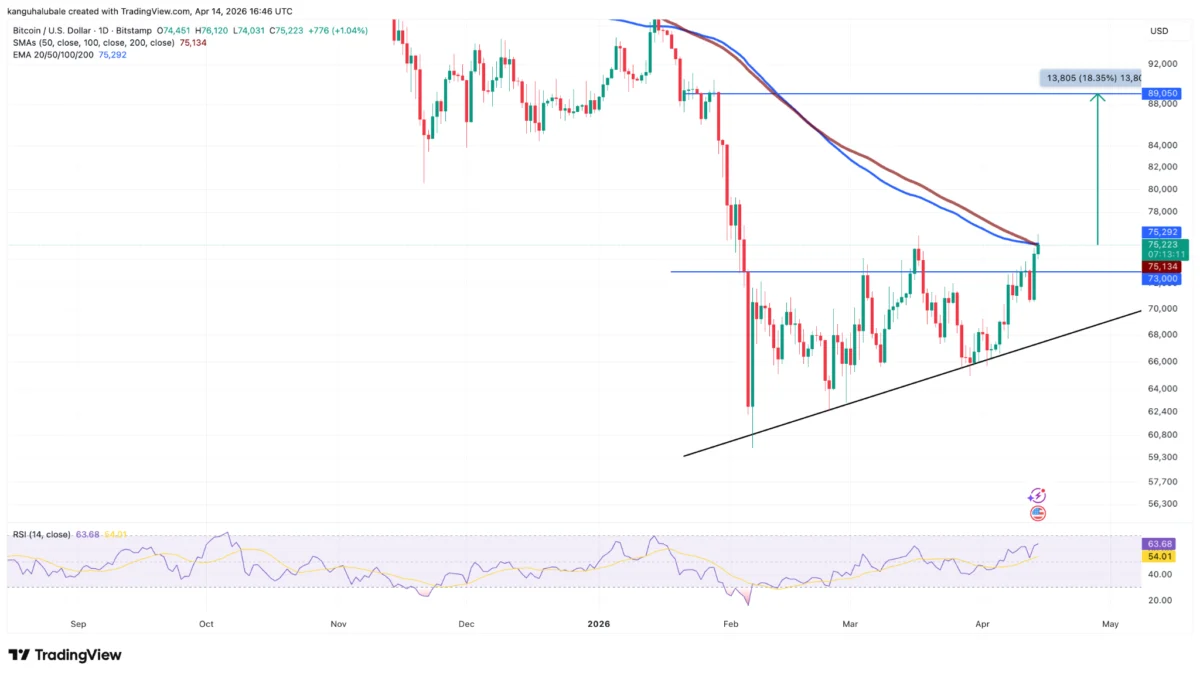
Market analysts are buzzing with renewed optimism for Bitcoin (BTC) as the digital asset demonstrates robust bullish momentum, eyeing a potential surge to the $90,000 mark. This invigorated outlook follows a significant 5% rally, pushing Bitcoin above $76,000 on Tuesday, April 5, 2026, a move underpinned by improving network activity that has reached a 17-month high. The confluence of strong technical breakouts and surging on-chain metrics paints a compelling picture for Bitcoin’s near-term trajectory, suggesting a continuation of its impressive market performance.
The cryptocurrency market, often characterized by its volatility, is currently witnessing a definitive upward trend for Bitcoin. Data from TradingView confirmed that the BTC/USD pair surged over 5% on Tuesday, reaching an intraday high of $76,120. This milestone represents a 70-day high, with Bitcoin’s price not having touched such levels since February 6, 2026. More importantly, this rally allowed Bitcoin to reclaim several crucial support levels, notably the $75,000 zone, where the 100-day exponential moving average (EMA) and simple moving average (SMA) converge. The ability to decisively break above and hold this critical juncture is often interpreted by traders as a strong signal of underlying strength and a potential shift in market sentiment from consolidation to expansion.

Industry expert CryptoBlockto, reflecting on this significant move, articulated the market’s sentiment in an X post, stating, "#Bitcoin surged above the $76,000 level, breaking above its March highs and signaling renewed bullish momentum." The analyst further emphasized the importance of this breakout, highlighting that the $76,000 level now serves as a pivotal resistance-turned-support. A sustained hold above this point, according to CryptoBlockto, would be instrumental in confirming "a trend reversal and sustained upside momentum." This perspective is widely shared among technical analysts who look for such decisive breaks to validate trend shifts.
From a purely technical standpoint, Bitcoin’s recent price action is validating a classic bullish pattern: an ascending triangle. This pattern is formed by a horizontal resistance line and an upward-sloping trendline connecting higher lows. Bitcoin’s successful breach above its upper trend line at $73,000 on Monday, April 4, 2026, marked the initial confirmation of this pattern. A subsequent daily candlestick close above the critical moving averages at $75,000 further solidifies this breakout, clearing the path towards higher resistance levels. The immediate psychological barrier for bulls now stands at $80,000. Should Bitcoin manage to overcome this hurdle, technical analysis suggests that the price could then target the triangle’s measured objective, which is approximately $89,050. This target implies an impressive 18% gain from the current price levels, bringing the $90,000 aspiration firmly into view.
Adding to the bullish technical confluence, the daily Relative Strength Index (RSI) has shown a remarkable recovery, climbing to 63 from an oversold condition of 15 observed on February 6, 2026. The RSI is a momentum oscillator that measures the speed and change of price movements. A reading of 15 indicates that an asset is heavily oversold and potentially due for a rebound, while a rise to 63 signifies increasing buying pressure and strengthening bullish momentum without yet entering the typically overbought territory (above 70). This upward trajectory in RSI corroborates the price action, reinforcing the narrative of growing investor confidence.

Another analyst, CryptOpus, provided a similar technical assessment via an X post, observing, "#Bitcoin is #trading within the horizontal supply zone of an ascending triangle pattern. The 100MA is also acting as a resistance barrier above the current price action." CryptOpus’s analysis underscores the significance of the moving averages as dynamic resistance points, further validating the importance of Bitcoin’s ability to overcome them. The analyst concluded, "A strong breakout above both the #pattern and the 100MA would confirm a #bullish rally in the market." As previously reported by Cointelegraph, a decisive close above $76,000 would indeed complete this bullish ascending triangle pattern, paving the way for a potential rally that could initially target $84,000 before reaching higher objectives.
Beyond the charts, the underlying strength of Bitcoin’s network activity is providing robust fundamental support for its price appreciation. The daily transaction count on the Bitcoin blockchain has witnessed a substantial increase, rising by 62% in the year 2026 to reach over 765,130 transactions on April 5. This level of network engagement has not been observed since November 2024, when the fervent anticipation surrounding the 2024 US Presidential Election, combined with other market catalysts, propelled Bitcoin’s price above $100,000 for the first time in history. This historical context highlights the correlation between heightened network activity and significant price milestones.
Analyst CW8900 captured the essence of this on-chain metric in an X post, noting, "$BTC daily transaction count is higher than when $BTC was $120K. The network is showing bull market behavior." This observation is crucial because a high transaction count signifies increased utility, adoption, and overall demand for the Bitcoin network. It indicates that more users are actively engaging with the blockchain for various purposes, from value transfer to decentralized application interactions, which is a hallmark of a healthy and expanding ecosystem during a bull market phase.

Further emphasizing the strength of on-chain fundamentals, Bitcoin’s total fee volume has also climbed, increasing by 4% over the last week to reach $153,700. This uptick in fees is a critical indicator of "heightened onchain demand," as highlighted by Glassnode in its latest Market Pulse report. The report elaborates that "This increase implies an uptick in network activity, potentially signalling a shift in user willingness to pay for transaction priority." When transaction fees rise, it suggests that users are increasingly willing to pay a premium to have their transactions processed faster, indicating network congestion and a high level of demand for block space. This competitive bidding for transaction priority is a strong bullish signal, as it reflects intense user activity and confidence in the network’s value proposition. The combination of increasing transaction counts and rising fees underscores that more users are not only interacting with the network but are doing so with urgency, further reinforcing the bullish sentiment.
Looking at the broader market context, several factors contribute to this renewed bullish sentiment. While the original article briefly mentioned "tame US PPI inflation" as a backdrop for Bitcoin’s earlier surge, the general macroeconomic environment often plays a significant role. In a climate where traditional financial assets might face uncertainties or yield lower returns, digital assets like Bitcoin can become attractive alternatives or hedges against inflation. The established presence of Bitcoin ETFs, which were launched in early 2024, has also profoundly impacted market liquidity and mainstream adoption. These investment vehicles have provided institutional and retail investors with an accessible and regulated avenue to gain exposure to Bitcoin, injecting significant capital into the ecosystem and fostering broader acceptance.
Furthermore, the impact of the 2024 Bitcoin Halving, which occurred in April of that year, cannot be overstated. Halving events, which reduce the supply of new Bitcoin entering the market by 50%, have historically preceded significant bull runs. The reduced supply, coupled with increasing demand, creates a powerful upward pressure on price. The current market activity, occurring in April 2026, would be well into the post-halving cycle, where the supply shock has had time to manifest its effects on market dynamics, contributing to the "bull market behavior" observed in on-chain metrics.

While the outlook appears overwhelmingly positive, it is prudent to acknowledge potential risks and market volatility. No asset ascends in a straight line, and Bitcoin is notoriously prone to significant price swings. Traders will need to monitor key resistance levels, especially the psychological $80,000 mark, and ensure that Bitcoin maintains its current support levels to sustain its upward momentum. Any significant macroeconomic shifts or unexpected regulatory changes could introduce volatility. However, the confluence of robust technical breakouts, validated by ascending patterns and momentum indicators, combined with surging on-chain activity — particularly the 17-month high in transaction counts and rising fee volumes — provides a strong fundamental case for Bitcoin’s continued appreciation.
In conclusion, Bitcoin’s recent rally above $76,000, driven by a powerful combination of technical breakouts and burgeoning network activity, has firmly set its sights on the $90,000 target. The validation of bullish chart patterns, the positive shift in momentum indicators, and the significant surge in daily transactions and fee volumes all signal a healthy, expanding network and robust market demand. As more users engage with the blockchain and institutional interest continues to grow, fueled by factors like the post-halving supply shock and ETF adoption, Bitcoin appears well-positioned to extend its gains and potentially reach new all-time highs in the coming period. The market is showing clear signs of a bull run, and the current indicators suggest the journey to $90,000 is firmly underway.