isnaini azizah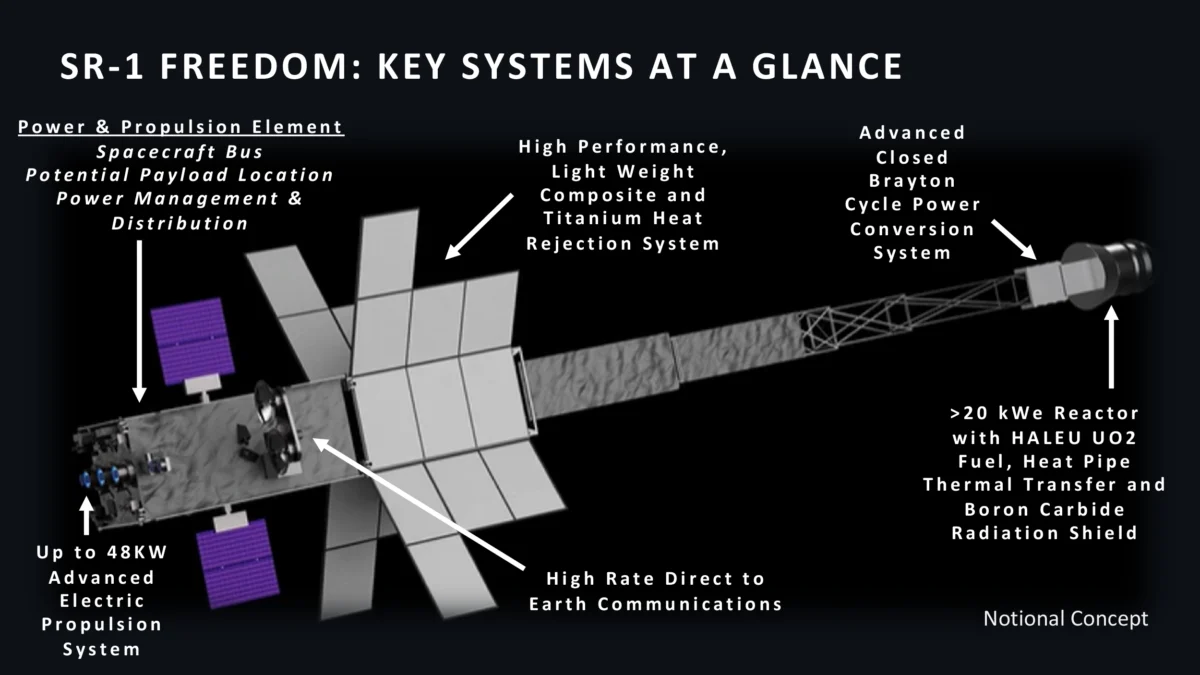
In a series of significant announcements from NASA headquarters, Administrator Jared Isaacman unveiled ambitious plans for lunar exploration, including regular missions and the establishment of a lunar south pole base by the end of the decade, alongside a firm commitment to deploying a nuclear reactor on the Moon. While these goals were largely anticipated, a groundbreaking revelation was the agency’s intention to construct and launch the first-ever nuclear reactor-powered interplanetary spacecraft, designated Space Reactor-1 Freedom, or SR-1, with a target Mars mission by the end of 2028. Isaacman declared this endeavor a pivotal moment, stating, "After decades of study, and billions spent on concepts that have never left Earth, America will finally get underway on nuclear power in space. We will launch the first-of-its-kind interplanetary mission." This development promises to usher in a new era of spaceflight, potentially making interplanetary travel faster and more accessible, while also positioning the United States advantageously in the geopolitical race to reach other planets before its primary rival, China.
Despite the exceptionally tight timeline, experts are expressing enthusiasm and anticipation regarding the potential for NASA and its industry partners to achieve this engineering feat. Simon Middleburgh, co-director of the Nuclear Futures Institute at Bangor University, remarked, "You wake up to that announcement, and it puts a big smile on your face." Although detailed information about SR-1 remains scarce, and NASA researchers were unavailable for comment, insights from nuclear power and propulsion experts shed light on the potential operational principles of this novel spacecraft.
Nuclear Propulsion 101
Traditional spaceflight relies on chemical propulsion, where the combustion of liquefied hydrogen and oxygen generates hot exhaust expelled through a nozzle for thrust. While this method provides significant thrust and will continue to be essential for Earth launches, nuclear propulsion offers a paradigm shift, enabling spacecraft to traverse the solar system with greater speed and duration. As Middleburgh explained, nuclear fuel is "orders of magnitude more efficient" than conventional fuels, offering "more bang per kilogram." Lindsey Holmes, an expert in space nuclear technology, echoed this sentiment, describing it as "really, really, really high efficiency."
Furthermore, nuclear power liberates spacecraft from their dependence on solar energy. While many current spacecraft, like the Artemis II mission’s Orion capsule, utilize solar panels, this energy source becomes unreliable in deep space, particularly beyond Mars where sunlight is significantly diminished. Historically, nuclear energy has been employed in space through Radioisotope Thermoelectric Generators (RTGs), used on missions like Voyager and Cassini. RTGs harness heat from the radioactive decay of plutonium to generate electricity. However, RTGs are fundamentally different from nuclear reactors; they are essentially "radioactive batteries," far less powerful and rudimentary in comparison.
The operational principle of a nuclear reactor in space mirrors its terrestrial counterpart: uranium fuel is bombarded with neutrons, initiating a self-sustaining nuclear fission chain reaction that generates immense heat. This heat can then be converted into electricity. While deploying a nuclear reactor in space might seem audacious, the concept and underlying technology have been explored for decades. The Soviet Union orbited numerous reactors, primarily for spy satellites, and the U.S. launched one experimental reactor, SNAP-10A, in 1965. Although SNAP-10A experienced a malfunction after just over a month of operation due to a high-voltage failure, its purpose was to demonstrate sustained operation in space. Now, over half a century later, the U.S. aims for its second space-based nuclear reactor to power an interplanetary mission.
Despite past initiatives, including the recently canceled DRACO program, which faced challenges related to high experimental costs, the declining price of conventional propulsion, and safety concerns for ground testing, external factors are now reshaping the landscape. The Artemis program’s resurgence and the intensifying space race have created a compelling imperative for advancements in deep-space navigation. Philip Metzger, a spaceflight engineering researcher at the Florida Space Institute, expressed his optimism: "I think it’s a very doable technology. I’m happy to see them finally doing this."

Two primary types of nuclear propulsion have been investigated: Nuclear Thermal Propulsion (NTP) and Nuclear Electric Propulsion (NEP). NTP involves heating a propellant, typically hydrogen due to its low molecular weight, to extremely high temperatures (around 5,000°F) in a nuclear reactor, then expelling it through a nozzle to generate thrust. While efficient, NTP engines can be precarious to operate due to the corrosive and explosive nature of hydrogen and may have limited operational lifespans. NEP, on the other hand, uses heat from a fission reactor to generate electricity, which then powers an electric thruster that expels charged gas to produce thrust. NEP offers very low thrust but exceptional efficiency, making it suitable for long-duration missions. Sebastian Corbisiero, the U.S. Department of Energy’s national technical director of space reactor programs, noted that NEP is "very low thrust, but very efficient, so you can use it for a long period of time." Both NTP and NEP offer significant advantages for human space exploration by reducing transit times, thereby minimizing astronauts’ exposure to harmful cosmic radiation. Metzger highlighted this benefit, stating, "It solves the radiation problem. That’s one of the main motivations for inventing better propulsion to and from Mars."
How to Build a Nuclear-Powered Spaceship
For SR-1, NASA has chosen the Nuclear Electric Propulsion (NEP) approach, which Middleburgh described as "a much simpler affair" compared to NTP. The core concept involves integrating a nuclear reactor with a power-and-propulsion system. Fortuitously, NASA already possesses a foundational element for this system: the power-and-propulsion element developed for the now-canceled Gateway lunar space station. While originally designed for solar power, this component will now be coupled with a custom-developed, space-hardened nuclear reactor.
Concept art for SR-1, as presented by Steve Sinacore, program executive of NASA’s Space Reactor Office, depicts the spacecraft as a large, finned arrow. At the rear will be the power-and-propulsion system, while the front will house a uranium-fueled nuclear reactor generating at least 20 kilowatts of power – a modest output compared to terrestrial nuclear plants but substantial for a spacecraft. The prominent "fins" on SR-1 are actually large radiators designed to dissipate the immense heat generated by the fission process. Holmes emphasized the necessity of "really large radiators" to prevent the reactor and spacecraft from overheating and melting.
The hardware development for SR-1 is scheduled to commence in June, with systems expected to be ready for assembly and testing by January 2028. The spacecraft is slated to arrive at the launch site by October 2028, poised for liftoff before the year concludes. A significant challenge will be ensuring the reactor’s integrity during the violent launch sequence. Middleburgh noted, "Going through the launch safely is going to be a challenge. You are being shaken, rattled, and rolled." Once in orbit, zero-gravity considerations will become paramount, and the functionality of the reactor’s terrestrial-engineered mechanics will be tested.
For safety, the nuclear reactor will be activated approximately two days after launch, once the spacecraft is safely in space. While uranium itself is not exceedingly hazardous, the nuclear waste products generated during operation pose a risk, necessitating that no such material return to Earth. If the ambitious schedule is met and SR-1 functions as intended, it is projected to reach Mars about a year after its launch. Holmes acknowledged the aggressive timeline, suggesting it’s partly driven by the nuclear space ambitions of China and Russia, who aim to deploy their own lunar surface reactor by 2035 for their International Lunar Research Station.
Regardless of SR-1’s ultimate success or failure in space, its operational data will provide invaluable insights for NASA’s planned deployment of a nuclear reactor on the lunar surface. Corbisiero pointed out the direct applicability, stating, "All of the things we’d be learning about how that system operates in space [are] very helpful for a surface application, because basically it’s the same. There’s still no air on the moon."
Should SR-1 prove triumphant, it would represent a transformative achievement for NASA and, as Middleburgh posited, "a massive win for the human race, frankly." He continued, "It will be a marvel of engineering, and it will move the dial in humans potentially taking a step on Mars." Like many of his colleagues, Middleburgh remains exhilarated by the prospect of the first nuclear-powered interplanetary spacecraft, even with the formidable timeline. "These are the things that get us up in the morning," he concluded. "These are the sorts of things we will remember when we’re old."