anjir abdul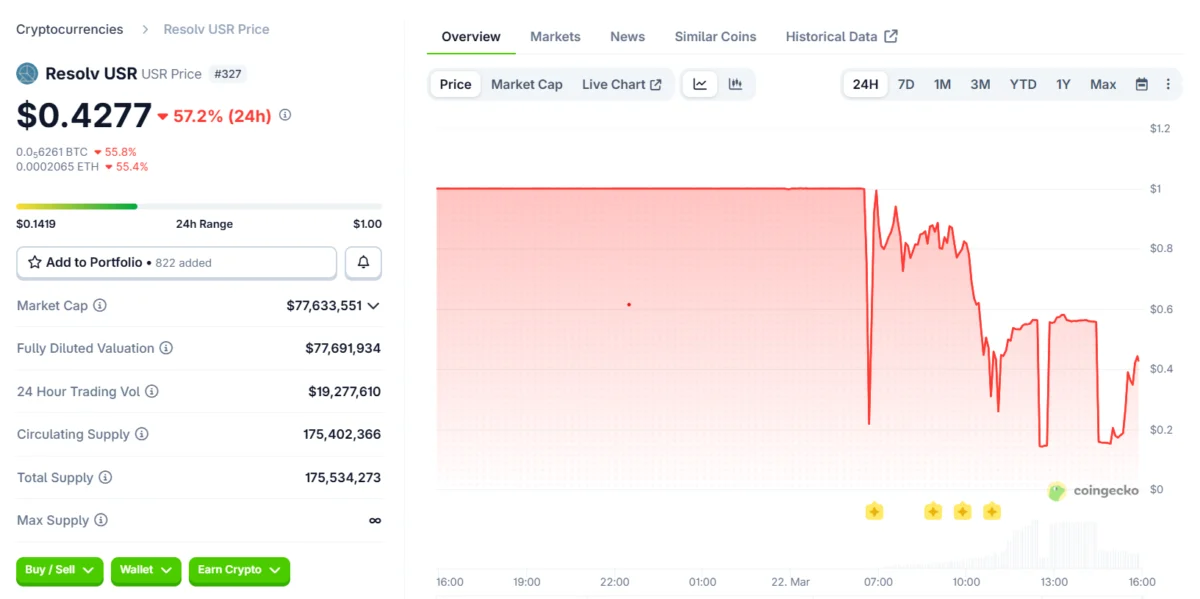
Resolv Labs moved Sunday to reassure its user base and the broader decentralized finance (DeFi) ecosystem following a severe exploit that compromised the issuance mechanics of its USR stablecoin. The incident, which saw the token aggressively depeg from its intended dollar parity, triggered rapid responses from various DeFi protocols exposed to USR, aiming to mitigate potential fallout. Resolv’s subsequent announcement that its collateral pool remains "fully intact" provided a crucial, albeit cautious, glimmer of relief amidst the market turmoil, suggesting the issue was isolated to the token’s minting process rather than the underlying assets.
The exploit, first reported earlier on Sunday, saw an attacker leverage a critical vulnerability within USR’s minting mechanics. This flaw allowed for the unauthorized creation of tens of millions of unbacked USR tokens. The attacker then proceeded to dump these newly minted tokens into various DeFi liquidity pools, creating immense sell pressure that inevitably shattered the stablecoin’s peg. In response to the unfolding crisis, Resolv Labs promptly paused all protocol functions to assess the extent of the damage and implement containment measures.
The immediate impact on USR’s value was stark and dramatic. Data from CoinGecko revealed that the token plummeted to an alarming low of $0.14, representing an 86% depreciation from its intended $1 price. While a partial rebound saw the token recover to $0.42 at the time of initial reporting, the event underscored the inherent fragility that can plague even well-intentioned stablecoin designs when critical vulnerabilities are exploited. The sudden depeg served as a stark reminder of the importance of robust security measures and real-time monitoring in the volatile crypto landscape.
In a pivotal statement released on X (formerly Twitter), the Resolv team confirmed that, despite the exploit, "the collateral pool remains fully intact." This assertion was a critical piece of information, differentiating the incident from scenarios where underlying assets are directly drained. Instead, Resolv clarified that the problem appeared "isolated to USR issuance mechanics," implying that the flaw permitted the creation of tokens without corresponding collateral being deposited. This distinction is vital for understanding the nature of the loss; while the circulating supply of USR became largely unbacked, the original collateral supporting legitimately minted tokens was not directly stolen. Containment efforts and a comprehensive impact assessment are currently ongoing as the team works to stabilize the situation and understand the full scope of the breach.
On-chain analysis swiftly corroborated the attacker’s actions. Data provided by Arkham, a blockchain intelligence firm, and independently verified by Web3 security firm Cyvers, showed the attacker systematically converting the newly minted USR into Ether (ETH). A significant portion of this illicit haul, approximately 11,400 ETH, was sold for an estimated $24 million. Independent analysts, such as EmberCN, further highlighted that an additional 36.74 million USR tokens were "still being continuously dumped," indicating the attacker’s sustained effort to liquidate their gains and the prolonged pressure on USR’s price. This continuous selling pressure exacerbated the depeg and made any immediate recovery for the stablecoin incredibly challenging.
Michael Pearl, Vice President GTM and Strategy at Cyvers, provided crucial insight into the economic mechanics of the attack. He explained that the rapid inflation of USR’s supply, far exceeding what the market could absorb, immediately led to the token’s depegging. Consequently, the value of any remaining unbacked tokens, or even those held by legitimate users, was severely impaired due to the massive dilution and lack of trust. The incident perfectly illustrates the devastating effects of supply-side manipulation on algorithmic or collateralized stablecoins, where the integrity of the minting mechanism is paramount.
DeFi Protocols Mobilize to Contain Fallout
The ripple effects of the USR stablecoin exploit sent immediate shockwaves through the broader DeFi ecosystem. Protocols with exposure to Resolv Labs’ USR token or related assets moved with urgency to clarify their positions and reassure their users. Liquid staking provider Lido Finance, for instance, promptly announced via X that "Lido Earn user funds were safe," indicating that their direct exposure, if any, did not jeopardize user assets. Similarly, Merlin Egalite, co-founder of lending protocol Morpho, emphasized that Morpho’s core contracts remained unaffected, though he acknowledged that "only certain vaults had exposure" to USR, suggesting a more contained risk profile within their platform. Aave founder Stani Kulechov also weighed in, confirming that Aave had "no direct USR exposure" and that Resolv was actively "repaying its outstanding debt" to the platform, further alleviating fears of broader contagion.
Despite these reassurances, some areas of potential loss were identified. The X account "yieldsandmore" highlighted possible vulnerabilities within Resolv’s junior RLP (Resolv Liquidity Provider) tranche. RLP tokens are typically issued to users who provide liquidity to Resolv’s ecosystem, often representing a claim on underlying assets or yield. Junior tranches, in particular, are designed to absorb initial losses, meaning holders of these tokens could face significant impairment. This raised concerns for yield-generating platforms like Stream and yoUSD, which had utilized RLP as collateral in their strategies, potentially exposing their users to indirect losses.

Pearl from Cyvers offered a more nuanced assessment of the overall risk. He stated that based on available data, the exposure appeared to be "relatively concentrated" within specific lending markets and leverage loops, "rather than system-wide contagion." He elaborated that the primary impact was observed in protocols that had integrated USR, wstUSR (wrapped staked USR), or RLP into their lending, leverage, or yield farming strategies. This localized nature of the risk was a critical factor in preventing a more widespread crisis across DeFi.
To prevent further damage, several prominent protocols took swift precautionary actions. Euler, Venus, Lista, and Fluid, for example, either paused specific markets or isolated vaults that had exposure to USR-related assets. These measures are standard operating procedures in DeFi security, designed to halt further interaction with compromised assets and prevent cascading liquidations or further exploits. Pearl concluded that it was "more accurate to describe the risk as concentrated with localized spillover, rather than widespread contagion," a sentiment that provided a degree of comfort to the market, distinguishing this incident from more systemic failures like the Terra Luna collapse.
Charles Guillemet, the Chief Technical Officer at Ledger, further reinforced this perspective on X, stating that "this is not a Terra Luna-type event" due to the "relatively small size of USR." The Terra Luna collapse, a much larger event involving an algorithmic stablecoin and its sister token, resulted in tens of billions of dollars in losses and had significant repercussions across the entire crypto market. The USR exploit, while severe for those directly affected, was contained to a much smaller scale, preventing a similar market-wide panic.
Questions Around Limitations of Security Audits and Operational Security
The Resolv Labs incident inevitably reignited crucial discussions about the efficacy and limitations of smart contract security audits. Resolv’s smart contracts had undergone multiple audits since 2024, a common practice in the DeFi space intended to identify vulnerabilities before deployment. However, Michael Pearl from Cyvers pointed out that while audits are "necessary," they are also "inherently static and scoped." This means an audit provides a snapshot of the code at a specific time, examining it against known vulnerabilities and defined parameters. It cannot, however, account for dynamic, real-time anomalies or unforeseen operational security lapses.
Pearl advocated for the necessity of real-time, artificial intelligence-powered monitoring to "continuously analyze protocol activity" and detect anomalies as they emerge. For stablecoin systems specifically, this would involve continuous monitoring of mint and burn flows against expected behavior, validating the supply against reserves and backing assets in real-time, and detecting irregularities in oracle inputs, pricing, and liquidity conditions. Such a proactive, continuous security posture, he argued, is vital to complement static audits and provide a more robust defense against evolving threats.
Perhaps the most revealing insight came from security firm Pashov, which had audited Resolv’s staking module in July 2025. Pashov commented that Resolv’s design was "good," suggesting that the smart contract code itself might not have been the primary culprit for the exploit. Instead, Pashov indicated that the "root cause was not the design so much as the private key compromise," which was "likely an operational security flaw." This distinction is paramount. A smart contract bug implies a flaw in the code logic itself, whereas a private key compromise points to a breach in the operational security practices surrounding the management of critical cryptographic keys.
An operational security flaw can manifest in various ways: a weak or compromised multi-signature scheme, a phishing attack targeting a key holder, an insider threat, or inadequate key management practices. If a private key with minting privileges was indeed compromised, it would allow an attacker to bypass the smart contract’s intended logic and directly mint unbacked tokens, regardless of how "good" the underlying code design was. Pashov stressed the importance of understanding "how that happens" to prevent similar incidents in the future. This emphasizes that while smart contract audits are foundational, they must be paired with equally stringent operational security protocols, including robust access controls, multi-factor authentication, cold storage solutions for sensitive keys, and comprehensive incident response plans.
The Resolv USR exploit serves as a stark reminder that security in the DeFi space is a multi-layered challenge. It encompasses not only the meticulous auditing of smart contract code but also the unwavering vigilance in operational security practices. The industry continues to mature, but each incident highlights critical areas for improvement, pushing protocols to adopt more comprehensive, dynamic, and integrated security frameworks. For users and investors, it underscores the importance of due diligence, understanding the underlying mechanisms of the stablecoins they use, and recognizing that even well-audited protocols can fall victim to sophisticated attacks or operational oversights. Cointelegraph reached out to Resolv Labs for comment but had not received a response by publication, leaving the community awaiting further details on the full recovery plan and the investigation into the private key compromise.