anjir abdul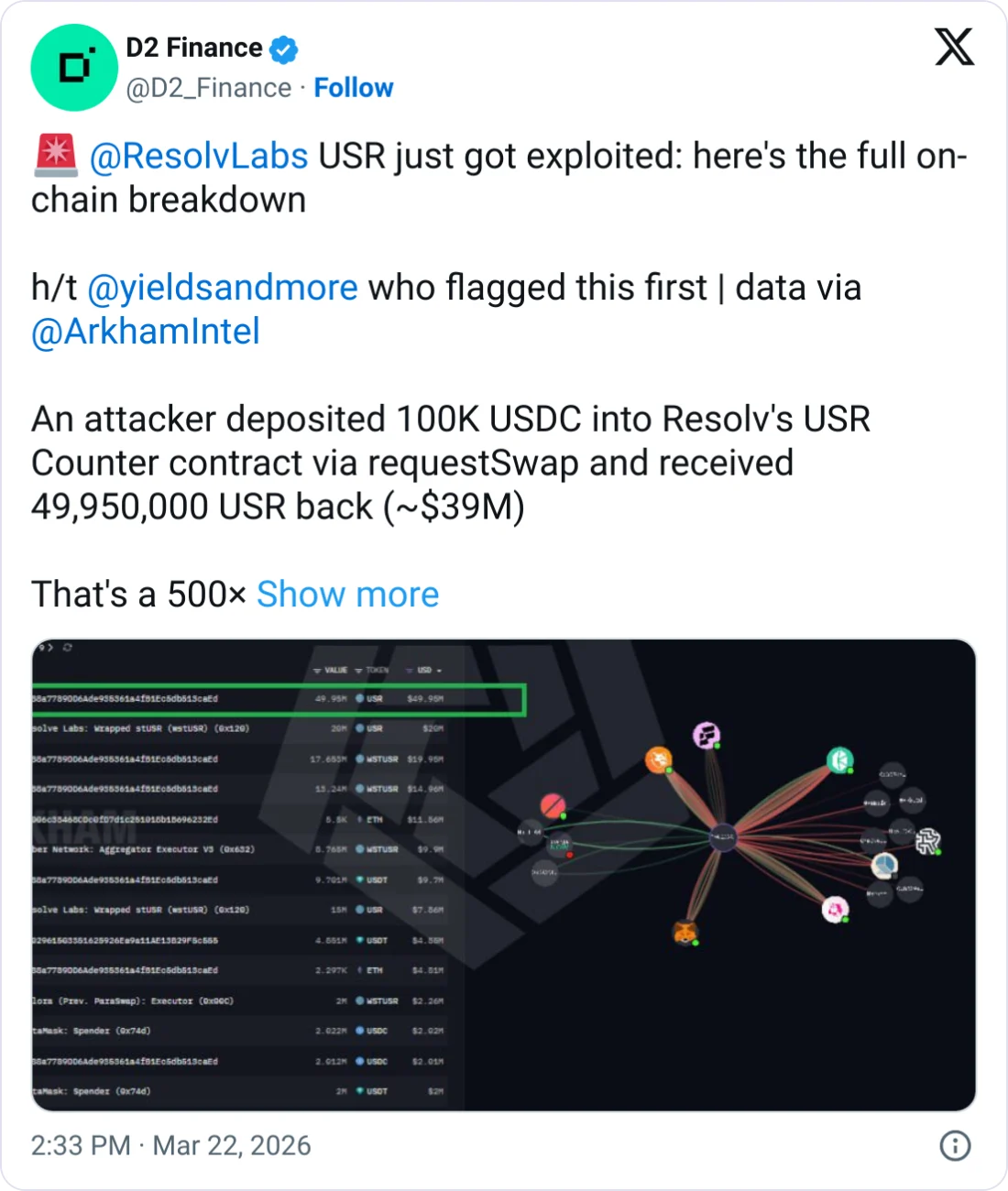
The core of the attack, as confirmed by Resolv Labs itself, involved a critical vulnerability in the USR token’s smart contract. On Sunday, Resolv Labs took to X (formerly Twitter) to inform its community and the broader crypto world about the exploit, stating, "The team has currently paused all the protocol functions to prevent further malicious actions and is actively working on recovery." The project disclosed that an attacker successfully minted an astonishing 50 million unbacked Resolv USR tokens, an act that immediately jeopardized the stablecoin’s integrity and its intended one-to-one parity with the US dollar.
Prior to Resolv Labs’ official announcement, on-chain sleuths and crypto observers had already detected anomalies. The X account "yieldsandmore" was among the first to flag the dramatic crash of USR. Their analysis, corroborated by publicly available on-chain data, revealed a highly suspicious transaction where an attacker was able to mint the initial 50 million USR tokens by depositing a mere $100,000 worth of USDC (USD Coin), another prominent stablecoin. This glaring disparity between the input collateral and the minted output immediately signaled a severe flaw in USR’s minting mechanism or its underlying price oracle. Further investigation by crypto security firm PeckShield Alert quickly identified an additional minting event, revealing that the attacker managed to create another 30 million USR tokens, bringing the total unauthorized mint to 80 million USR.

The precise nature of the exploit remained a subject of intense speculation and analysis in the immediate aftermath. Crypto fund D2 Finance weighed in, suggesting that the minting function on USR’s contract was fundamentally compromised. They proposed several potential vectors for the attack: "Either the oracle was gamed, the off-chain signer was compromised, or the amount validation between request and completion is simply missing." Each of these possibilities points to a critical failure in the smart contract’s design or its operational security. An oracle attack would imply that the price feed used by the stablecoin to determine collateralization was manipulated, tricking the contract into believing it had received sufficient collateral. A compromised off-chain signer would mean a private key controlling critical functions was illicitly accessed. The absence of amount validation, arguably the most straightforward yet catastrophic flaw, would imply the contract simply minted tokens based on a request without properly verifying the deposited collateral against the requested output.
This incident, while alarming, occurs against a backdrop of fluctuating trends in crypto security. February had notably seen a sharp decline in crypto-related hacks, with total losses due to exploits dropping to $49 million, a significant decrease from the $385 million recorded in January. This shift had led some to believe that attackers were increasingly favoring phishing scams and approval exploits over more complex protocol-level breaches. However, the Resolv Labs incident serves as a stark reminder that sophisticated protocol exploits remain a potent threat, capable of inflicting substantial damage and eroding trust.
The attacker’s actions following the illicit minting were executed with textbook precision, demonstrating a clear understanding of DeFi liquidity and cash-out strategies. D2 Finance meticulously tracked the attacker’s movements, observing that the 50 million USR tokens were swiftly moved across multiple crypto protocols. The primary goal was to convert the newly minted, but now unbacked, USR into more stable and liquid assets like USDC and USDt (Tether, USDT). Subsequently, the attacker "aggressively" converted these stablecoins into Ether (ETH), a widely accepted and highly liquid cryptocurrency, often favored for its ease of movement and subsequent obfuscation. D2 Finance aptly described this as "The attacker’s exit playbook is textbook DeFi hack cashout running at full speed," highlighting the speed and efficiency with which exploiters leverage the decentralized nature of these markets to extract value.

The impact on USR’s peg and market liquidity was immediate and severe. As the attacker offloaded vast quantities of USR, the stablecoin’s price plummeted. D2 Finance reported trades as low as 50 cents on some protocols, a drastic deviation from its intended $1 peg. This rapid sell-off exacerbated liquidity and slippage issues across various decentralized exchanges. The on-chain data revealed "multiple failed transactions," indicative of the intense pressure on liquidity pools and the attacker’s urgent attempts to divest the compromised tokens. Based on the scale of the attack and the rapid depeg, D2 Finance estimated that the attacker managed to extract approximately $25 million from the ecosystem, a substantial sum resulting from the exploit.
Monitoring services like CoinGecko confirmed the dire state of USR, which, at the time of reporting, was trading around 87 cents, marking a persistent 13% deviation from its dollar peg. The most dramatic price action was observed on Curve Finance, a decentralized exchange known for its stablecoin liquidity pools. The USR/USDC pool on Curve, which was USR’s most liquid pool with a 24-hour volume of $3.6 million, experienced a flash crash. According to DEX Screener, USR’s price in this pool plummeted to an alarming low of 2.5 cents. This precipitous drop occurred at 2:38 am UTC on Sunday, a mere 17 minutes after the attacker initiated the initial $50 million token mint, showcasing the lightning speed at which vulnerabilities can be exploited and market value can be destroyed in DeFi. While the pool has since seen some recovery, trading around 84.5 cents, the initial plunge illustrates the fragility of stablecoin pegs under severe stress.
The Resolv Labs incident serves as a critical case study for the broader cryptocurrency community, emphasizing the paramount importance of rigorous smart contract audits and robust security measures. While Resolv Labs has paused protocol functions and initiated recovery efforts, the path to full restitution and regaining user trust is often long and arduous in the decentralized space. Such events underscore the need for continuous vigilance, proactive threat modeling, and immediate transparency from projects when vulnerabilities are discovered or exploited. The incident also highlights the indispensable role of on-chain analytics and crypto security firms in identifying, tracking, and reporting malicious activity in real-time, acting as crucial watchdogs in a largely unregulated environment. As the DeFi sector continues to innovate, the constant battle against sophisticated attackers necessitates an equally sophisticated and collaborative approach to security, ensuring that the promise of decentralized finance is not undermined by recurring exploits.