anjir abdul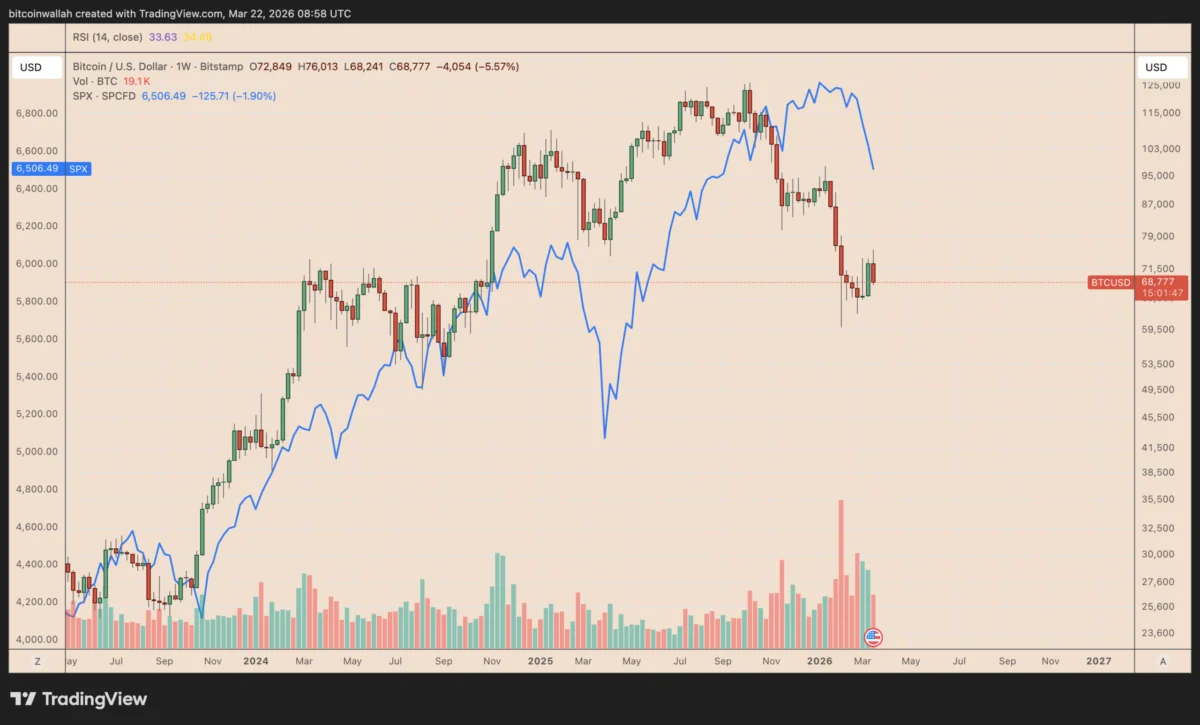
Bitcoin (BTC), after a brief surge fueled by geopolitical tensions, has rapidly retreated this week, conspicuously aligning itself once again with the broader downturn observed across traditional risk assets, particularly US equities. This renewed correlation is not merely a temporary blip; a critical metric is now flashing a potent bearish signal, suggesting a potential 50% price crash for the world’s largest cryptocurrency if historical patterns hold true.
The cryptocurrency market, often touted for its decentralized nature and supposed independence from traditional financial systems, frequently finds itself grappling with the gravitational pull of mainstream markets. This week, as global investors navigated a complex landscape of geopolitical uncertainty and shifting economic forecasts, Bitcoin shed a significant portion of its recent gains, plummeting 5.65% week-to-date to approximately $68,700 by Sunday. In parallel, the S&P 500 (SPX), the benchmark for US equities, concluded the week down 1.90%, underscoring a synchronized movement that has market analysts concerned.
The Alarming Correlation Signal
The core of this bearish thesis stems from a specific technical indicator: the 20-week rolling correlation between Bitcoin and the S&P 500. As of Saturday, this metric registered at 0.13, a substantial rebound from its recent low of around -0.5. To put this into perspective, a correlation coefficient ranges from -1 to +1. A value of +1 indicates a perfect positive correlation (they move in the same direction), -1 indicates a perfect negative correlation (they move in opposite directions), and 0 suggests no linear relationship. The shift from a moderately negative correlation to a positive one, even if modest at 0.13, signifies a critical change in market dynamics.
Historically, such sharp recoveries in the BTC-SPX correlation have preceded significant market declines for Bitcoin, averaging a staggering 50% drop. Analyst Tony Severino, a prominent voice in technical analysis, minced no words, stating, "It is a warning sign that the stock market is going to collapse and take BTC with it." This sentiment echoes a growing apprehension among market watchers who track the evolving relationship between crypto and traditional finance.
Should this historical pattern repeat, a 50% decline from Bitcoin’s current price of around $68,700 would imply a downside target of roughly $34,350. This projection aligns with the views of several other analysts who have previously forecasted Bitcoin dropping into the $30,000-$40,000 range, potentially even extending into 2026 if the broader market downturn persists.

Looking back, the years 2020 and 2022 provide stark reminders of this phenomenon. In both instances, Bitcoin’s declines were not immediate but often lagged by several months. These periods were characterized by "bull traps," where BTC initially rallied alongside a rising SPX correlation, lulling investors into a false sense of security, only to reverse course sharply and erase those gains. These historical precedents serve as a potent cautionary tale, suggesting that the current positive correlation, though seemingly mild, could be the precursor to a more severe correction.
A Confluence of Macroeconomic Headwinds
The renewed correlation and the ominous historical pattern are amplified by a backdrop of challenging macroeconomic conditions that continue to weigh heavily on both traditional and crypto markets.
-
Persistent Inflation: Despite the Federal Reserve’s aggressive interest rate hikes, inflation remains a stubborn concern. Elevated Consumer Price Index (CPI) and Producer Price Index (PPI) figures signal that price pressures are not abating as quickly as policymakers or markets had hoped. Persistent inflation erodes purchasing power, reduces corporate profit margins, and forces consumers to tighten their belts, all of which dampen investor sentiment and risk appetite for speculative assets like Bitcoin. The fear of "stagflation" – a period of high inflation coupled with low economic growth – looms large, presenting a particularly difficult environment for risk assets.
-
Federal Reserve’s Stance on Interest Rates: The market’s previous optimism for multiple interest rate cuts in 2024 has waned significantly. Higher-than-expected inflation data has led to a recalibration of expectations, with many now anticipating fewer cuts, or even the possibility of further rate hikes if inflation proves intractable. The Federal Reserve’s hawkish posture translates to tighter monetary conditions, making borrowing more expensive and reducing the overall liquidity in the financial system. This directly impacts asset prices, as investors become less willing to take on risk in an environment where the "cost of money" is high. For Bitcoin, which often thrives on abundant liquidity, a tighter monetary policy acts as a significant headwind.
-
Elevated Oil Prices: Geopolitical instability, particularly in key oil-producing regions, continues to push crude oil prices higher. Elevated oil prices feed directly into inflationary pressures across the economy, increasing transportation costs, manufacturing expenses, and ultimately consumer prices. This creates a vicious cycle where inflation remains sticky, further complicating the Fed’s efforts to achieve its 2% target and reinforcing the cautious outlook for equities and, by extension, correlated cryptocurrencies.
-
Geopolitical Instability: While the immediate US-Iran tensions have subsided, the broader global geopolitical landscape remains fraught with uncertainty. Regional conflicts, trade disputes, and political instability create an overarching sense of risk aversion among institutional investors. In such environments, capital tends to flow out of riskier assets and into perceived safe havens, or simply stays on the sidelines, awaiting clearer signals. This global uncertainty contributes to the "risk-off" sentiment that is currently affecting both the stock market and Bitcoin.

MicroStrategy’s Pause Adds to Caution
Further compounding the cautious outlook is the noticeable pause in corporate accumulation, particularly from MicroStrategy (MSTR). MicroStrategy, led by Michael Saylor, has become synonymous with institutional Bitcoin adoption, consistently increasing its BTC holdings through strategic capital raises. Its aggressive buying sprees have often provided significant buy-side pressure, acting as a crucial support for Bitcoin’s price.
However, according to data from STRC.LIVE, MicroStrategy has not purchased BTC via the sales of its STRC preferred stock this week. Its last announced acquisition, made on March 16, added a substantial 22,337 BTC worth $1.57 billion, bringing its total holdings to an impressive 761,068 BTC. This previous buying spree undeniably contributed to Bitcoin’s rally, especially during the period of heightened US-Iran tensions, where BTC managed to beat US stocks.
The absence of fresh purchases from such a significant institutional player is noteworthy. While it may be a temporary pause for strategic reasons, it removes a key source of demand that has previously helped cushion Bitcoin during market volatility. With MicroStrategy’s "STRC-fueled buying" on hold, Bitcoin becomes more exposed to the prevailing market sentiment and the potential sell-off in traditional stocks, making it more susceptible to the downside risks highlighted by the renewed correlation. This pause could signal a wait-and-see approach from even the most bullish institutional players, reflecting a broader hesitation in the market.
Broader Market Sentiment and Technical Considerations
Beyond the correlation, broader market sentiment indicators also lean towards caution. While Bitcoin ETF outflows have remained relatively low, as noted by related market analyses, the overall mood reflected in metrics like the Crypto Fear & Greed Index is far from euphoric, suggesting underlying investor apprehension.
From a technical perspective, if the $68,700 level fails to hold, Bitcoin could quickly test significant support zones. A 50% drop would indeed bring it to the $34,350 region, but intermediate support levels at $60,000, $50,000, and $40,000 would become critical battlegrounds for bulls and bears. Breaking below these psychological and technical thresholds could trigger further cascading sell-offs.

It is crucial to acknowledge that correlations are dynamic and can shift. Bitcoin’s long-term value proposition, rooted in its decentralization, scarcity, and potential as a hedge against fiat currency debasement, remains compelling for many. The upcoming halving event (though not directly addressed in the timeframe of this immediate analysis, it’s a structural long-term bullish factor) continues to fuel optimistic long-term projections. However, in the immediate to medium term, the confluence of a strengthening correlation with equities, challenging macroeconomic conditions, and a temporary halt in major corporate accumulation presents a formidable challenge.
Conclusion
The latest data points a concerning picture for Bitcoin. Its renewed and strengthening correlation with the S&P 500, especially when viewed through the lens of historical precedents, suggests that the cryptocurrency is at a critical juncture. With analyst warnings of a potential 50% crash, exacerbated by persistent inflation, hawkish central bank policies, and geopolitical uncertainty, investors are advised to exercise extreme caution. The temporary absence of significant institutional buying pressure further exposes Bitcoin to these macroeconomic headwinds. While Bitcoin’s inherent strengths offer long-term promise, the short-term outlook is clouded by the specter of a synchronized market downturn, potentially dragging BTC into a significant correction if the patterns of the past prove predictive. The coming weeks will be crucial in determining whether Bitcoin can decouple from traditional markets or if it will indeed follow the path laid out by its historical correlation with US equities.
This article does not contain investment advice or recommendations. Every investment and trading move involves risk, and readers should conduct their own research when making a decision. While we strive to provide accurate and timely information, Cointelegraph does not guarantee the accuracy, completeness, or reliability of any information in this article. This article may contain forward-looking statements that are subject to risks and uncertainties. Cointelegraph will not be liable for any loss or damage arising from your reliance on this information.