Imroatul Nasiyah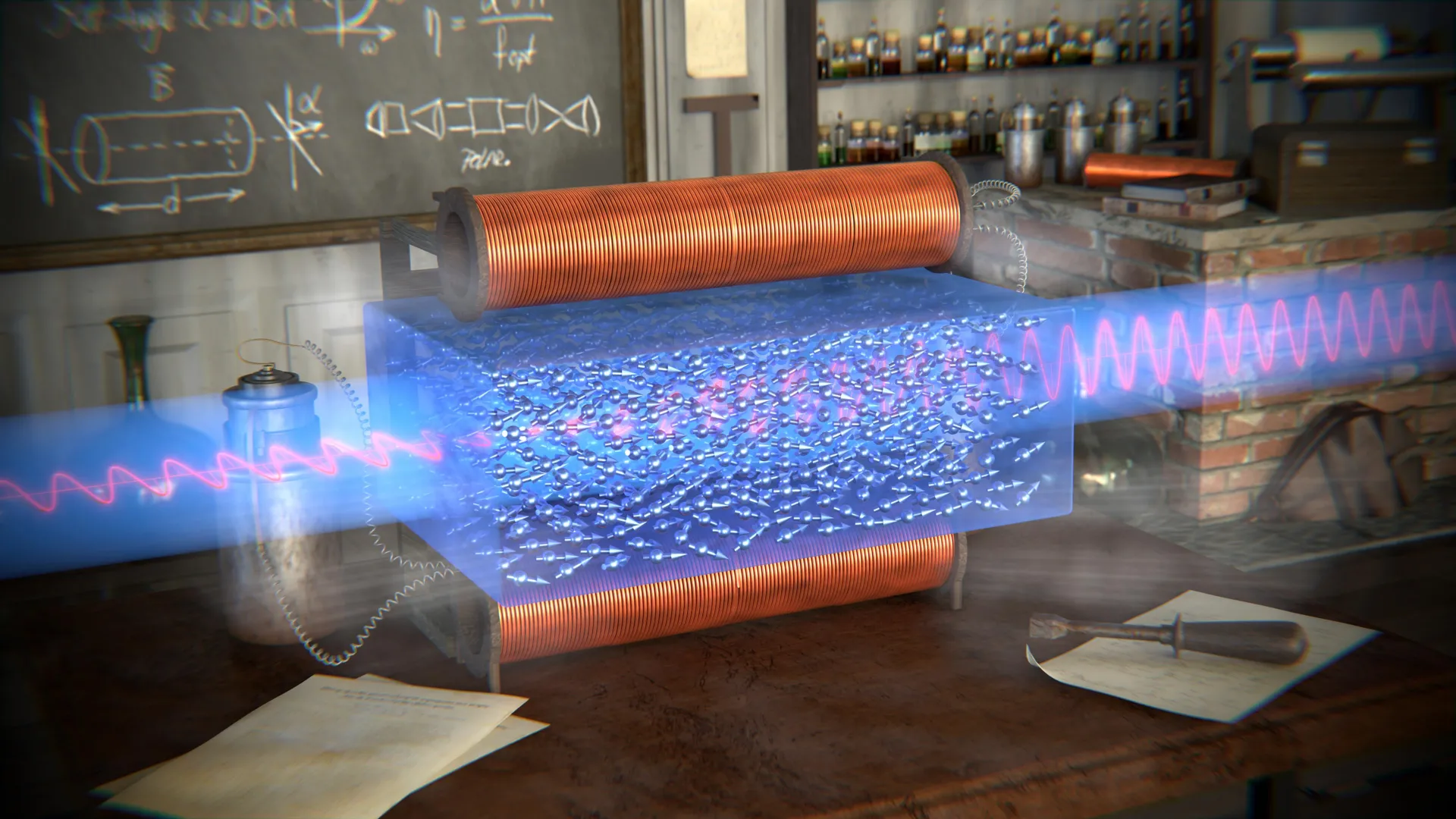
This pivotal research, meticulously detailed in a recent publication in the prestigious journal Scientific Reports, part of the Nature portfolio, asserts that the oscillating magnetic field of light is not merely a passive companion to its electric counterpart but an active participant, exerting a measurable influence on how light behaves when encountering magnetic materials. This discovery represents a profound shift, moving beyond the long-held view that light’s primary interaction with matter is through illumination and electrical forces, to reveal that light possesses a distinct magnetic influence, capable of directly interacting with the intrinsic magnetic properties of atoms.
The Faraday Effect, first observed by Michael Faraday in 1845, describes a fascinating interaction: when light traverses a transparent medium that is subjected to a uniform magnetic field, its plane of polarization undergoes a rotation. This rotation is proportional to the strength of the magnetic field and the distance traveled through the material. For decades, the prevailing explanation attributed this rotation entirely to the Lorentz force acting on charged particles within the material, induced by the external magnetic field and modulated by the electric field of the light. This explanation, while successful in many contexts, implicitly relegated the magnetic aspect of light itself to a secondary or even negligible role.
Dr. Capua eloquently summarizes the essence of the discovery: "In simple terms, it’s an interaction between light and magnetism. The static magnetic field ‘twists’ the light, and the light, in turn, reveals the magnetic properties of the material. What we’ve found is that the magnetic part of light has a first-order effect; it’s surprisingly active in this process." This statement underscores the core revelation: the magnetic field of the light wave itself, not just the external magnetic field applied to the material, is a key driver of the Faraday Effect.
The researchers’ innovative approach involved employing advanced theoretical calculations, deeply rooted in the principles of magnetism and electromagnetism. Crucially, they leveraged the Landau-Lifshitz-Gilbert (LLG) equation, a fundamental equation in the study of magnetic phenomena that describes the dynamics of magnetization in magnetic materials. By applying this sophisticated framework, they were able to model how the magnetic field of light could induce a torque on the atomic spins within a material. This induced torque, analogous to the effect of an external static magnetic field, directly contributes to the rotation of light’s polarization. This is a radical departure from previous models, which primarily focused on the interaction of the light’s electric field with the material’s electrons.
"In other words," Dr. Capua elaborates, "light doesn’t just illuminate matter; it magnetically influences it." This powerful statement encapsulates the paradigm shift. Light is now understood not just as a carrier of energy and information through electromagnetic waves, but as a force that can directly manipulate the magnetic state of materials. The implications of this are far-reaching, suggesting that light can be used as a tool to probe and control magnetic properties in ways previously unimagined.
To quantify the magnitude of this newly identified magnetic contribution, the team meticulously applied their theoretical model to Terbium Gallium Garnet (TGG), a crystalline material renowned for its strong magneto-optical properties and frequently used in experimental studies of the Faraday Effect. Their rigorous analysis revealed that, within the visible spectrum, the magnetic component of light is responsible for approximately 17% of the observed polarization rotation. This figure, while seemingly modest, is significant because it represents a previously unaccounted-for portion of the effect. The impact is even more pronounced in the infrared spectrum, where the magnetic contribution of light can account for as much as 70% of the observed rotation. This stark contrast highlights the wavelength-dependent nature of this interaction and suggests that certain regions of the electromagnetic spectrum might be particularly fertile ground for exploiting light’s magnetic influence.
Benjamin Assouline further emphasizes the significance of this discovery: "Our results show that light ‘talks’ to matter not only through its electric field, but also through its magnetic field, a component that has been largely overlooked until now." This metaphor of light "talking" to matter through different channels powerfully conveys the expanded understanding of light-matter interactions. The electric field has long been understood as communicating with the charged particles, while the magnetic field, until this study, was thought to primarily interact with the external magnetic environment rather than its own intrinsic magnetic nature.
The implications of this revised understanding are not confined to theoretical physics; they extend directly into the realm of technological innovation. The researchers posit that this breakthrough could unlock new avenues for advancements in several cutting-edge fields. For instance, in the area of optical data storage, a deeper understanding of light-magnetism interactions might lead to more efficient and higher-density storage media. The ability of light to directly influence magnetic states could enable novel writing and reading mechanisms.
Spintronics, a burgeoning field that seeks to harness the intrinsic spin of electrons in addition to their charge for information processing and storage, stands to benefit immensely. If light can directly manipulate electron spins through its magnetic field, it opens up possibilities for all-optical control of spin states, potentially leading to faster, more energy-efficient spintronic devices. This could bypass some of the limitations faced by current spintronic technologies that rely on electrical currents for spin manipulation.
Furthermore, the research holds significant promise for emerging quantum technologies. Quantum computing, particularly spin-based quantum computing, relies on the precise control of quantum bits (qubits), which are often encoded in the spin of individual particles. The discovery that light’s magnetic field can directly influence atomic spins suggests that light could become a powerful tool for initializing, manipulating, and reading out qubit states. This could lead to new architectures for quantum computers that are less reliant on complex cryogenic systems or highly controlled electromagnetic pulses. The potential for using light to perform delicate quantum operations with high precision is a tantalizing prospect.
The study’s findings also prompt a re-evaluation of existing magneto-optical devices and phenomena. It suggests that the performance of many technologies that rely on the Faraday Effect, such as optical isolators and modulators, might be further optimized by accounting for and potentially enhancing the magnetic contribution of light. This could lead to more efficient and compact devices for telecommunications, sensing, and scientific instrumentation.
In essence, this research represents a paradigm shift in our understanding of light and its interaction with the physical world. By revealing the long-hidden magnetic secret of light, the scientists at the Hebrew University of Jerusalem have not only corrected a nearly two-century-old misconception but have also illuminated a new path towards the development of next-generation technologies. The universe of light, once thought to be understood in its fundamental interactions, has just revealed another layer of its complexity, promising a future where light plays an even more active and influential role in shaping our technological landscape. This discovery serves as a potent reminder that even the most well-established scientific principles can hold surprises, and that continued exploration and rigorous investigation can lead to profound and transformative insights. The magnetic whispers of light, once ignored, are now poised to shout their importance across the fields of science and technology.