Imroatul Nasiyah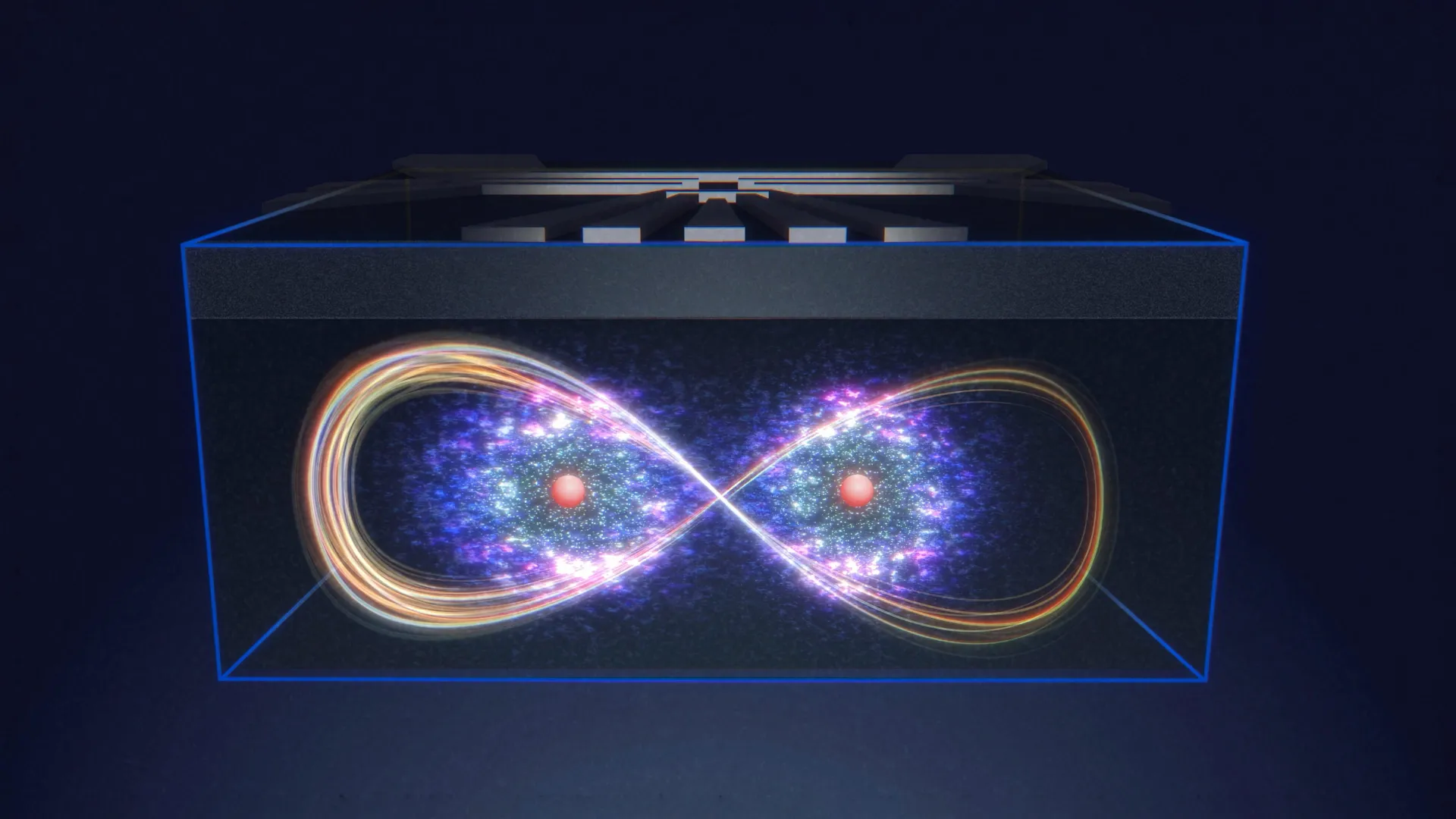
In a groundbreaking leap for quantum computing, UNSW engineers have achieved a pivotal advance by creating "quantum entangled states" between two separate atomic nuclei within silicon chips. This remarkable feat, detailed in the prestigious journal Science on September 18th, marks a significant stride towards realizing large-scale quantum computers – one of the most ambitious scientific and technological frontiers of the 21st century. The research, led by Dr. Holly Stemp, unlocks the potential to construct the future microchips required for quantum computing using existing, mature silicon fabrication technologies.
"We succeeded in making the cleanest, most isolated quantum objects talk to each other, at the scale at which standard silicon electronic devices are currently fabricated," Dr. Stemp explained. This achievement directly addresses a fundamental challenge in quantum computing: the delicate balance between shielding sensitive quantum bits (qubits) from environmental noise and enabling them to interact for computation. The diversity of hardware platforms vying for quantum supremacy highlights this dilemma; some excel at rapid operations but are prone to errors from noise, while others are robust against noise but difficult to control and scale.
The UNSW team’s innovation lies in their chosen platform: the nuclear spin of phosphorus atoms implanted in a silicon chip. This approach places them firmly in the category of highly stable, low-noise quantum systems. Scientia Professor Andrea Morello, from the UNSW School of Electrical Engineering & Telecommunications, elaborated on the intrinsic advantages of this method. "The spin of an atomic nucleus is the cleanest, most isolated quantum object one can find in the solid state," he stated.
Over the past 15 years, Professor Morello’s group has been at the forefront of breakthroughs in silicon-based quantum computing. They have previously demonstrated the ability to preserve quantum information for over 30 seconds – an extraordinary duration in the quantum realm – and to perform quantum logic operations with an error rate below 1%. "We were the first in the world to achieve this in a silicon device," Professor Morello noted, "but it all came at a price: the same isolation that makes atomic nuclei so clean, makes it hard to connect them together in a large-scale quantum processor."
Historically, coupling multiple atomic nuclei required them to be positioned in close proximity, often within the embrace of a single electron. This electron, due to its quantum mechanical nature, can "spread out" in space, interacting with multiple nuclei simultaneously. Dr. Stemp, who conducted this research at UNSW and is now a postdoctoral researcher at MIT, explained this phenomenon: "Most people think of an electron as the tiniest subatomic particle, but quantum physics tells us that it has the ability to ‘spread out’ in space, so that it can interact with multiple atomic nuclei." However, the range of this electron-mediated interaction is limited, and adding more nuclei to the same electron complicates individual control.
Bridging the Distance: Atomic Nuclei Communicate via Electronic "Telephones"
To illustrate the problem and their solution, Dr. Stemp employed a compelling analogy. "By way of metaphor, one could say that, until now, nuclei were like people placed in a sound-proof room," she said. "They can talk to each other as long as they are all in the same room, and the conversations are really clear. But they can’t hear anything from the outside, and there’s only so many people who can fit inside the room. This mode of conversation doesn’t ‘scale’."
The breakthrough, she explained, is akin to equipping these individuals with "telephones to communicate to other rooms. All the rooms are still nice and quiet on the inside, but now we can have conversations between many more people, even if they are far away."
These "telephones" are, in fact, precisely controlled electrons. Mark van Blankenstein, another co-author on the Science paper, delved into the sub-atomic mechanics. "By their ability to spread out in space, two electrons can ‘touch’ each other at quite some distance. And if each electron is directly coupled to an atomic nucleus, the nuclei can communicate through that." This electron-mediated interaction acts as a quantum communication channel, enabling entanglement between nuclei that are not in direct proximity.
The distance achieved in these experiments is significant. The nuclei were separated by approximately 20 nanometers – roughly one-thousandth the width of a human hair. While this may seem minuscule, Dr. Stemp provided a powerful perspective: "That doesn’t sound like much, but consider this: if we scaled each nucleus to the size of a person, the distance between the nuclei would be about the same as that between Sydney and Boston!"
Crucially, this 20-nanometer scale aligns precisely with the dimensions of modern silicon transistors found in everyday personal computers and mobile phones. "You have billions of silicon transistors in your pocket or in your bag right now, each one about 20 nanometers in size," Dr. Stemp emphasized. "This is our real technological breakthrough: getting our cleanest and most isolated quantum objects talking to each other at the same scale as existing electronic devices. This means we can adapt the manufacturing processes developed by the trillion-dollar semiconductor industry, to the construction of quantum computers based on the spins of atomic nuclei."
A Scalable Path Forward for Silicon Quantum Computing
Despite the inherent complexity and exotic nature of quantum mechanics, the UNSW team’s approach maintains fundamental compatibility with the established manufacturing pipelines of the global semiconductor industry. The precise implantation of phosphorus atoms into ultra-pure silicon was a collaborative effort, with the silicon slab provided by Professor Kohei Itoh at Keio University in Japan, and the implantation expertise from Professor David Jamieson’s team at the University of Melbourne.
By circumventing the requirement for atomic nuclei to be tethered to the same electron, the UNSW researchers have removed a major bottleneck in scaling up silicon-based quantum computers. Professor Morello expressed optimism about the future: "Our method is remarkably robust and scalable. Here we just used two electrons, but in the future we can even add more electrons, and force them in an elongated shape, to spread out the nuclei even further."
The malleability and controllability of electrons are key advantages. "Electrons are easy to move around and to ‘massage’ into shape, which means the interactions can be switched on and off quickly and precisely," Professor Morello added. "That’s exactly what is needed for a scalable quantum computer." This ability to precisely manipulate and control these electron-mediated connections is paramount for building the complex quantum circuits required for powerful quantum processors. The implications of this research extend far beyond theoretical curiosity, offering a tangible and industrially compatible pathway towards realizing the immense potential of quantum computation.