Imroatul Nasiyah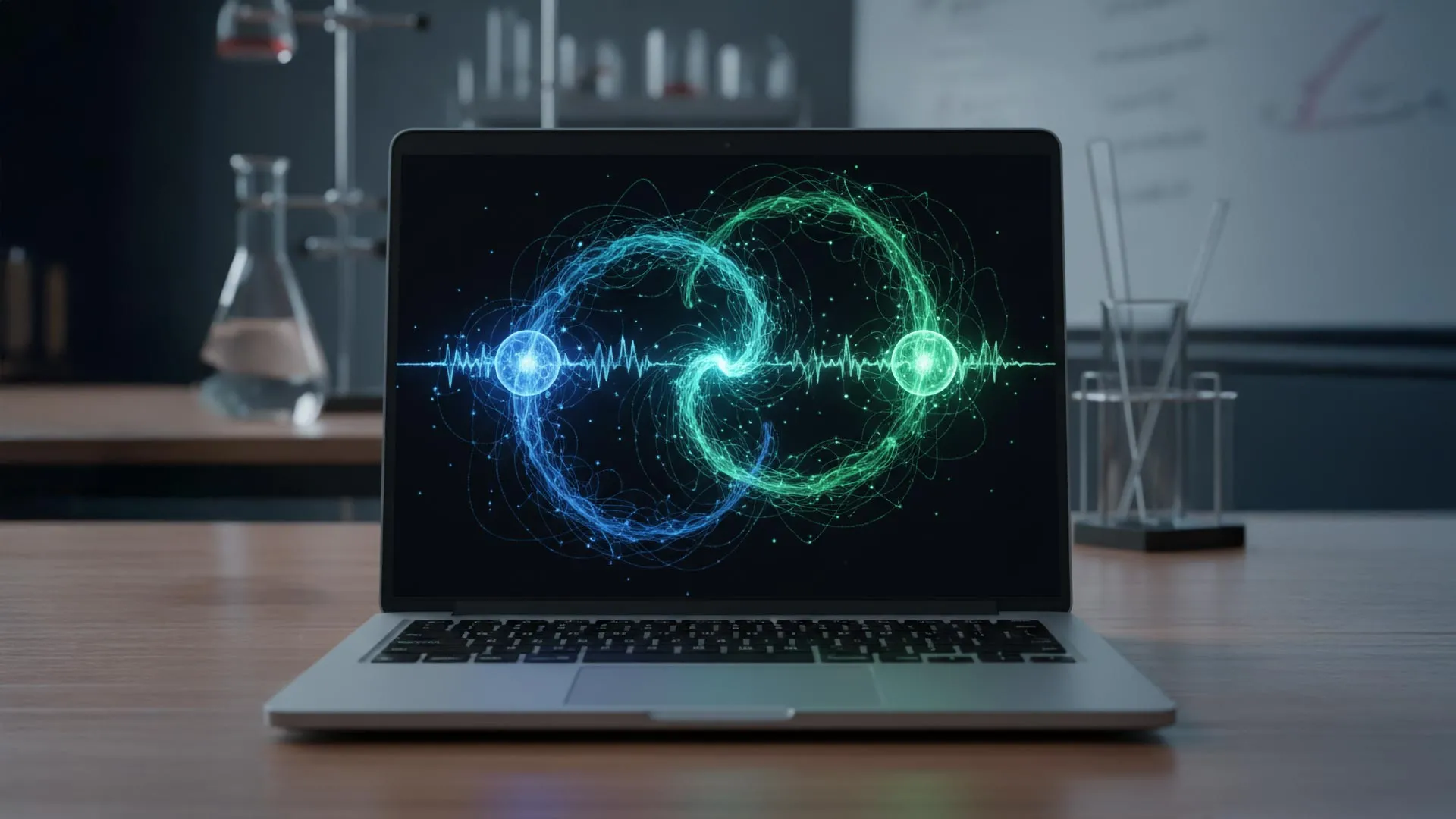
Picture diving deep into the quantum realm, where unimaginably small particles can exist and interact in more than a trillion possible ways at the same time. This mind-bending reality, governed by the peculiar laws of quantum mechanics, presents a profound challenge for scientists seeking to understand and predict the behavior of matter at its most fundamental level. The sheer number of potential states and interactions within even moderately sized quantum systems quickly overwhelms traditional computational approaches, leading physicists to often rely on the immense processing power of supercomputers or sophisticated artificial intelligence algorithms. However, a recent breakthrough from researchers at the University at Buffalo is set to dramatically alter this landscape, demonstrating that many of these once-prohibitive quantum simulations can now be performed on a standard laptop.
This paradigm shift is rooted in the expansion of a cost-effective computational technique known as the truncated Wigner approximation (TWA). For decades, TWA has served as a valuable "physics shortcut," simplifying the complex mathematical frameworks of quantum mechanics. While theoretically powerful, its practical application has historically been confined to highly idealized, isolated quantum systems where no energy is exchanged with the environment. The University at Buffalo team, led by Assistant Professor of Physics Jamir Marino, has successfully extended TWA to handle more realistic and complex systems, particularly those exhibiting dissipative spin dynamics – a phenomenon crucial for understanding many real-world quantum phenomena. Their innovative approach, detailed in a September publication in the prestigious journal PRX Quantum, not only broadens the applicability of TWA but also provides a remarkably accessible and user-friendly framework for researchers.
"Our approach offers a significantly lower computational cost and a much simpler formulation of the dynamical equations," stated Dr. Jamir Marino, the study’s corresponding author and a recent addition to UB’s College of Arts and Sciences faculty. "We think this method could, in the near future, become the primary tool for exploring these kinds of quantum dynamics on consumer-grade computers." This sentiment underscores the transformative potential of their work, suggesting a future where cutting-edge quantum research is no longer solely the domain of institutions with access to massive computing infrastructure.
The research, which began during Marino’s tenure at Johannes Gutenberg University Mainz in Germany, is a testament to collaborative scientific endeavor. Co-authors Hossein Hosseinabadi and Oksana Chelpanova, both former students of Marino and now involved in his lab at UB, played pivotal roles in developing and refining the TWA framework. The project received crucial financial backing from esteemed organizations such as the National Science Foundation, the German Research Foundation, and the European Union, highlighting the international significance and support for this pioneering research.
At its core, the challenge lies in the inherent complexity of quantum systems. Precisely simulating every quantum interaction is often computationally intractable, as the required processing power escalates exponentially with the number of particles and their interconnectedness. This computational barrier necessitates the use of approximations and simplified models. Semiclassical physics, a domain that balances quantum accuracy with computational feasibility, has long been a fertile ground for such approximations. TWA, a semiclassical method originating in the 1970s, falls into this category. However, its efficacy was largely limited to scenarios where quantum systems operated in isolation, devoid of any external influences that could introduce energy fluctuations.
Marino’s team ingeniously tackled this limitation by extending TWA to accommodate the "messier" quantum systems encountered in reality. These are systems where particles are constantly influenced by external forces, leading to the leakage of energy into their surroundings – a process known as dissipative spin dynamics. "Plenty of groups have tried to do this before us. It’s known that certain complicated quantum systems could be solved efficiently with a semiclassical approach," Marino explained. "However, the real challenge has been to make it accessible and easy to do." This emphasis on accessibility is a key differentiator of their work.
Historically, researchers wishing to employ TWA faced a steep learning curve. The mathematical derivations required to adapt the method to a new quantum problem were often intricate and time-consuming, demanding a deep understanding of the underlying physics and a willingness to re-derive complex equations from scratch for each new application. The University at Buffalo researchers have effectively demystified this process. They have transformed what were once pages of dense, nearly impenetrable mathematical formulations into a straightforward conversion table. This table acts as a translator, enabling physicists to readily convert a quantum problem into a set of solvable equations that can be efficiently processed by the TWA framework.
"Physicists can essentially learn this method in one day, and by about the third day, they are running some of the most complex problems we present in the study," remarked Chelpanova, underscoring the remarkable ease of use and rapid implementation of the new TWA framework. This significantly lowers the barrier to entry for quantum simulations, empowering a wider range of researchers to engage with complex quantum phenomena without requiring extensive specialized training or access to high-performance computing resources.
The ultimate aim of this development is to judiciously allocate computational resources. By enabling a vast array of quantum dynamics problems to be solved on standard laptops, the new method liberates supercomputing clusters and advanced AI models for the truly intractable quantum systems. These are the systems that defy even semiclassical approximations, possessing not just trillions, but potentially more possible states than there are atoms in the observable universe. "A lot of what appears complicated isn’t actually complicated," Marino observed. "Physicists can use supercomputing resources on the systems that need a full-fledged quantum approach and solve the rest quickly with our approach." This strategic deployment of computational power ensures that the most demanding quantum challenges receive the attention they require, while more manageable, yet still scientifically significant, problems can be addressed with unprecedented efficiency and accessibility.
The implications of this research are far-reaching. It promises to accelerate progress in diverse fields that rely on understanding quantum phenomena, including materials science, condensed matter physics, quantum computing, and even quantum chemistry. By democratizing access to powerful quantum simulation tools, the University at Buffalo’s work is poised to foster innovation and discovery at an accelerated pace, paving the way for new technologies and a deeper comprehension of the fundamental workings of our universe. The era of wrestling with supercomputers for every quantum simulation may well be drawing to a close, replaced by a more agile and accessible approach that brings the quantum realm within reach of a broader scientific community.