Imroatul Nasiyah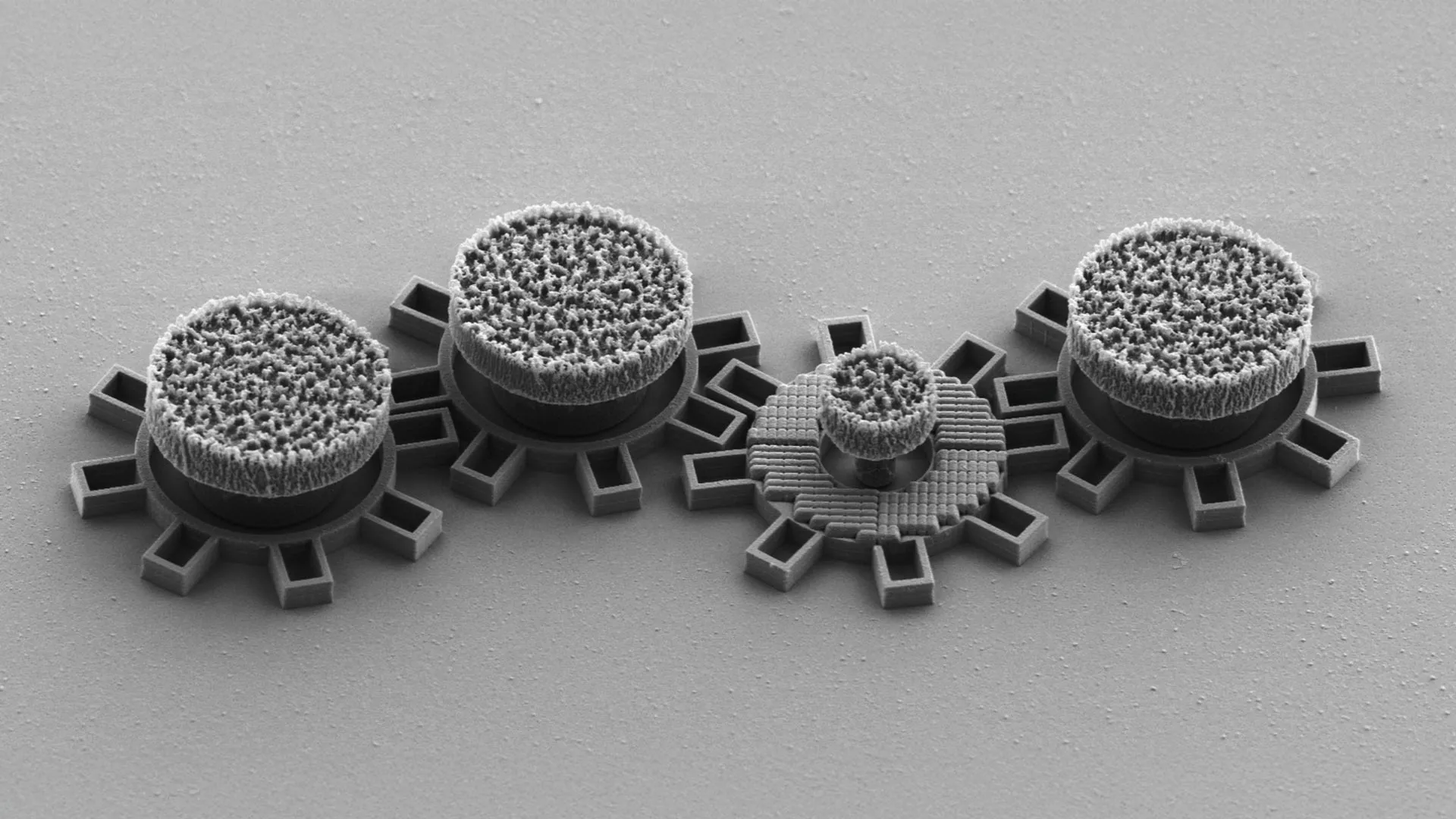
Researchers at the University of Gothenburg have achieved a groundbreaking feat, successfully constructing light-powered gears on a micrometer scale, paving the way for the creation of the smallest on-chip motors ever conceived, capable of fitting within the diameter of a human hair. This remarkable innovation represents a significant leap forward in the field of micro-engineering, overcoming long-standing limitations in the miniaturization of mechanical systems.
For over three decades, the scientific community has been striving to develop increasingly diminutive gears to construct micro-engines. However, progress had consistently hit a wall at approximately 0.1 millimeters, as the intricate drive trains necessary for their operation could not be scaled down further. This plateau has now been shattered by the innovative approach developed by researchers at the University of Gothenburg and their collaborators. Instead of relying on traditional, bulky mechanical drive trains, they have ingeniously harnessed the power of laser light to directly set these microscopic gears in motion.
The core of this breakthrough lies in the utilization of optical metamaterials. These are not merely small structures; they are precisely engineered, patterned elements designed to interact with light on a nanoscale, enabling them to capture and control it with unprecedented precision. The researchers have employed established lithography techniques, a process akin to creating intricate stencils for printing, to manufacture gears directly onto microchips using silicon. These newly fabricated gears, adorned with the optical metamaterial, possess a diameter ranging from a few tens of micrometers. The magic happens when a laser beam is directed onto the metamaterial. The interaction between the light and the patterned structure causes the gear wheel to spin. The intensity of the laser light serves as a direct control mechanism for the speed of rotation, while the polarization of the light offers the ability to dictate the direction of the gear’s movement. This level of control over microscopic mechanical components driven by light is truly transformative.
The implications of this development are profound, bringing the realization of functional micromotors tantalizingly close. As Gan Wang, the study’s first author and a researcher in soft matter physics at the University of Gothenburg, explains, "We have built a gear train in which a light-driven gear sets the entire chain in motion." This cascade effect, where a single light-powered element can animate a series of connected gears, is a crucial step towards building complex micro-mechanical systems. Furthermore, these light-powered gears are not limited to simple rotation; they can also convert rotational motion into linear motion, execute precise periodic movements, and even control microscopic mirrors to deflect light. This versatility opens up a vast landscape of potential applications.
The ability to integrate these miniature machines directly onto a microchip and power them wirelessly with light ushers in entirely new possibilities. The inherent advantages of laser light are manifold. Firstly, it eliminates the need for any fixed physical contact with the machine, simplifying assembly and reducing wear and tear. Secondly, laser light is exceptionally easy to control, allowing for precise adjustments to speed, direction, and timing. This ease of control is paramount when considering the potential for scaling up these micromotors into complex microsystems, where numerous individual components must work in concert.
"This is a fundamentally new way of thinking about mechanics on a microscale," states Gan Wang. "By replacing bulky couplings with light, we can finally overcome the size barrier." This paradigm shift represents a departure from traditional mechanical engineering principles, which have often been constrained by the physical limitations of gears, shafts, and bearings. The adoption of light as a direct actuator bypasses these limitations, allowing for a level of miniaturization previously thought impossible.
The potential applications of these microscopic marvels span a wide array of fields, with medicine being a particularly promising area. The researchers envision micro- and nanomachines capable of precisely controlling light, manipulating minuscule particles, and being seamlessly integrated into future lab-on-a-chip systems. The size of these gear wheels, which can be as small as 16-20 micrometers, is particularly significant because it falls within the range of human cell sizes. This comparability to biological entities suggests a natural synergy with medical applications.
"We can use the new micromotors as pumps inside the human body, for example to regulate various flows," Gan Wang elaborates. The ability to create precisely controlled, miniaturized pumps within the body could revolutionize drug delivery, allowing for targeted and timed release of medications. Furthermore, he is actively exploring their functionality as valves, capable of opening and closing microscopic channels to control the flow of fluids. This could have implications for a variety of diagnostic and therapeutic procedures.
Beyond medicine, the implications for microfluidics are immense. These light-powered gears could be used to create incredibly precise microfluidic devices for chemical analysis, biological sorting, and the manipulation of single cells. Imagine laboratories on a chip, where complex experiments can be conducted with minimal sample volumes and high throughput, all powered by these tiny, light-driven engines.
The development also holds significant promise for the field of optics and photonics. The ability to control microscopic mirrors with such precision could lead to the development of novel optical switches, beam deflectors, and components for advanced imaging systems. The controlled manipulation of light at the microscale is a cornerstone of many emerging technologies, and these micromotors provide a new tool for achieving that control.
The manufacturing process itself, utilizing established lithography techniques, is a critical enabler of this technology. This means that these micromotors can, in principle, be mass-produced using existing semiconductor fabrication facilities. This scalability is crucial for the widespread adoption and commercialization of such innovations. The integration onto silicon chips also means that these micromotors can be readily interfaced with electronic control systems, creating sophisticated mechatronic devices at the microscale.
The research team is actively pursuing further refinements, aiming to increase the efficiency and robustness of these light-powered micromotors. They are exploring different metamaterial designs, laser wavelengths, and control strategies to optimize performance and expand the range of applications. The long-term vision includes the development of fully autonomous micro-robots capable of performing complex tasks within confined environments, such as inspecting micro-circuitry, cleaning microscopic debris, or even assisting in delicate surgical procedures.
In conclusion, the breakthrough achieved by the University of Gothenburg researchers represents a monumental step forward in the realm of micro-engineering. By ingeniously leveraging the power of light and optical metamaterials, they have overcome the size limitations that have long hampered the development of micro-engines. The creation of light-powered gears smaller than a human hair opens up a vast frontier of possibilities, promising to revolutionize fields ranging from medicine and microfluidics to optics and beyond. This innovative approach not only pushes the boundaries of what is mechanically possible but also fundamentally redefines our understanding of mechanics at the smallest scales, heralding a new era of miniaturized, intelligent machines.