Imroatul Nasiyah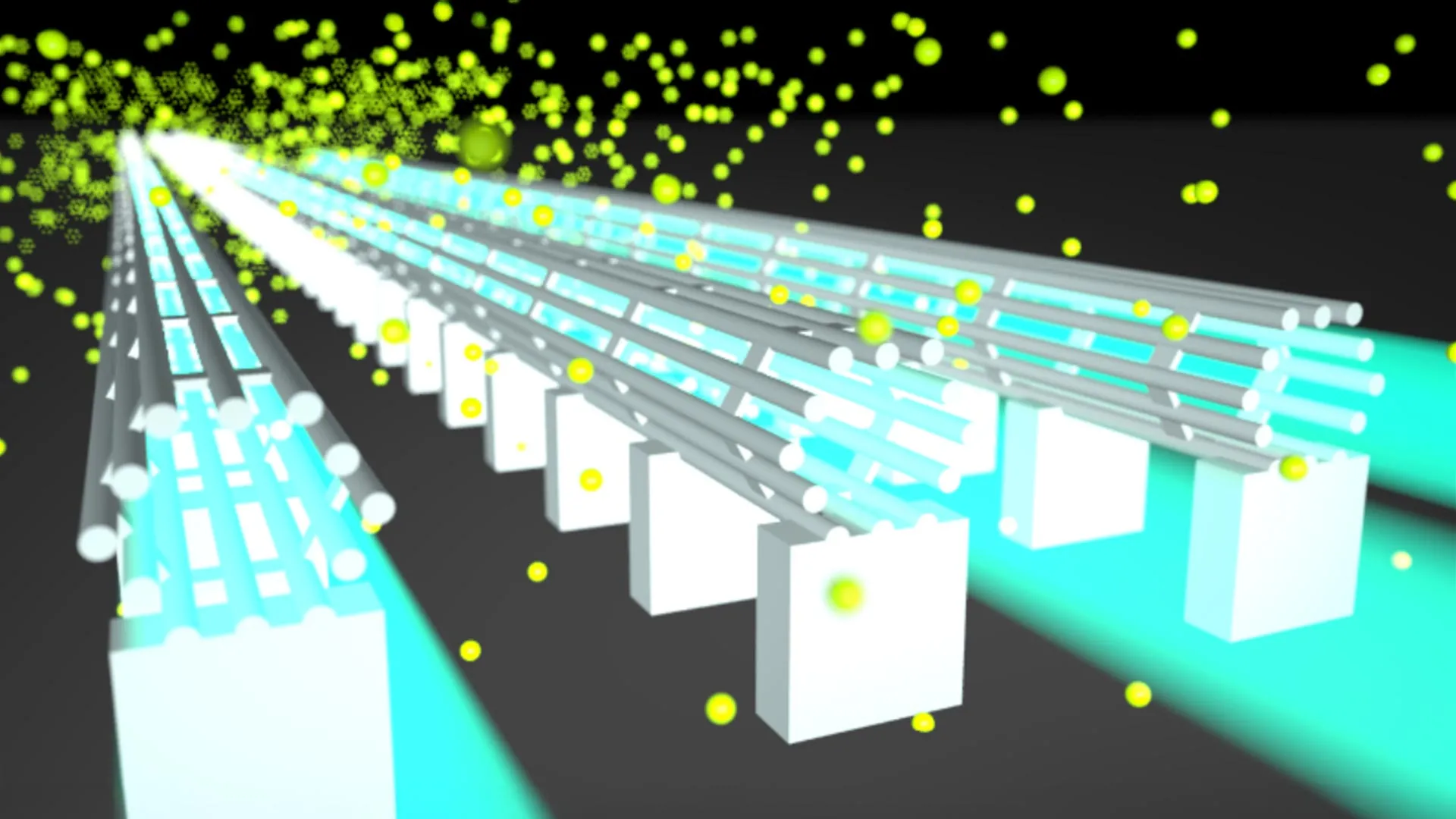
A groundbreaking advancement in this critical field has been recently unveiled in a new study published in the prestigious journal Light: Science & Applications. Researchers, a collaborative effort between Humboldt-Universität zu Berlin, the Leibniz Institute of Photonic Technology, and the University of Stuttgart, have pioneered a novel type of quantum memory. This innovative memory is constructed from intricately designed 3D-nanoprinted structures, aptly named "light cages," which are subsequently filled with atomic vapor. By ingeniously integrating both light and atoms onto a single chip, the research team has forged a versatile platform specifically engineered for scalability and seamless integration into the burgeoning landscape of quantum photonic systems.
The Distinctive Advantages of Light Cages
The ingenuity of light cages lies in their unique architectural design. These are essentially hollow-core waveguides meticulously engineered to confine and guide light with exceptional precision, while concurrently maintaining open access to the internal volume. This distinctive configuration presents a substantial advantage over conventional hollow-core fibers. The latter often present a protracted challenge, with filling processes that can span several months to adequately saturate with atomic vapor. In stark contrast, the inherent open nature of light cages facilitates a dramatically accelerated diffusion of cesium atoms into the core, reducing the filling time to a mere matter of days, all without any discernible compromise in optical performance.
The fabrication of these intricate structures is achieved through a sophisticated process known as two-photon polymerization lithography, leveraging commercially available 3D printing systems. This cutting-edge approach empowers researchers to directly print highly complex hollow-core waveguides onto silicon chips with an astonishing degree of precision. To safeguard the delicate waveguide structures from potential chemical reactions with cesium, they are meticulously coated with a protective layer. Rigorous testing has demonstrated an impressive resilience, with no indications of degradation observed even after an extended operational period of five years, underscoring the exceptional long-term stability of this pioneering system.
"We have successfully developed a guiding structure that not only permits rapid diffusion of gases and fluids within its core but also offers the inherent versatility and reproducibility characteristic of the 3D-nanoprinting process," explained the research team. "This breakthrough enables true scalability of this platform, not only for intra-chip fabrication of the waveguides but also for inter-chip production, allowing for the generation of multiple chips exhibiting identical performance characteristics."
Transforming Light into Stored Quantum Information
Within the confines of the light cages, incoming light pulses are efficiently transformed into collective excitations of the surrounding atomic ensemble. Following a predetermined storage duration, a precisely tuned control laser orchestrates the reversal of this process, releasing the stored light at the exact moment required. In a pivotal demonstration of this capability, the researchers adeptly stored extremely faint light pulses, containing as few as a handful of photons, for durations extending into several hundred nanoseconds. The team expresses strong confidence that this methodology can eventually be extended to achieve the storage of single photons for considerably longer periods, measured in milliseconds.
Another significant milestone achieved by the researchers is the successful integration of multiple light cage memories onto a single chip, all housed within a cesium vapor cell. Subsequent measurements revealed that distinct light cages, fabricated with identical designs, exhibited remarkably consistent storage performance across two separate devices situated on the same chip. This level of exceptional reproducibility is an indispensable prerequisite for the successful development of scalable quantum systems.
The robust reproducibility is a direct consequence of the exquisite precision afforded by the 3D-nanoprinting process. Variations within a single chip were meticulously controlled to be less than 2 nanometers, while differences between individual chips were kept below a mere 15 nanometers. Such stringent control is paramount for enabling spatial multiplexing, a sophisticated technique that holds the potential to dramatically amplify the number of quantum memories operating in unison on a single device.
Profound Implications for Quantum Networks and Computing
The advent of light cage quantum memories directly addresses several long-standing impediments that have hindered the progress of quantum technologies. Within the framework of quantum repeater networks, these memories are poised to revolutionize synchronization by enabling multiple single photons to be aligned simultaneously, thereby substantially enhancing the efficiency of long-distance quantum communication. In the realm of photonic quantum computing, these memories provide the precisely controlled temporal delays that are essential for implementing feed-forward operations in measurement-based quantum computing architectures.
Furthermore, the platform distinguishes itself through its remarkable practicality. In stark contrast to many competing technologies, it operates effectively at temperatures slightly above room temperature, obviating the need for costly and complex cryogenic cooling or elaborate atom-trapping setups. This inherent simplicity in operation not only facilitates easier deployment but also offers a superior bandwidth per memory mode. The capacity to manufacture numerous identical quantum memories on a single chip presents a clear and viable pathway toward achieving large-scale quantum photonic integration.
The inherent flexibility of the fabrication process imbues this technology with the potential for seamless integration with direct fiber coupling and existing photonic components. These compelling advantages collectively position light cage quantum memories as a highly promising candidate for the foundational infrastructure of future quantum communication networks.
A Scalable Trajectory Towards the Future
The development of light cage quantum memories represents a monumental stride forward in the field of quantum photonic research. By ingeniously merging advanced 3D-nanoprinting techniques with the fundamental principles of quantum optics, the researchers have successfully engineered a compact, highly scalable system. This breakthrough is poised to accelerate the realization of practical quantum networks and pave the way for the development of significantly more powerful quantum computers, ushering in a new era of technological innovation.