Imroatul Nasiyah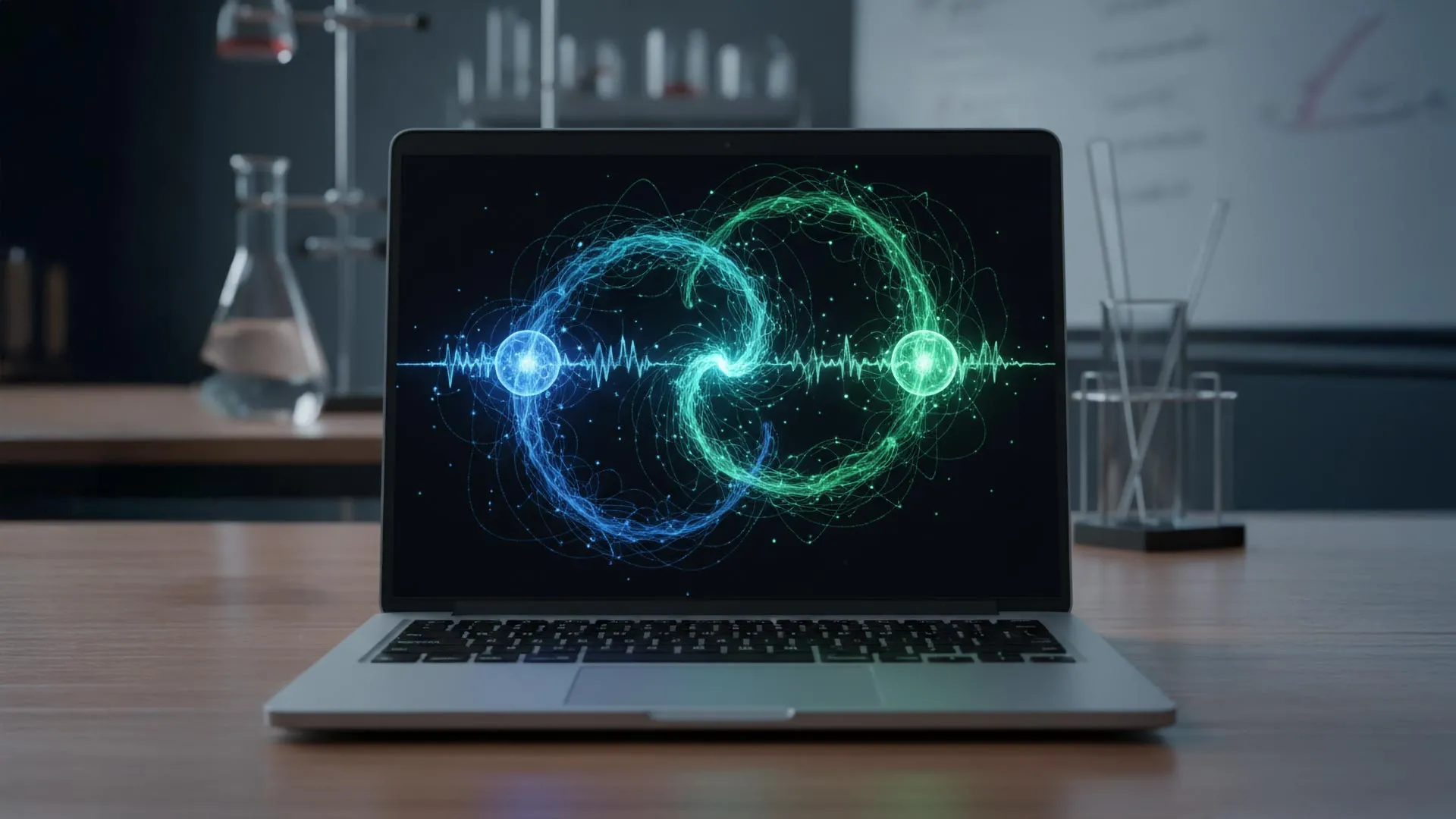
Picture diving deep into the quantum realm, where unimaginably small particles can exist and interact in more than a trillion possible ways at the same time. This is a universe of mind-bending complexity, where the fundamental building blocks of reality operate under rules that defy our everyday intuition. For decades, physicists seeking to unravel the mysteries of these intricate quantum systems, with their myriad of potential configurations, have been tethered to the immense processing power of supercomputers or the sophisticated algorithms of artificial intelligence. These powerful tools have been indispensable for simulating the behavior of quantum phenomena, allowing scientists to explore scenarios that would otherwise remain inaccessible. However, a groundbreaking advancement by researchers at the University at Buffalo is poised to democratize access to quantum simulations, bringing capabilities once confined to the realm of high-performance computing directly to the desks of everyday scientists.
The core of this revolution lies in the significant expansion of a cost-effective computational technique known as the truncated Wigner approximation (TWA). This method, essentially a clever physics shortcut, simplifies the complex mathematical underpinnings of quantum mechanics, making it computationally tractable. While theoretically capable of handling a broader range of quantum problems, practically implementing TWA for systems demanding substantial computing power had remained an elusive goal. The University at Buffalo team, led by Dr. Jamir Marino, has now bridged this gap, transforming TWA into a powerful and accessible framework. Their innovative approach, detailed in a September publication in the esteemed journal PRX Quantum, not only drastically reduces the computational burden but also offers a remarkably user-friendly interface. This means researchers can now input their quantum data and obtain meaningful, insightful results within a matter of hours, a stark contrast to the days or even weeks that supercomputer simulations might have previously required.
"Our approach offers a significantly lower computational cost and a much simpler formulation of the dynamical equations," states Dr. Jamir Marino, the study’s corresponding author and an assistant professor of physics at UB’s College of Arts and Sciences. His enthusiasm is palpable as he describes the implications of their work. "We think this method could, in the near future, become the primary tool for exploring these kinds of quantum dynamics on consumer-grade computers." This sentiment underscores the transformative potential of their research, suggesting a paradigm shift in how quantum physics is studied. Dr. Marino, who joined UB this past fall, initiated this pivotal research during his tenure at Johannes Gutenberg University Mainz in Germany. His collaborators on this project include two of his former students from Germany, Hossein Hosseinabadi and Oksana Chelpanova, with Chelpanova now continuing her postdoctoral research in Marino’s lab at UB, further solidifying the collaborative spirit driving this breakthrough. The research itself received crucial financial backing from prominent institutions, including the National Science Foundation, the German Research Foundation, and the European Union, highlighting the international recognition of its importance.
The fundamental challenge in quantum physics is that not every quantum system can be solved exactly through direct simulation. The computational resources required to do so escalate exponentially as the complexity of the system increases. Imagine trying to map out every single interaction between trillions of particles simultaneously – the computational demand quickly becomes astronomically prohibitive. To circumvent this limitation, physicists have long relied on a middle-ground approach known as semiclassical physics. This strategy cleverly retains just enough of the quantum mechanical essence to maintain accuracy while judiciously discarding details that have a negligible impact on the overall outcome. TWA, a descendant of this semiclassical philosophy, has been around since the 1970s. However, its utility was historically confined to isolated, idealized quantum systems where energy exchange with the environment was negligible, meaning no energy was gained or lost. The University at Buffalo team’s crucial innovation was to extend TWA’s capabilities to the far more prevalent and complex "messier" systems found in the real world. These are systems where particles are constantly influenced by external forces, experiencing pushes and pulls, and crucially, losing energy to their surroundings – a phenomenon known as dissipative spin dynamics.
"Plenty of groups have tried to do this before us. It’s known that certain complicated quantum systems could be solved efficiently with a semiclassical approach," Dr. Marino explains, acknowledging the long-standing quest in the field. "However, the real challenge has been to make it accessible and easy to do." This accessibility is precisely what his team has achieved. Historically, applying TWA to a new quantum problem was a formidable task, often requiring researchers to meticulously re-derive the underlying mathematical equations from scratch. This presented a significant barrier to entry, deterring many from utilizing the method. The UB researchers have ingeniously streamlined this process. They have transformed what were once pages of dense, arcane mathematical derivations into a straightforward conversion table. This table acts as a translator, effectively mapping a quantum problem onto a set of solvable equations, making the TWA framework vastly more approachable.
Oksana Chelpanova elaborates on the practical implications of this simplification: "Physicists can essentially learn this method in one day, and by about the third day, they are running some of the most complex problems we present in the study." This rapid learning curve and swift application demonstrate the profound impact of their user-friendly framework. The implications of this advancement are far-reaching. The hope is that this new, accessible TWA method will liberate precious supercomputing resources and sophisticated AI models, allowing them to be dedicated to the truly gargantuan quantum systems – those that genuinely defy semiclassical approximations. These are the systems with not just trillions, but potentially more possible states than there are atoms in the observable universe.
"A lot of what appears complicated isn’t actually complicated," Dr. Marino asserts, emphasizing the power of efficient tools. "Physicists can use supercomputing resources on the systems that need a full-fledged quantum approach and solve the rest quickly with our approach." This judicious allocation of computational power is critical for accelerating scientific discovery. By offloading a significant portion of quantum simulation tasks to readily available laptops, researchers can explore a wider range of phenomena, test hypotheses more rapidly, and ultimately gain deeper insights into the fundamental workings of the universe. This breakthrough promises to democratize quantum research, empowering a broader community of scientists to delve into the quantum realm without the prohibitive cost and complexity previously associated with such endeavors. The future of quantum simulation is no longer confined to the hallowed halls of supercomputing centers; it is now within reach, on the laptops that power our everyday lives.