Imroatul Nasiyah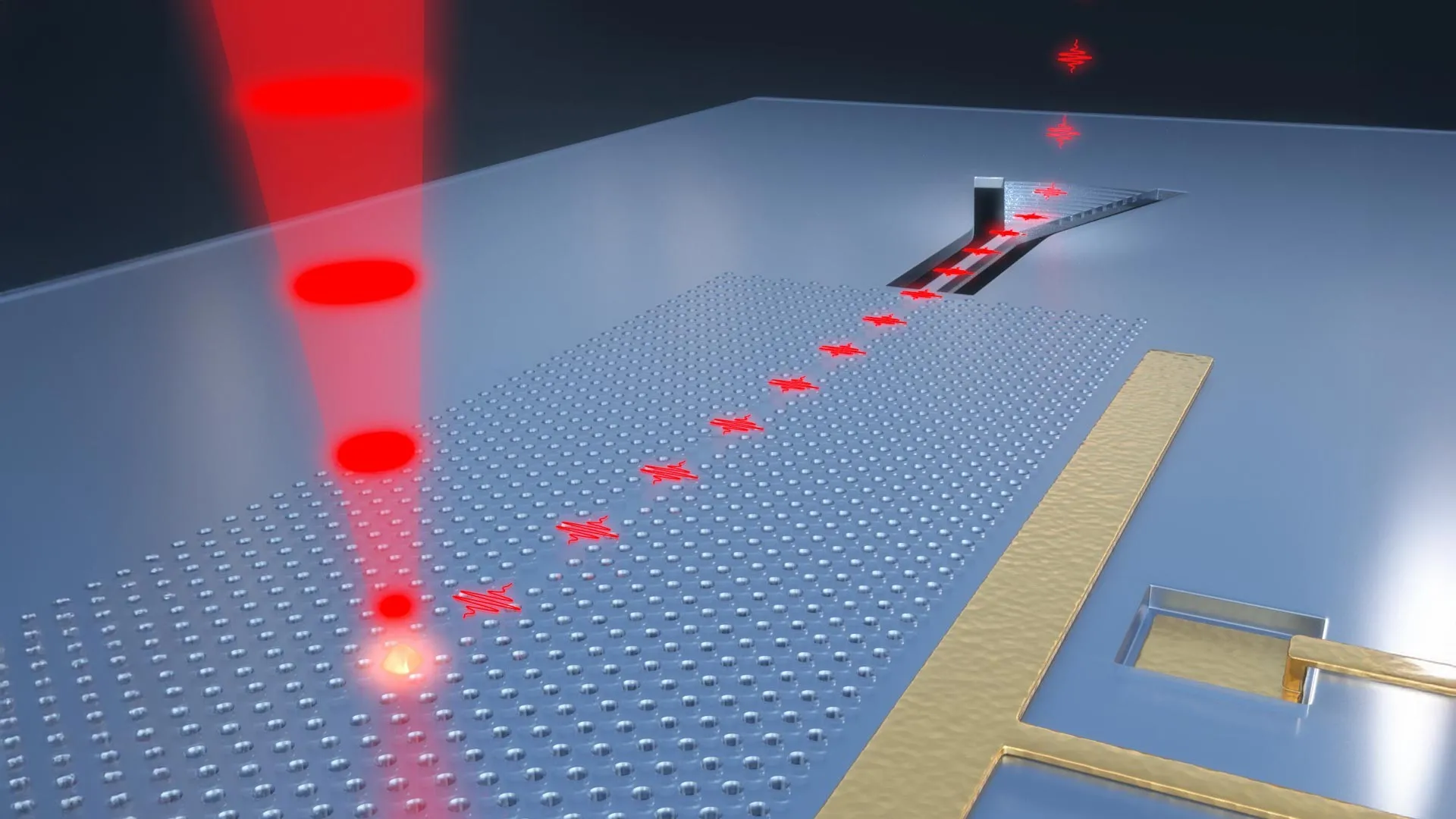
Researchers at the University of Iowa have achieved a groundbreaking advancement in the field of quantum optics, developing a novel technique to "purify" photons, the fundamental particles of light. This pioneering approach promises to significantly enhance the performance and bolster the security of light-based quantum technologies, addressing long-standing limitations that have hindered the reliable generation of single photons. By meticulously refining the process by which these individual light particles are produced, the team’s work opens exciting new avenues for the development of more robust photonic quantum computers and ultra-secure communication networks.
The quest for pure, single photons has been a persistent challenge in optical quantum systems. The University of Iowa team, led by Assistant Professor Ravitej Uppu and graduate student Matthew Nelson in the Department of Physics and Astronomy, focused their attention on two primary obstacles that impede the consistent and reliable generation of single photons. These elusive particles are the bedrock of photonic quantum computing, enabling complex calculations that surpass the capabilities of classical computers, and are also crucial for establishing quantum communication networks that offer unparalleled security.
The first significant hurdle is a phenomenon known as laser scatter. In a typical process designed to generate a single photon, a laser beam is directed at an atom, exciting it to a point where it releases a single photon. However, this interaction is not always perfectly precise. The laser’s energy can inadvertently trigger the emission of additional, unwanted photons. These extraneous particles act as noise within an optical circuit, analogous to how stray electrical currents can disrupt the flow of information in conventional electronic systems. This interference degrades the efficiency of quantum operations, making it difficult to maintain the integrity of quantum information.
The second major obstacle arises from the inherent behavior of atoms when interacting with laser light. While the goal is for an atom to emit precisely one photon, there are instances, albeit rare, where an atom can release more than one photon simultaneously. This multi-photon emission is particularly problematic for quantum applications. Quantum operations rely on the precise timing and order of photon arrivals to perform calculations and encode information. When multiple photons are emitted at once, the intended one-by-one flow is disrupted, leading to errors and a breakdown in the delicate quantum state. This lack of precise control over photon generation limits the scalability and reliability of current photonic quantum systems.
In a remarkable turn of events, the new study by Nelson and Uppu has revealed an unexpected and elegant solution by discovering a profound connection between these two seemingly disparate problems. Their theoretical work demonstrates that when an atom emits multiple photons, the spectral characteristics and waveform of these unwanted photons bear a striking resemblance to those of the original laser light used to excite the atom. This crucial insight suggests a novel pathway for manipulation and control.
According to the researchers, this remarkable similarity between the multi-photon emission and the laser light allows for a sophisticated cancellation process. By carefully tuning and adjusting the properties of the laser beam, the team has theoretically shown that the unwanted photons can be made to interfere destructively with themselves, effectively canceling each other out. In essence, the very phenomenon that was previously considered a nuisance – laser scatter – can now be harnessed as a powerful tool to suppress the emission of unwanted, multiple photons, thereby purifying the resulting light stream.
"We have shown that stray laser scatter, typically considered a nuisance, can be harnessed to cancel out unwanted, multi-photon emission," stated Ravitej Uppu, the study’s corresponding author and an assistant professor in the Department of Physics and Astronomy. "This theoretical breakthrough could turn a long-standing problem into a powerful new tool for advancing quantum technologies. Instead of fighting against this noise, we’re learning to use it to our advantage."
The significance of this advancement cannot be overstated, particularly for the burgeoning field of photonic quantum computing. Photonic computing, which utilizes light rather than electricity to perform computations, holds the promise of vastly superior processing speeds and energy efficiency compared to conventional computers. While classical computers rely on bits, which represent either a one or a zero through electrical or optical pulses, quantum computers employ qubits. These quantum bits can exist in multiple states simultaneously, a phenomenon known as superposition, and can be entangled with other qubits, enabling them to perform calculations that are currently impossible. Photons, due to their speed, low interaction with the environment, and ease of manipulation, are ideal candidates for qubits in many emerging quantum computing architectures.
Many leading technology companies and research institutions are investing heavily in photonic platforms, viewing them as a crucial component in the future of quantum computing. The successful realization of this vision hinges on the ability to generate and control a stable and predictable stream of single photons. An orderly stream of single photons is not only easier to manage and scale, allowing for the construction of more complex quantum circuits, but it also significantly enhances security. The researchers draw an apt analogy: managing a stream of single photons is akin to guiding students through a cafeteria line one at a time, ensuring each individual is accounted for and their movement is predictable. In contrast, a crowd moving chacotically increases the risk of collisions and disruptions. Similarly, a well-ordered single photon stream minimizes the chances of data being intercepted, corrupted, or overheard during transmission, forming the basis for unhackable communication networks.
Uppu further elaborated on the practical implications of their findings, emphasizing the critical role of precision control over the laser beam. "If we can control exactly how the laser beam shines on an atom — the angle at which it’s coming, the shape of the beam, and so on — you can actually make it cancel out all the additional photons that the atom likes to emit," he explained. "We would be left with a stream that is actually very pure." This level of meticulous control over the excitation process allows for the fine-tuning of the interaction, leading to the desired purification of the photon stream.
The theoretical framework presented by the University of Iowa team suggests that two major impediments to the advancement of photonic circuitry can be addressed simultaneously. If this theoretical breakthrough can be successfully translated into experimental reality, it could significantly accelerate the development of next-generation quantum computers, paving the way for solutions to complex problems in medicine, materials science, and artificial intelligence. Furthermore, it promises to usher in an era of truly secure communication, where sensitive information can be transmitted with absolute confidence. The researchers are now focused on validating their theoretical model through rigorous experimental testing, a crucial next step in bringing this revolutionary technology to fruition.
The study, titled "Noise-assisted purification of a single-photon source," has been published in the prestigious journal Optica Quantum, marking a significant contribution to the scientific literature. The research received vital financial backing from the Office of the Under Secretary of Defense for Research and Engineering within the U.S. Department of Defense, highlighting the strategic importance of this work for national security and technological advancement. Additional support was provided through a seed grant from the University of Iowa Office of the Vice President for Research via the P3 program, which played a crucial role in initiating and fostering the early stages of this groundbreaking project. This multi-faceted support underscores the collaborative and forward-thinking nature of the scientific endeavor.