Imroatul Nasiyah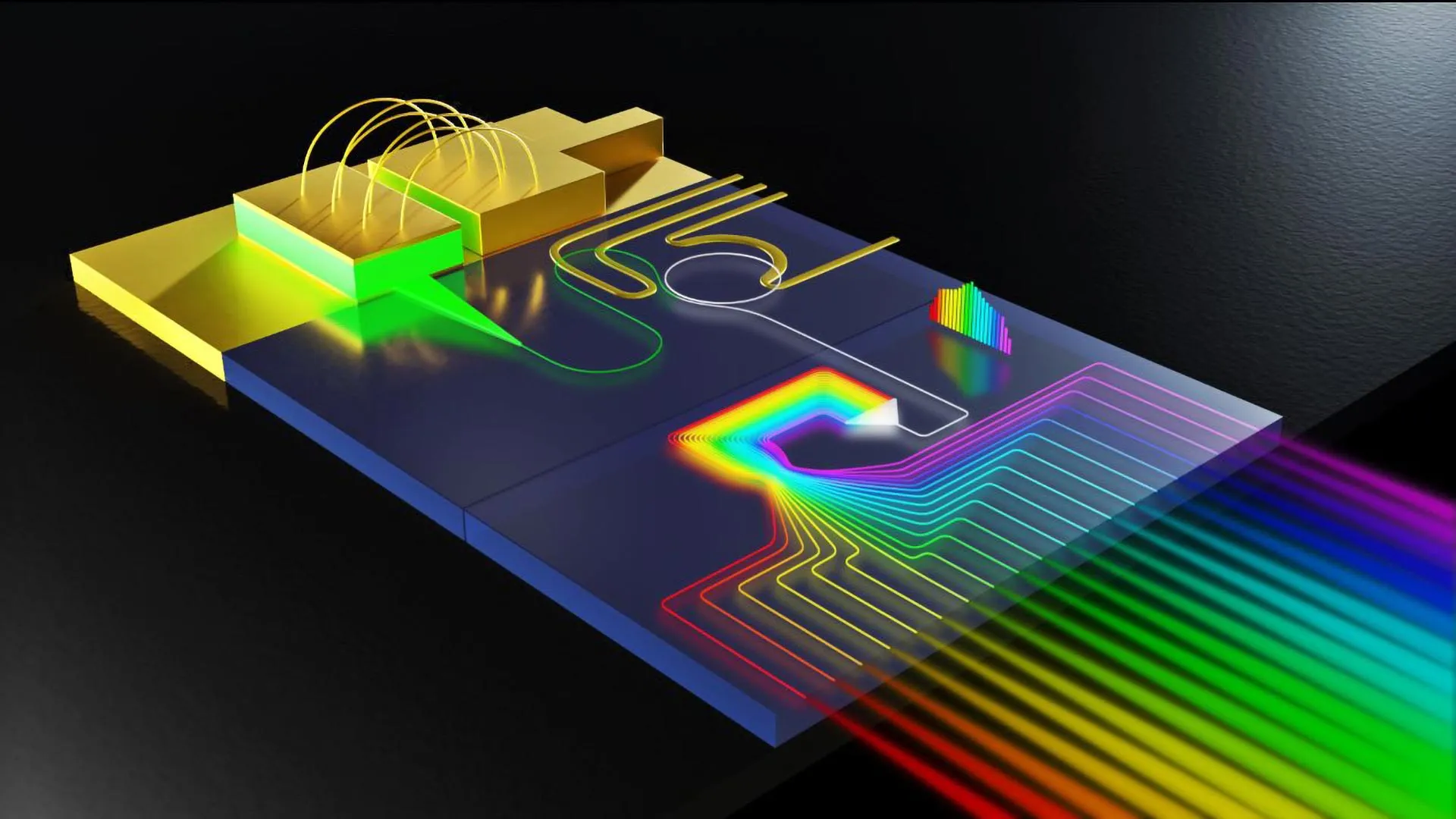
In a serendipitous discovery that promises to revolutionize the digital landscape, scientists in Professor Michal Lipson’s lab have stumbled upon a groundbreaking method for generating a powerful and highly organized form of light, dubbed a "frequency comb," directly on a microchip. This unexpected breakthrough, initially pursued to enhance LiDAR technology by creating more intense light beams for distance measurement, has unveiled a compact and cost-effective solution that could dramatically boost the capacity and efficiency of the internet, data centers, and a host of other advanced technological applications. The implications are vast, suggesting a future where data flows with unprecedented speed and where complex computational tasks are handled with remarkable energy efficiency.
The genesis of this remarkable innovation lies in a seemingly simple experimental endeavor. Researchers were focused on pushing the boundaries of power delivery within specialized chips designed for LiDAR systems. Their goal was to generate more potent light beams, a critical factor in improving the accuracy and range of distance-measuring technologies that are increasingly vital for autonomous vehicles, robotics, and environmental monitoring. It was during this process of incrementally increasing the power flowing through the experimental chip that an astonishing phenomenon emerged. Andres Gil-Molina, a former postdoctoral researcher in Lipson’s lab and a key figure in the discovery, recounted the moment of revelation: "As we sent more and more power through the chip, we noticed that it was creating what we call a frequency comb."
A frequency comb, in essence, is a unique and highly structured form of light. Unlike a continuous spectrum of colors, a frequency comb is composed of a discrete series of distinct frequencies, or colors, that are arranged side-by-side in a perfectly ordered sequence. Imagine the vibrant bands of a rainbow, but with an extraordinary level of precision: each color band shines with intense brightness, while the spaces between these bands are conspicuously dark. When viewed on a spectrogram, these bright, evenly spaced frequencies manifest as a series of sharp, distinct spikes, reminiscent of the teeth on a comb. This precise arrangement is not merely aesthetically pleasing; it holds immense practical significance. Each individual color, or frequency, within the comb can serve as a distinct channel, capable of carrying its own independent stream of data without interfering with any of the other channels. This parallel processing capability is the cornerstone of high-capacity data transmission.
Historically, the generation of such powerful and coherent frequency combs has been a technically demanding and resource-intensive undertaking. It typically required the use of large, expensive, and often cumbersome lasers, coupled with sophisticated amplifiers to boost the light’s intensity and purity. These systems were not only costly to acquire and maintain but also occupied significant physical space, limiting their widespread deployment in more compact and cost-sensitive applications. However, the recent work by Professor Lipson and her colleagues, detailed in a new study published in the prestigious journal Nature Photonics, shatters these limitations. They have demonstrated a revolutionary approach that achieves the same powerful frequency comb effect using a single, remarkably small microchip. This miniaturization and integration represent a paradigm shift in optical technology.
The demand for efficient and high-capacity light sources has been escalating dramatically, driven by the insatiable growth of data centers. These massive facilities, the backbone of the internet and cloud computing, are constantly grappling with the challenge of processing and transmitting ever-increasing volumes of information. Gil-Molina, now a principal engineer at Xscape Photonics, elaborated on this critical need: "Data centers have created tremendous demand for powerful and efficient sources of light that contain many wavelengths." The technology developed by Lipson’s team directly addresses this demand. "The technology we’ve developed takes a very powerful laser and turns it into dozens of clean, high-power channels on a chip. That means you can replace racks of individual lasers with one compact device, cutting cost, saving space, and opening the door to much faster, more energy-efficient systems." This consolidation promises not only economic benefits but also a significant reduction in the physical footprint and energy consumption of critical digital infrastructure.
Professor Lipson underscored the significance of this achievement within the broader context of her research: "This research marks another milestone in our mission to advance silicon photonics." Silicon photonics, a field focused on integrating optical components onto silicon chips, is rapidly becoming a cornerstone of modern computing and communication. As these technologies become increasingly integral to essential services and daily life, the pursuit of efficiency is paramount. "As this technology becomes increasingly central to critical infrastructure and our daily lives, this type of progress is essential to ensuring that data centers are as efficient as possible," Lipson stated.
The journey to this breakthrough began with a fundamental and deceptively simple question: "how powerful a laser could they integrate onto a chip?" The team’s innovative approach involved working with a multimode laser diode, a type of laser known for its ability to produce immense amounts of light, commonly found in industrial cutting tools and medical devices. While these lasers are powerful, their output beams are often characterized as "messy" or chaotic, making them unsuitable for the precise applications required in advanced optical systems. Integrating such a potent but unruly light source into the intricate world of silicon photonics, where light traverses microscopic pathways measured in mere microns or even hundreds of nanometers, demanded ingenious engineering solutions.
The key to taming this powerful, yet noisy, light source lay in a novel "locking mechanism" developed by the researchers. "We used something called a locking mechanism to purify this powerful but very noisy source of light," Gil-Molina explained. This mechanism leverages the unique properties of silicon photonics to meticulously reshape and refine the laser’s output. The result is a significantly cleaner and remarkably stable beam, a characteristic scientists refer to as high coherence. This purification process is crucial; it transforms the raw, unrefined power of the industrial laser into a precisely controlled and stable light source.
Once the light has been purified and its coherence enhanced, the chip’s inherent nonlinear optical properties come into play. These properties allow the single, powerful, and coherent beam to be meticulously split into dozens of evenly spaced colors, thereby generating the signature pattern of a frequency comb. The culmination of this intricate process is a compact, highly efficient light source that masterfully combines the raw power of an industrial laser with the precision and stability demanded by cutting-edge communications and sensing technologies.
The timing of this discovery is particularly opportune, coinciding with an era of unprecedented digital expansion. The explosive growth of artificial intelligence (AI) is placing immense strain on the infrastructure of data centers, which are struggling to keep pace with the demand for rapid data transfer, especially between processors and memory modules. While modern data centers already employ fiber optic links for data transport, a significant limitation remains: most of these systems still rely on single-wavelength lasers, meaning each fiber can only carry one data stream at a time.
Frequency combs offer a transformative solution to this bottleneck. Instead of a single beam carrying a single data stream, the frequency comb technology enables dozens of independent data streams to be transmitted simultaneously through the same fiber optic cable. This principle is the foundation of wavelength-division multiplexing (WDM), the very technology that propelled the internet into a global high-speed network during the late 1990s. By miniaturizing the generation of high-power, multi-wavelength frequency combs to the scale of a microchip, Professor Lipson’s team has made this powerful capability accessible for integration into the most compact and cost-sensitive components of modern computing systems.
The potential applications extend far beyond the confines of data centers. The same chips that can supercharge internet speeds could also enable the development of portable spectrometers for rapid chemical analysis, ultra-precise optical clocks for scientific and navigation applications, compact quantum computing devices, and even more advanced and versatile LiDAR systems. "This is about bringing lab-grade light sources into real-world devices," Gil-Molina emphasized. "If you can make them powerful, efficient, and small enough, you can put them almost anywhere." This vision of ubiquitous, high-performance optical technology hints at a future where scientific discovery, industrial efficiency, and everyday connectivity are all profoundly enhanced by this tiny, accidental rainbow.