Imroatul Nasiyah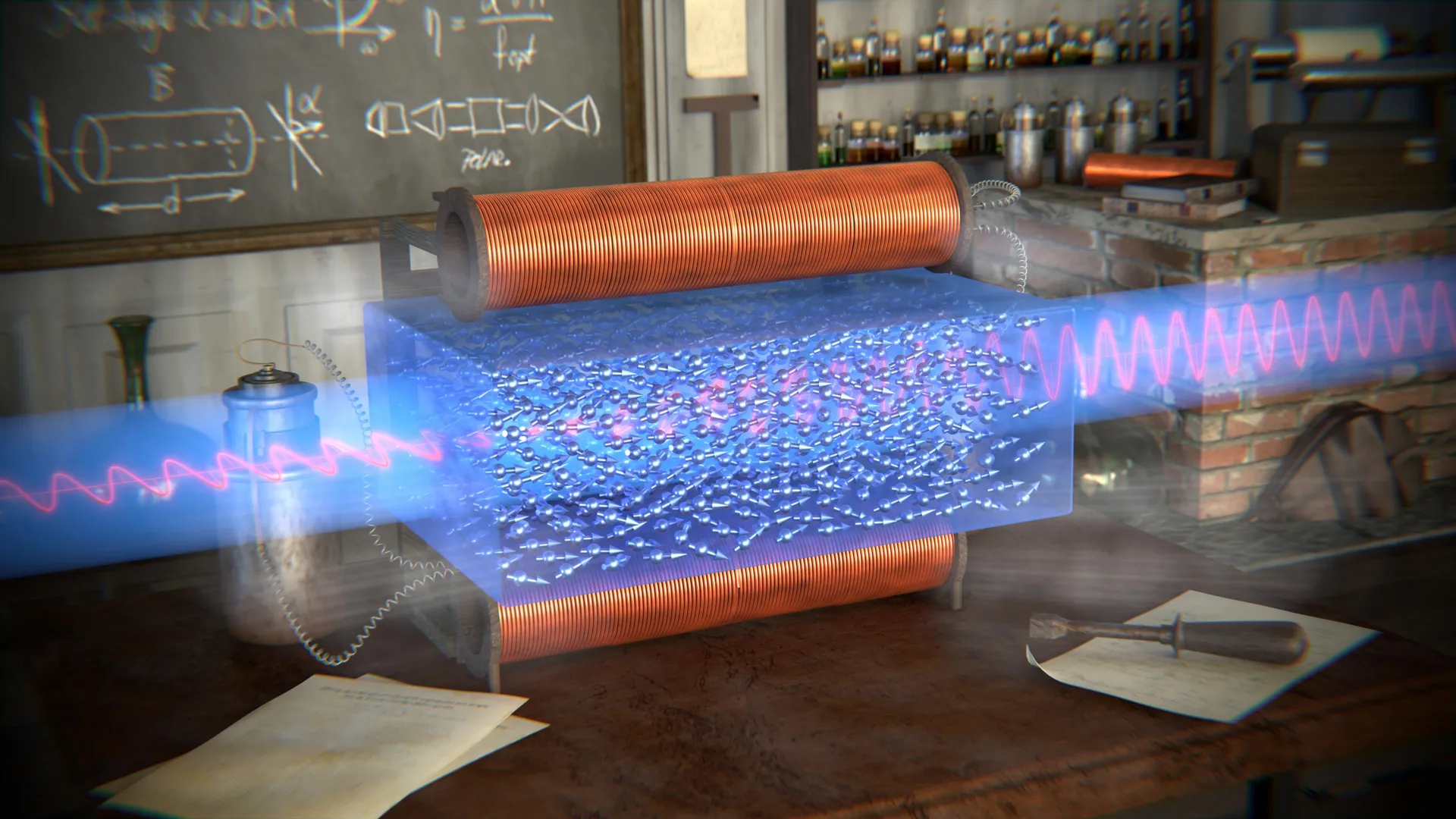
The research, spearheaded by Dr. Amir Capua and Benjamin Assouline from the university’s Institute of Electrical Engineering and Applied Physics, meticulously details how the oscillating magnetic field of light, a facet long relegated to theoretical obscurity in the context of the Faraday Effect, is, in fact, a crucial player. The Faraday Effect, first observed by Michael Faraday in 1845, describes a fundamental interaction between light and magnetism. In essence, a static magnetic field applied to a material causes the plane of polarization of light passing through it to rotate. This rotation is proportional to the strength of the magnetic field and the path length of the light within the material. While the effect itself has been extensively studied and applied, the precise mechanism of interaction has been a subject of ongoing scientific inquiry. The prevailing explanation, which has stood for generations, focused on how the electric field of light interacts with the electrons in the material, causing them to oscillate and, in turn, influencing the propagation of light. This perspective viewed the magnetic component of light as largely inconsequential in this specific interaction.
However, the work by Capua and Assouline introduces a radical re-evaluation. Their theoretical framework demonstrates that the magnetic field of light itself can directly interact with the intrinsic magnetic properties of matter, specifically with atomic spins. These spins are fundamental quantum mechanical properties of electrons and atomic nuclei, behaving like tiny magnets. For decades, it was assumed that the magnetic field of light was too weak to exert a noticeable influence on these spins, especially when compared to the powerful static magnetic fields used in experiments. The new research, however, posits that this assumption was an oversimplification. Dr. Capua elaborates on this crucial finding, stating, "In simple terms, it’s an interaction between light and magnetism. The static magnetic field ‘twists’ the light, and the light, in turn, reveals the magnetic properties of the material. What we’ve found is that the magnetic part of light has a first-order effect, it’s surprisingly active in this process." This statement highlights the surprising magnitude of the magnetic field of light’s contribution, suggesting it’s not a subtle or secondary effect but a primary driver of the observed phenomena.
The theoretical underpinnings of this discovery are rooted in sophisticated calculations that draw upon the Landau-Lifshitz-Gilbert (LLG) equation. This fundamental equation in magnetism describes the dynamics of magnetic moments in a material, particularly how they respond to external magnetic fields and damping forces. By integrating the principles of electromagnetism and quantum mechanics, the researchers were able to model how the oscillating magnetic field of light could induce a torque on the atomic spins within a material. This induced torque, analogous to the torque exerted by a static magnetic field, directly influences the spin orientation and, consequently, the polarization of the light. "In other words," Dr. Capua emphasizes, "light doesn’t just illuminate matter, it magnetically influences it." This is a profound conceptual leap, moving light from a passive observer to an active participant in magnetic phenomena.
To quantify the significance of this magnetic contribution, the research team applied their theoretical model to Terbium Gallium Garnet (TGG). TGG is a well-established and widely used magneto-optic material, frequently employed in scientific research to study the Faraday Effect due to its strong Faraday rotation and transparency across a broad spectrum. Their analysis of TGG yielded remarkable results. The calculations revealed that the magnetic component of light is not a negligible factor but accounts for a substantial portion of the observed polarization rotation. Specifically, in the visible spectrum, the magnetic field of light is responsible for approximately 17% of the Faraday effect. This figure rises dramatically in the infrared spectrum, where the magnetic component contributes as much as 70% to the observed rotation. These percentages underscore the critical role that light’s magnetic field plays, a role that has been systematically overlooked for nearly two centuries.
Benjamin Assouline further articulates the broader implications of this discovery: "Our results show that light ‘talks’ to matter not only through its electric field, but also through its magnetic field, a component that has been largely overlooked until now." This statement encapsulates the paradigm shift. It suggests that our understanding of light-matter interactions has been incomplete, akin to understanding a conversation by only listening to one speaker. The magnetic dialogue between light and matter is now revealed to be a significant part of the exchange.
The ramifications of this revised understanding extend far beyond academic curiosity. The researchers believe that this newfound insight into light’s magnetic capabilities can pave the way for significant technological advancements. In the realm of optical data storage, for instance, a more precise control over the magnetic interaction between light and materials could lead to higher density and faster data writing and reading capabilities. Spintronics, a burgeoning field that harnesses the spin of electrons in addition to their charge to create novel electronic devices, stands to benefit immensely. The ability to manipulate electron spins with light’s magnetic field opens up new avenues for designing more efficient and powerful spintronic components. Furthermore, the field of emerging quantum technologies, particularly spin-based quantum computing, could see a boost. Quantum computers rely on the precise control of quantum states, including electron spins. If light’s magnetic field can be effectively utilized to manipulate these spins, it could lead to new methods for initializing, controlling, and reading out quantum information, potentially accelerating the development of robust quantum computers.
In summary, the work by the Hebrew University of Jerusalem researchers marks a monumental step in our understanding of light. It challenges a 180-year-old scientific tenet, revealing that light possesses a magnetic influence on matter that is both direct and substantial. This discovery, born from rigorous theoretical modeling and validated through calculations on a key experimental material, not only corrects a long-standing misconception but also unlocks new possibilities for innovation across a spectrum of advanced technological fields. The magnetic secret of light, hidden in plain sight for nearly two centuries, is finally out, promising a brighter and more magnetically influenced future for science and technology.