Imroatul Nasiyah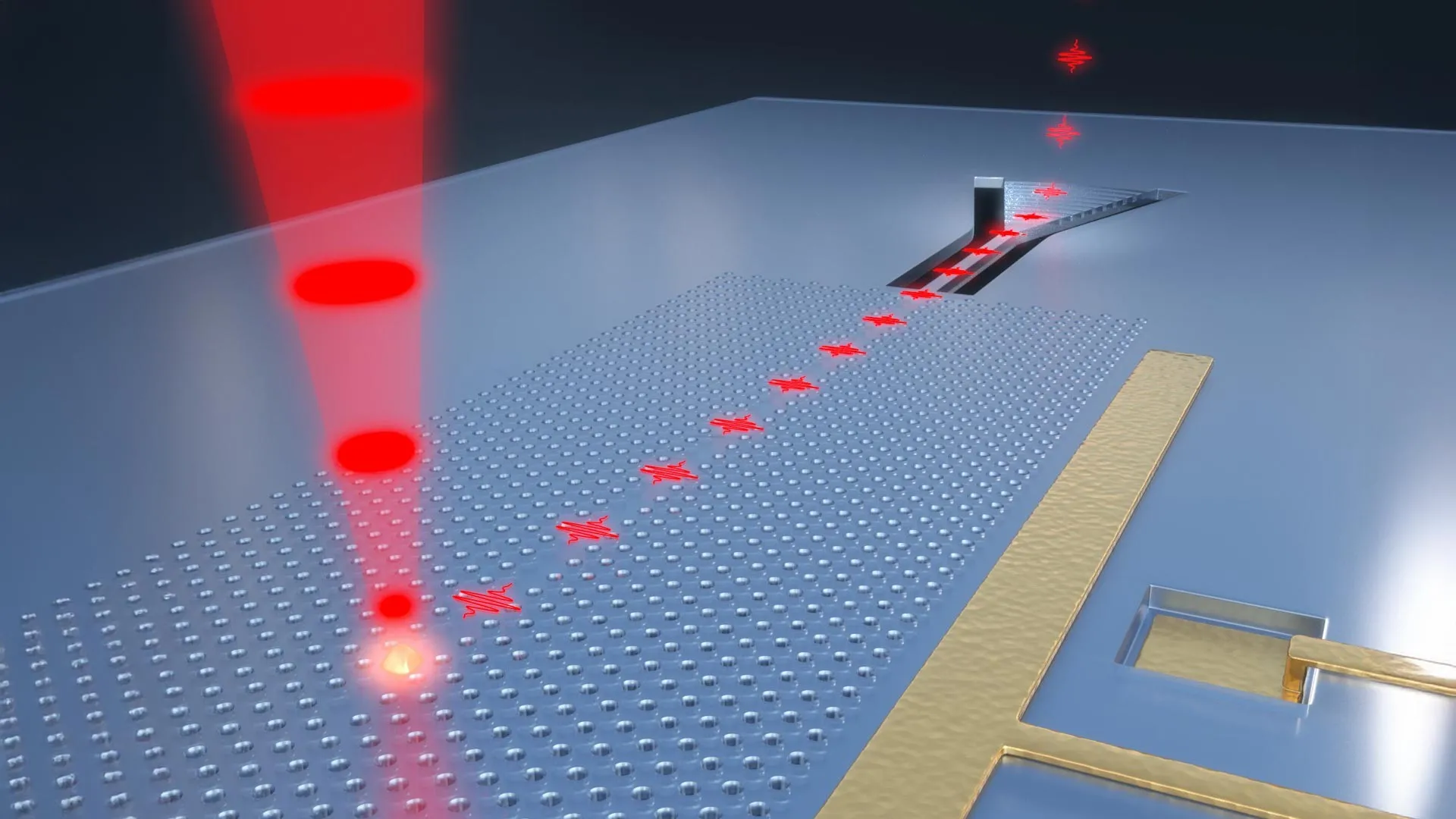
The team at the University of Iowa has meticulously tackled two persistent obstacles that have historically hampered the reliable generation of single photons. These fundamental building blocks are absolutely critical for the advancement of photonic quantum computers, which promise computational power far exceeding classical machines, and for establishing truly secure communication networks that are impervious to eavesdropping. The researchers, led by Matthew Nelson, a graduate student in the Department of Physics and Astronomy, and Ravitej Uppu, assistant professor and corresponding author, have unearthed a surprising synergy between these two seemingly disparate problems.
One of the primary adversaries in the quest for pure single photons is a phenomenon known as laser scatter. The process of stimulating an atom with a laser to release a single photon, a meticulously orchestrated event, is often marred by the unintended production of extra, superfluous photons. These unwanted light particles act as insidious noise within an optical circuit, analogous to stray electrical current disrupting the precise functioning of a conventional electronic circuit. This interference significantly diminishes the efficiency and reliability of quantum operations, introducing a level of uncertainty that is detrimental to the sensitive nature of quantum information processing. Imagine trying to send a crucial message, only to have it garbled by static – that’s the effect of laser scatter on single photons.
The second significant hurdle arises from the inherent nature of atomic responses to laser excitation. While the goal is to elicit the emission of a single photon, atoms, in rare but problematic instances, can emit more than one photon simultaneously. This multi-photon emission shatters the precise sequencing required for delicate quantum operations. Quantum computing and communication rely on the predictable, one-by-one arrival of photons to encode and transmit information. When an atom releases multiple photons at once, the intended single photon is overshadowed by its companions, leading to a breakdown in the ordered flow and introducing errors that can cascade through quantum computations or compromise the integrity of secure communication. This chaotic emission disrupts the delicate dance of quantum information, making it difficult to maintain the coherence and fidelity of quantum states.
The ingenious breakthrough presented by the University of Iowa team lies in their discovery of an unexpected and powerful connection between these two vexing issues. Matthew Nelson observed that when an atom emits multiple photons, the resulting wavelength spectrum and waveform of these unwanted photons bear a striking resemblance to the very laser light used to initiate the emission. This remarkable similarity is not a mere coincidence; it represents a fundamental aspect of the interaction between light and matter.
This profound observation led the researchers to a revolutionary idea: if the unwanted photons generated by multi-photon emission closely mirror the characteristics of the laser light, then by carefully adjusting the properties of the laser itself, these two signals could be engineered to actively cancel each other out. In essence, the very phenomenon that causes trouble – laser scatter – can be repurposed and harnessed to suppress the unwanted, multi-photon emissions. This is akin to using a precisely tuned noise-canceling headphone to eliminate an irritating sound; the University of Iowa team has found a way to "cancel" unwanted light using light itself.
"We have shown that stray laser scatter, typically considered a nuisance, can be harnessed to cancel out unwanted, multi-photon emission," states Ravitej Uppu, the study’s corresponding author. "This theoretical breakthrough could turn a long-standing problem into a powerful new tool for advancing quantum technologies." This statement underscores the transformative potential of their work, moving beyond mere problem-solving to actively leveraging a previously detrimental factor as a key component of a solution.
The significance of single photons for quantum computing cannot be overstated. Photonic quantum computing offers a compelling alternative to traditional electronic computing, leveraging the unique properties of light to perform calculations. Instead of relying on bits – the binary units of information represented by electrical or optical pulses that are either a 0 or a 1 – quantum computers utilize qubits. Qubits, often embodied by subatomic particles such as photons, can exist in a superposition of states, meaning they can be both 0 and 1 simultaneously, along with a spectrum of possibilities in between. This quantum phenomenon unlocks the potential for exponential increases in processing power for specific types of problems, such as drug discovery, materials science, and complex optimization challenges.
Emerging technology companies worldwide are placing significant bets on photonic platforms as the future of quantum computing. The ability to generate and manipulate a stable, highly controlled stream of single photons is the linchpin for realizing this ambitious vision. An orderly flow of single photons is not only easier to manage and scale to larger, more powerful quantum systems, but it also dramatically enhances security. The researchers aptly draw an analogy to managing a cafeteria line: guiding students one by one is far more efficient and less prone to chaos than allowing them to surge forward as a disorganized crowd. Similarly, a neat, single-photon stream minimizes the risk of data interception or eavesdropping, creating a more secure communication channel. Any deviation from this orderly flow can be a tell-tale sign of an attempted intrusion, alerting the system to potential threats.
The key to this novel purification method, as explained by Uppu, lies in the meticulous control of the laser beam. "If we can control exactly how the laser beam shines on an atom – the angle at which it’s coming, the shape of the beam, and so on – you can actually make it cancel out all the additional photons that the atom likes to emit," he elaborates. "We would be left with a stream that is actually very pure." This highlights the precision engineering involved, where subtle adjustments to the laser’s parameters can yield dramatically cleaner photon streams. The ability to fine-tune these interactions opens up new avenues for manipulating quantum states with unprecedented accuracy.
The theoretical framework presented by the University of Iowa researchers demonstrates, in principle, that two of the most significant barriers to faster and more efficient photonic circuitry can be addressed concurrently. If these theoretical predictions are borne out by experimental verification, this technique could serve as a powerful catalyst for accelerating the development of advanced quantum computers and ushering in an era of truly secure communication systems. The team is enthusiastic about moving forward and plans to rigorously test their groundbreaking idea in upcoming experiments. This next phase of research will be crucial in translating this theoretical elegance into practical quantum technologies.
The study, titled "Noise-assisted purification of a single-photon source," has been formally published in the esteemed journal Optica Quantum, a testament to the rigor and significance of the research. The work was made possible through substantial funding from the Office of the Under Secretary of Defense for Research and Engineering within the U.S. Department of Defense, underscoring the strategic importance of quantum technologies. Additional crucial support was provided by a seed grant from the University of Iowa Office of the Vice President for Research, specifically through the P3 program, which plays a vital role in nurturing and launching promising new research initiatives. This multi-faceted support highlights the collaborative effort and belief in the potential of this pioneering scientific endeavor.